Wintering on the Swiss Riviera
In January 1905 the visitors’ paper of Montreux printed, among its list of doctors, the hours of Arthur Gamgee. He saw patients daily at the Villa Miguel in Territet, except on Sundays and Tuesdays. On Tuesdays he was at Caux, on the mountain terrace above.1
Gamgee was not an ordinary resort doctor. He was a Fellow of the Royal Society and had been the first Brackenbury professor of physiology at Owens College, Manchester, and physician to the Manchester hospital for consumption. In later life he left England, and the Dictionary of National Biography records that he settled first at Lausanne and then at Montreux. Five years earlier the same paper had listed him consulting on the Avenue du Kursaal. Now he was following his patients up the hill.2
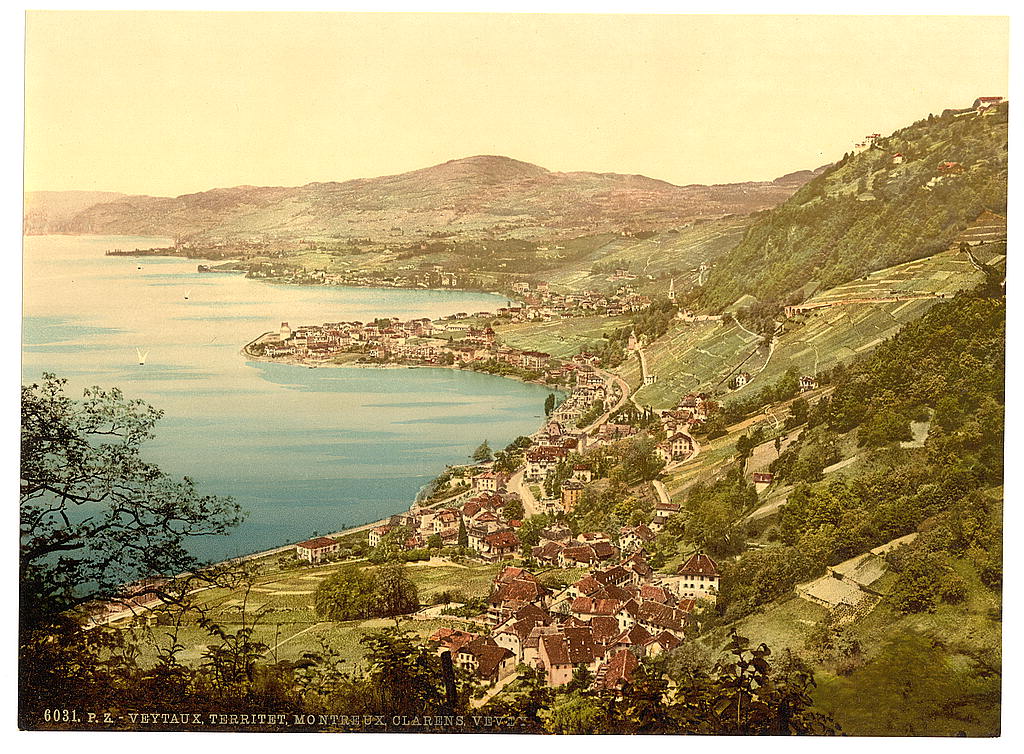
The stretch of Lake Geneva shore between Vevey and Villeneuve came to be called the Swiss Riviera. It spent the forty years before the First World War as a winter home for thousands of English families. They had come for their health, they stayed for the season, and wherever they settled they wanted an English church. Most of the English churches of Vaud were built for them.
The illness that sent them
Consumption was tuberculosis of the lungs. The old name describes what people saw: someone slowly wasting away, with a cough, a low fever and, in the end, blood. By the early nineteenth century it caused roughly one death in four in England. It fell hardest on the crowded poor, but money was no protection.3
Nothing cured it. Robert Koch did not identify the bacterium responsible until 1882, and effective drugs were more than half a century further off. What a doctor could offer was air. If the disease was in the lungs, the lungs should have the best air obtainable, and for a family with means that meant leaving England for the winter.4
At first the invalids went south, to the Mediterranean. The Scottish physician Sir James Clark published The Influence of Climate in the Prevention and Cure of Chronic Diseases in 1829, and Madeira filled with British invalids each winter. So, above all, did the coast of southern France and north-west Italy that the English called simply “the Riviera”. It meant Hyères, Cannes and Nice, Menton near the Italian border, and San Remo beyond it. Menton owed its fame to one English doctor, J. Henry Bennet. He contracted tuberculosis himself and went there in 1859, expecting to die “in a quiet corner, like a wounded denizen of the forest”. He recovered, and his book Winter and Spring on the Shores of the Mediterranean sent others after him. By 1862 some three hundred families were wintering at Menton.5 This was the Riviera, and for most of the century it was where an English doctor sent a patient who could afford to go. When the shore of Lake Geneva around Montreux began to be called the Swiss Riviera, on account of its mild climate, the name was borrowed from this coast.6
Switzerland came later, and for a mixture of reasons. At Davos a German-born doctor, Alexander Spengler, treated patients with mountain air, rest and milk. Enough of them improved that by 1875 winter visitors to Davos outnumbered summer ones for the first time. The science moved too: in 1877 Arthur Downes and Thomas Blunt showed that light killed bacteria, and in 1890 Koch showed that sunlight killed the tubercle bacillus. In 1903 Auguste Rollier opened his sun clinic at Leysin, an hour or so from Montreux.7 The warm south and the high Alps went on competing for the same patients for decades. Montreux, low and mild and on a lake, sat comfortably between the two.
What they found
In November 1884 the travel page of The Queen, a London weekly for women, answered its readers’ questions about Montreux. It is the clearest account we have of what drew them.8
The climate came first. Montreux, the paper said, was “somewhat cold, but absolutely sheltered from wind, and enjoys a great deal of warm sunshine throughout the winter months”. It stood “under the shelter of the mountains at the head of the lake of Geneva”, and for “delicate people who desire to arrest the early stages of consumption” the paper could “unhesitatingly recommend” it, provided they remembered that they were invalids. Tobogganing parties up into the snow were not for them, however popular. “Ladies and gentlemen vie with each other in the rapidity with which they travel down the snowy paths.”
The second attraction was price, and here the comparison was with the French Riviera, which the paper simply calls “the Riviera”. Montreux suited those who wished to winter abroad “and yet can hardly afford the more expensive journey and greater cost of living on the Riviera”. There were forty or fifty hotels and pensions. They charged seven to nine francs a day in the hotels and five to seven in the pensions, with everything included except lights and wine. The wine was cheap anyway: the local white cost a franc and a half at the hotels. “Roughly speaking, the cost of living at Montreux is slightly more than half that of the Riviera,” the paper concluded, and the journey from England was shorter and cheaper too.
The rest of the list reads like a family weighing up the winter. There were good schools for boys and girls, and teachers of music, painting and languages “on singularly reasonable terms”. In spring came the Alpine flowers, primulas, gentians, lily of the valley and narcissus, and “the study of the Alpine flora alone is worth the winter’s residence at Montreux”. A Kursaal had opened within the last two years, with concerts, French plays and dances. There were English libraries, “and a pleasant society among the five or six hundred English and Americans who form the chief part of the winter colony”. And “the English church is well situated, and the services are regularly and well conducted. There is an excellent resident chaplain, who does all in his power to make the services attractive.”
That chaplain, though the paper does not name him, was almost certainly Philip Sankey of St John’s, Territet, who served there from 1878 to 1906.9 The Encyclopædia Britannica of 1911 summed up the same story more briefly: “At first foreigners were attracted by the cheapness and good air of the region, added to the grape cure.” The grape cure was a real prescription, a diet of as much as two pounds of grapes a day. Der Bund reported in 1900 that many autumn visitors came to Montreux for it.10
The English came with a picture of the place already in their minds. They knew Clarens from Rousseau’s La Nouvelle Héloïse, and the dungeon at Chillon from Byron. From 1839 there was a Hotel Byron near the castle for those who came to see it. (Why the English came to love mountains at all is the subject of a separate page.) Vevey, in the Britannica’s words, “commands fine views of the snowy mountains seen over the glassy surface of the lake”, and the country around it was covered in vineyards “which (with the entertainment of foreign visitors) occupy the inhabitants”.11
A summer place turned into a winter one
The season did not begin that way. In 1845 the chaplain at Vevey reported a resident congregation of about forty, “chiefly of the upper class”. Some five thousand visitors passed through “from June to end of September”. His congregation averaged seventy in summer and thirty in winter.12
By the end of the century that had turned round. Paul Schniewind is the historian of the Anglican chaplaincies in Switzerland. He describes the flow of tourists “especially in the winter season, to the mild region of Lake Geneva, called the Swiss Riviera”. He counts at least fifty hotels and pensions between Vevey and Villeneuve by the end of the 1870s. In September 1900 Der Bund reported that Montreux’s autumn season had begun. Some visitors were stopping on their way further south, it said, and many chose Montreux as their “Herbst- und Winteraufenthaltsort”, their autumn and winter residence.13
The doctors show it most clearly, because their summer addresses were printed beside their winter ones. In January 1900 Dr Nolda practised at Montreux in winter and at St Moritz in summer; Dr Isler spent his summers in the Engadine; Dr Leeson went up to Glion. By January 1913 Tucker Wise, formerly visiting physician to the consumption infirmary in Margaret Street, London, simply printed his Montreux season: “(October to May.)”14
The numbers grew for forty years, from two or three thousand visitors in the Montreux district in 1873 to nearly 75,000 in 1912.15
Nearly all of them were well off. Susan Barton’s study of the British in the Swiss resorts draws its picture largely from the Oxford Dictionary of National Biography. That is to say, from people prominent enough to be in it. It describes a decidedly upper-class clientele.16 The people who wintered at Montreux were not touring. They took rooms or a villa for the season and brought their households with them: children, governesses and servants.
They were not the only foreigners. Among the visitors to Montreux in 1902, the Britannica records slightly more Germans than English, with the French third. The English were the most visible colony and the best provided for.17
The Swiss built it
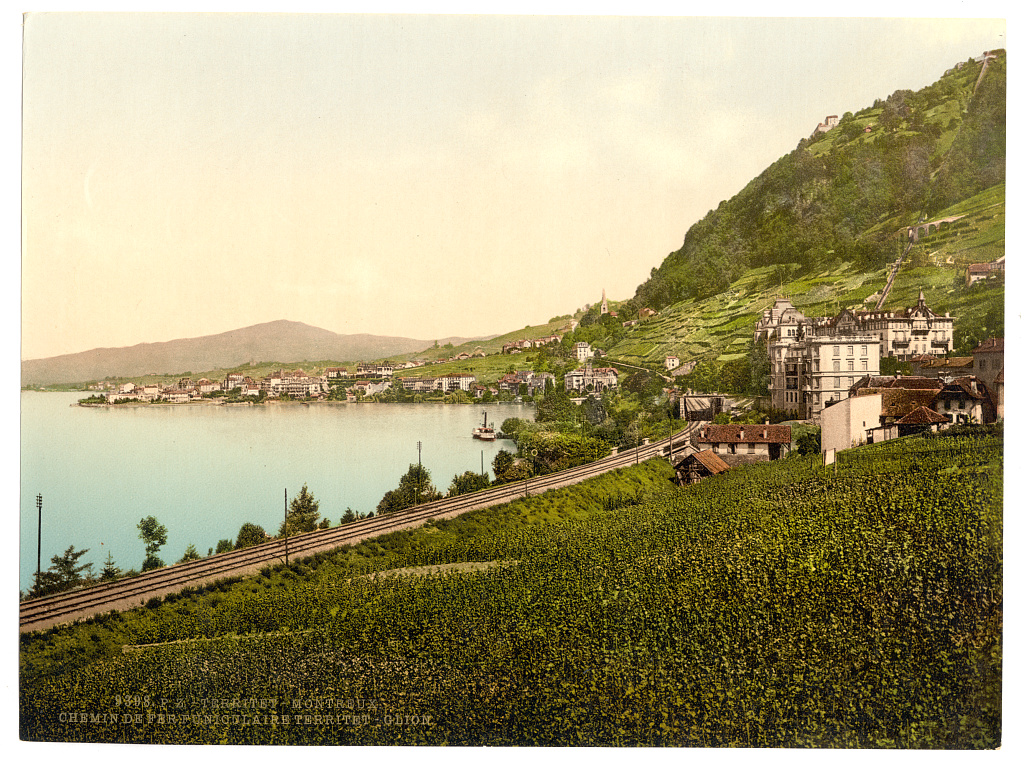
Almost every hotel, funicular and railway on this coast that can be traced to a named promoter traces to a Swiss one, and to a small circle of them. The Dictionnaire historique de la Suisse names two men at its centre. Ami Chessex (1840–1917), born at Territet, enlarged the family hotel there into the Grand-Hôtel de Territet in 1887. He helped found the Territet–Glion funicular in 1881, and other mountain railways after it. The dictionary calls him, with his brother-in-law Alexandre Emery, “l’artisan du développement de la Riviera”, the maker of the Riviera’s development.18
Emery (1850–1931) came to Montreux in 1877 as Chessex’s secretary and became a hotelier six years later. He promoted the Montreux-Palace, sat in the Swiss parliament, and from 1893 to 1925 presided over the Swiss hoteliers’ association. The Dufour brothers held the Grand Hôtel at Les Avants. Albert Cuénod administered the company that built the Caux Palace. Chessex also gave the land for St John’s, Territet, beside his Hôtel des Alpes. He and Emery together built the English chapel at Aigle, in the grounds of their spa hotel.19
For 1908 the Territet–Glion funicular paid its shareholders a dividend of 14 per cent, and the rack railway above it 7.5 per cent. English money and English engineers had helped build the Swiss main lines in the 1850s, but on this coast, a generation later, the capital and the returns were local.20
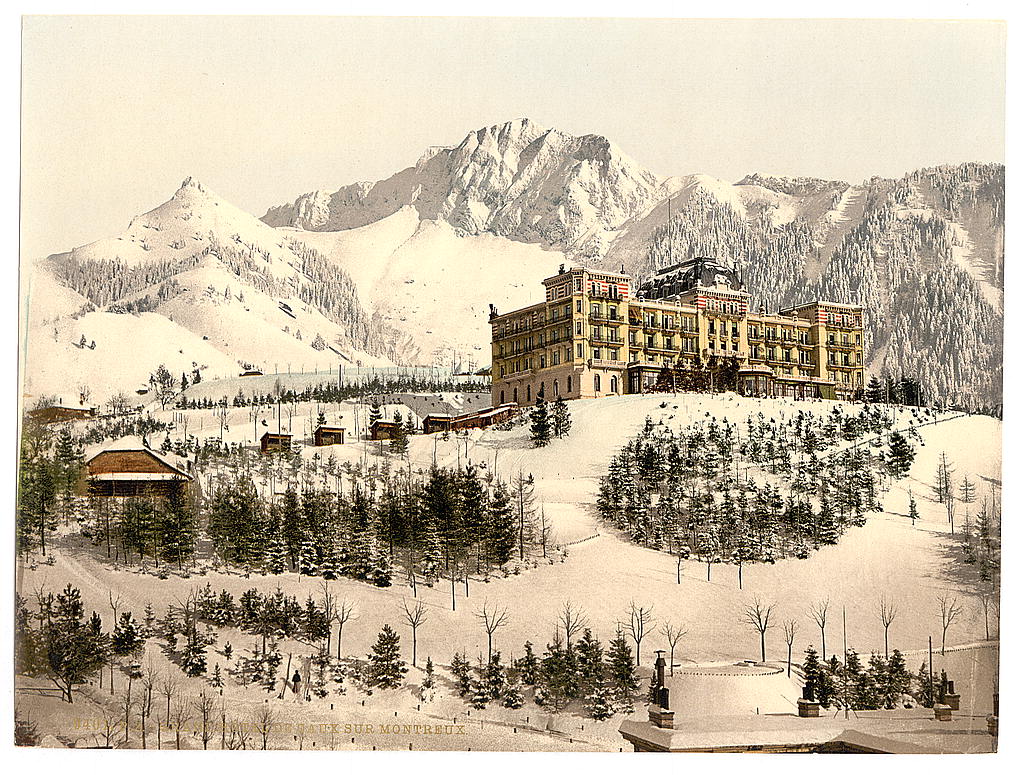
If the lake sold the cure, the terraces above it sold the snow. Glion stands at about 700 metres, Les Avants at about 1,000 and Caux at 1,100. The Britannica noted that “as the delights of clear, cold weather in winter and of tobogganing (here called ‘luging’) and skiing became appreciated”, the higher hotels filled in winter too.21
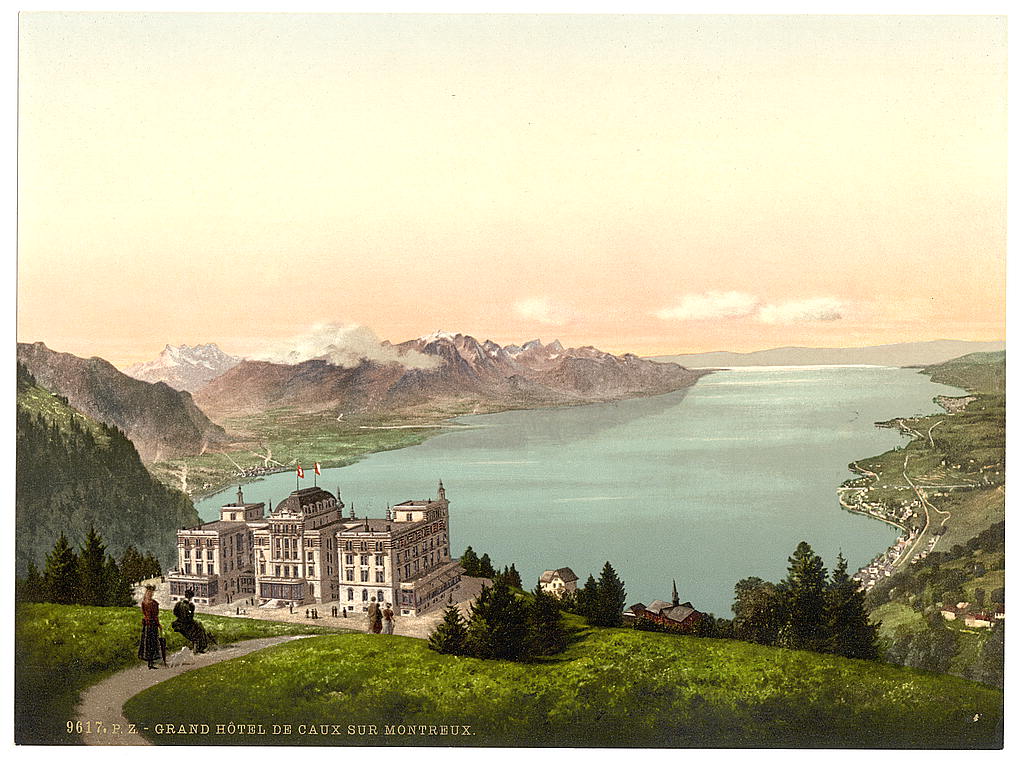
Caux shows how deliberately it was done. A company was formed in February 1899 to build a palace hotel there, and its inauguration was announced for 5 July 1902. A Swiss paper described one of those immense modern hotels that rise “as if by enchantment” where it seems hardest to build. It was reached by its own road cut into the rock. It had “l’aspect d’un château-fort du moyen-âge, avec donjons, tourelles et machicoulis”: the look of a mediaeval fortress, with keeps, turrets and machicolations.22
At Les Avants the hotel family ran the sport as well. In February 1911 the entries for a figure-skating competition there, with imposed figures, free skating and a waltz, went to M. Louis Dufour. That November, when the skating clubs of French-speaking Switzerland met at Lausanne to form an association, Les Avants took two of the five committee seats.23
Over the mountain, in the Pays-d’Enhaut, the same thing was happening without a railway at all. On 6 January 1900 the Montreux paper reported from Château-d’Œx that there were as many foreigners there as in summer. “Tous les chalets sont occupés par des familles venues dans l’intention de passer l’hiver et de jouir des sports de cette saison.” Every chalet was taken by families who had come for the winter and its sports. The Montreux–Oberland Bernois railway company was six months old that morning and had not laid a metre of track. Its line reached Les Avants in 1901, crossed to Montbovon in 1903 and arrived at Château-d’Œx in 1904.24 At Château-d’Œx the winter season came before the railway.
What the British supplied
If the Swiss built the hotels and railways, the British built the system that filled them. The historian Laurent Tissot describes how the English, using the new means of transport, developed “une véritable technologie touristique” linking the guidebook to the travel agency. Murray and Baedeker told people where to go; Thomas Cook and Henry Lunn took them there and sold them the ticket.25
Cook opened an office at Montreux in 1892; most such offices, Tissot notes, were rented rooms inside a hotel. Tissot found that arrangements with Cook spared Swiss transport companies “la coûteuse tâche de rechercher une clientèle”, the costly business of finding customers and advertising abroad. The Montreux–Oberland Bernois was promised that Cook’s publications would make the line known in every country where Cook had an office. Cook also used its clients’ remarks to press the hoteliers to improve their service.26
Lunn worked through a different network: the professions, the clergy he gathered into conferences, and public-school boys, for whom he organised winter-sports holidays. Schniewind notes that Lunn opened Villars among other resorts to winter tours from Britain, and that he “always expected that church services would be provided for his groups”.27
A church in the directory
On the Swiss Riviera the English church was part of what a resort offered. In the Montreux visitors’ paper of January 1900 the two Anglican chaplaincies appear in the same columns as the English pharmacy, the English libraries and the tailor offering “English styles”.28
People said so at the time. In 1887 a Neuchâtel paper complained that its town’s English service stopped at the end of September. It was losing families who would otherwise have settled there, and who went instead to places that had one: “Genève, Lausanne, Vevey, Montreux et Clarens”. In 1903 a chaplain’s memorandum from Caux called the absence of a proper church there “a conspicuous want of the life here”. Visitors, it pointed out, had come to expect such churches in other parts of Switzerland.29 Sometimes the hoteliers built it. At Aigle Chessex and Emery put up a chapel beside their spa hotel in 1888. At Les Avants the Dufour brothers gave the land for one that opened in 1877. Sometimes the English colony set out to build one itself. In March 1887 a paper reported that “la colonie anglaise de Montreux se propose d’ériger, cette année, une chapelle à Glion”. That would give the district no fewer than five English chapels.30 Why the English felt they needed these churches, and how they were paid for and staffed, is the subject of our page on the English churches.
By 1913 the Swiss Riviera had a bishop. Herbert Bury, Bishop for Northern and Central Europe, took a house called La Valletta at Territet in 1912 and looked after St John’s himself. The directory of January 1913 lists him there.31
The colony did not always go down well. In March 1900 news came of the Boer general Cronjé’s surrender. The English at Montreux celebrated openly, and some ladies paid as much as five francs a copy for the newspaper’s special supplement. At Yverdon, the same report added, young Englishmen raised the British flag and had to take it down again “afin de prévenir une manifestation hostile”, to forestall a hostile demonstration. Swiss opinion during the South African war was largely on the Boers’ side.32
The Germans, meanwhile, had their own institutions. By 1913 an imperial German consulate held hours at Montreux every Saturday, and a club of German nationals met twice a week opposite the Kursaal. Britain’s vice-consulate, by contrast, worked from the offices of William Cuénod & Cie, a Vaudois bank.33
January 1914
On 18 January 1914 a Geneva paper carried the ice-hockey results from Les Avants. England had beaten Bohemia one goal to nil; Germany had beaten Switzerland nine to one; Germany and Bohemia had drawn. Toboggan races would follow on Monday and the bobsleigh on Tuesday and Wednesday. The average temperature was ten degrees below zero. “Les patinoires sont excellentes; temps idéal pour les sports d’hiver.”34
Within seven months most of those countries were at war. Most of the English went home, and the season that had grown for forty years stopped in a single summer.35 It came back only in part. After the war there were fewer visitors, and after 1929 fewer still. When a cure for tuberculosis finally arrived in the middle of the century, the first reason for the whole arrangement went with it.
The chapels emptied one by one. When the English chapel at Caux was falling into ruin in 1941, its altar and four carved angels were given to the chapel at Les Avants. In June 1980 the altar and two of the angels went back to Caux, and two stayed where they had been sent.36
If you have letters, photographs or family memories of a winter on the Swiss Riviera, please write to us at info(a)stpeters.ch.
Related pages
- The English churches in Switzerland — why the English needed churches, and a guide to every one in Vaud
- Why the English came to the Alps
- What did the English do all winter?
- Montreux — St John’s, Territet
- Vevey — All Saints
- Clarens — Christ Church
- Glion — English Chapel
- Caux — St Michael and All Angels
- Les Avants — English Chapel
- Château-d’Œx — St Peter’s
-
Journal et liste des étrangers de Montreux, de Vevey, de la Vallée du Rhône et des Stations climatériques romandes, 7 January 1905, list of physicians, read from the page image held by Scriptorium (Bibliothèque cantonale et universitaire, Lausanne). ↩
-
Dictionary of National Biography, supplement of 1912, “Gamgee, Arthur” (1841–1909); Journal et liste des étrangers, 6 January 1900, for the Avenue du Kursaal address. Gamgee died of pneumonia in Paris on 29 March 1909. ↩
-
P. Glaziou, K. Floyd and M. Raviglione, “Trends in tuberculosis in the UK”, Thorax 73:8 (2018), 702–703, for the early-nineteenth-century mortality share. ↩
-
R. A. Hobday, “Sunlight Therapy and Solar Architecture”, Medical History 42 (1997), 455–472, for Koch; O. R. McCarthy, “The key to the sanatoria”, Journal of the Royal Society of Medicine 94 (2001), 413–417, for the sanatorium regime. ↩
-
Royal College of Physicians, biographical record of Sir James Clark; J. Henry Bennet, Winter and Spring on the Shores of the Mediterranean (first edition 1861), catalogued by the Wellcome Collection. The Menton figure comes from local published histories and is offered at that weight. Bennet’s name appears as “Bennett” in some reference works; his own title pages give “Bennet”. ↩
-
Schniewind, p. 14, on the “Riviera vaudoise”, so called “on account of its exceptionally mild climate”, and p. 56 on the “Swiss Riviera”. ↩
-
House of Switzerland, on Alexander Spengler and the Davos season of 1875; Hobday (1997) for Arthur Downes and Thomas Blunt (1877), Koch (1890) and Rollier (1903). ↩
-
“The Tourist. To correspondents. Montreux”, The Queen, 1 November 1884, p. 7 (British Newspaper Archive BL/0002627/18841101, art. 032), read on the page image. All quotations in this section are from this article. “The Riviera” in the article means the French and Italian coast. ↩
-
Paul W. Schniewind, Anglicans in Switzerland (Berne, 1992), pp. 5 and 56–57. The identification of the 1884 chaplain as Sankey is ours; the article names no one. ↩
-
Encyclopædia Britannica, 11th edition (1911), vol. 18, “Montreux”; Der Bund, 19 September 1900, “Die Saison am Lemansee”: “Viele kommen zur Traubenkur”. The quantity of grapes is from the Wellcome Collection’s account of the cure. ↩
-
Lüthi (2003), pp. 2–3, on Rousseau, Byron and Chillon; Simon Bradley, “Following in Lord Byron’s Swiss footsteps”, swissinfo.ch, 26 May 2016, https://www.swissinfo.ch/eng/culture/the-summer-of-1816_following-in-lord-byron-s-swiss-footsteps/42172864, for the Hotel Byron; Encyclopædia Britannica, 11th edition, vol. 28, “Vevey” (W. A. B. Coolidge). ↩
-
The chaplain’s return to the Biber inquiry of 1845, quoted in Schniewind, pp. 52–56 (Vevey). ↩
-
Schniewind, p. 56; Der Bund, 19 September 1900. ↩
-
Journal et liste des étrangers, 6 January 1900 and 4 January 1913, physicians’ lists, read from the page images. ↩
-
Schniewind, p. 14, citing Murray’s handbook of 1873, which counted two to three thousand visitors in the Montreux district and remarked that congregations of five hundred were not uncommon at Montreux and Vevey. For the later figures, Gustave Bettex, Montreux (1913), p. 333, as cited by Dave Lüthi, St John the Evangelist, Territet-Montreux: Historic Study (2003), p. 2, n. 3: 22,870 visitors in 1896 and 74,990 in 1912. ↩
-
Jill Steward, review of Susan Barton, Healthy Living in the Alps: The Origins of Winter Tourism in Switzerland, 1860–1914 (Manchester University Press, 2008), Reviews in History, no. 796 (2009). ↩
-
Encyclopædia Britannica, 11th edition, “Montreux”: 31,473 visitors in 1902, when the town had about fourteen thousand inhabitants, among them 7,634 Germans, 7,327 English and 5,651 French. The population of the Montreux villages was 14,144 in 1900. ↩
-
Dictionnaire historique de la Suisse, “Ami Chessex” (Gilbert Marion). The railways he helped found include those up to the Rochers-de-Naye and from Aigle to Leysin. He sat on the boards of a bank, a chocolate firm and an engineering works, and served on the Montreux council for fifty years. ↩
-
Dictionnaire historique de la Suisse, “Alexandre Emery” (Gilbert Marion); Julie Lapointe, “Les sociétés anonymes à vocation hôtelière de l’arc lémanique (1826–1914)”, Études de lettres 4 (2010), for Cuénod and the Caux company; Lüthi (2003), p. 4, for the St John’s site; Le Messager des Alpes, 1888, for Aigle (details and sources on the Aigle page). ↩
-
Le National suisse, 27 June 1909, “Heureux actionnaires!”; Diccon Bewes, Slow Train to Switzerland (2013), quoting Murray’s handbook on the railways of the 1850s, “many of the lines being executed by English engineers and with English capital”. ↩
-
Encyclopædia Britannica, 11th edition, “Montreux”. ↩
-
Lapointe (2010) for the company of February 1899; Der Bund, 30 June 1902, for the inauguration date; Le Confédéré, 16 July 1902, “Vaud — Un hôtel moderne”, for the description. ↩
-
Tribune de Genève, 18 February 1911, “Sports d’hiver — Patinage aux Avants”; La Suisse, 29 November 1911, “Une association de patineurs”. ↩
-
Journal et liste des étrangers, 6 January 1900, “Échos de nos stations”; the Montreux–Oberland Bernois company’s published chronology (mob.ch) for its foundation on 26 June 1899 and the Montreux–Les Avants section in 1901; Geschäftsblatt für den obern Teil des Kantons Bern, 3 October 1903, for the opening of the Les Avants–Montbovon section on 29 September 1903. ↩
-
Laurent Tissot, Histoire du tourisme en Suisse au XIXe siècle: Les Anglais à la conquête de la Suisse (Alphil, 2017). ↩
-
Tissot (2017). Tissot also records an eight-day Montreux circuit of 1911 at £6 6s. ↩
-
Schniewind, p. 16. ↩
-
Journal et liste des étrangers, 6 January 1900, “Renseignements et adresses diverses”. ↩
-
La Suisse libérale, 7 October 1887; the Caux memorandum of 1903, quoted in Schniewind, pp. 102–103. ↩
-
Le National suisse, 27 March 1887. ↩
-
Schniewind, p. 15, quoting the English Herald of 5 October 1912; Journal et liste des étrangers, 4 January 1913. Bury was Bishop for Northern and Central Europe from 1911 to 1926. ↩
-
Journal du Jura, 4 March 1900; Schniewind, p. 14, on Swiss opinion during the war. ↩
-
Journal et liste des étrangers, 4 January 1913. ↩
-
La Suisse, 18 January 1914, “La saison aux Avants”. ↩
-
Schniewind, pp. 16–18 and 21: “Most English people returned home at the outbreak of World War I”; and in 1932 the bishop reported “a drop of at least three-quarters in the number of visitors”. ↩
-
Vuillomenet, L’Est vaudois, 29 April 1981, p. 3 (Scriptorium item 231362), the account of the Caux angels read on the page image for our Les Avants page, which dates the move to 27 August 1941 and the return to June 1980; Anne Vallelian, on the chapel at Les Avants, Réformés.ch, 15 June 2026. ↩
Questions answered
- What drew the English to Montreux?
- Health first, and then price. In November 1884 The Queen, a London weekly for women, recommended Montreux to readers who wanted to winter abroad but could not afford the French Riviera. The climate was somewhat cold but absolutely sheltered from wind, with a great deal of warm sunshine in winter. Living at Montreux cost slightly more than half as much as on the Riviera. The paper also listed the schools, the Alpine flowers in spring and the Kursaal's concerts. It added an English church with a resident chaplain, and a society of five or six hundred English and Americans.
- What was consumption, and why did it send people abroad?
- Consumption was tuberculosis of the lungs. By the early nineteenth century it caused roughly one death in four in England, and nothing cured it until the middle of the twentieth century. What a doctor could offer was air. For a family with means that meant leaving England for the winter. For the forty years before the First World War, thousands of English families wintered on the Swiss Riviera around Montreux.
- Where did the British go before they went to Switzerland?
- South, to the Mediterranean. After Sir James Clark published his book on climate and disease in 1829, British invalids filled Madeira each winter. Above all they went to the coast of southern France and north-west Italy that the English called simply the Riviera: Hyères, Cannes, Nice, Menton and San Remo. Menton owed its fame to an English doctor, J. Henry Bennet, who went there in 1859 expecting to die of tuberculosis and recovered. By 1862 some three hundred families were wintering at Menton. The Lake Geneva shore around Montreux later borrowed the name, as the Swiss Riviera.
- Why did the Alps take trade from the warm south?
- Partly because of results and partly because the science changed. At Davos enough of Alexander Spengler's patients improved that by 1875 winter visitors outnumbered summer ones for the first time. In 1877 Downes and Blunt showed that light killed bacteria. In 1882 Koch identified the tuberculosis bacterium, and in 1890 he showed that sunlight killed it. In 1903 Auguste Rollier opened his sun clinic at Leysin. Even so, the warm south and the Alps went on competing for the same patients for decades, and Montreux, low and mild, sat between the two.
- Was Montreux a summer or a winter resort?
- Montreux began as a summer place and became a winter one. In 1845 the chaplain at Vevey reported some five thousand visitors passing through from June to the end of September. In September 1900 Der Bund reported that many visitors chose Montreux as their autumn and winter residence. By January 1913 a Montreux physician, formerly of a London consumption infirmary, printed his season simply as October to May.
- Who built the hotels and railways of the Montreux Riviera?
- Where a named promoter can be traced, he was almost always Swiss, and from a small circle. The Dictionnaire historique de la Suisse names Ami Chessex and his brother-in-law Alexandre Emery as the makers of the Riviera's development. Chessex, born at Territet, enlarged the family hotel into the Grand-Hôtel de Territet in 1887, and helped found the Territet–Glion funicular in 1881. Emery promoted the Montreux-Palace and presided over the Swiss hoteliers' association from 1893 to 1925. The Dufour brothers held the Grand Hôtel at Les Avants.
- Why did English churches appear in Swiss resorts?
- Because English visitors expected them. In 1887 a Neuchâtel paper complained that its town's English service stopped at the end of September, and that English families went instead to Geneva, Lausanne, Vevey, Montreux and Clarens. Sometimes the hoteliers built the church, as Chessex and Emery did at Aigle in 1888. Sometimes the English colony set out to build its own, as the English of Montreux proposed to do at Glion in 1887.
- Did the railway create the winter season at Château-d'Œx?
- No, at Château-d'Œx the winter season came first. On 6 January 1900 the Montreux visitors' paper reported as many foreigners at Château-d'Œx as in summer. Every chalet was taken by families who had come for the winter and its sports. The Montreux–Oberland Bernois railway company was then six months old and had not laid a metre of track. Its line reached Château-d'Œx in 1904.