History of St John’s Anglican Church, Montreux
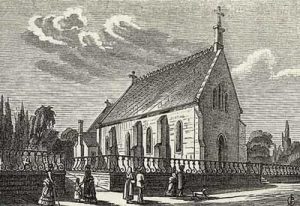
When John Lomas died of pneumonia at Territet on 1 March 1927, the Feuille d’avis de Montreux called him the doyen of the English colony. The town council rose in his memory. An old friend wrote to The Scotsman. Lomas was eighty-one and, his friend said, the oldest resident of the large British and English-speaking colony of Territet, Montreux and Clarens. Born and bred in Yorkshire and an accomplished musician, he had become organist of St John the Evangelist “for the love of church and music”. In the same voluntary spirit he had served as its treasurer and leading lay member of the Church Council until the day he died. “Chaplains and Bishops came and went or died,” the writer added, “but he went on for ever.” He had celebrated his golden wedding the year before.1
Lomas was organist by 1885, when he supervised the first enlargement of the church’s organ, and he lived to see almost every stage of the building’s growth. He was also chairman of the local funicular railway, whose line runs past the east end of the church. In 1928, the year after his death, the apse was taken down and rebuilt further east, towards the funicular, in his memory.2 The church itself, St John’s at Territet, had been opened in May 1877.7
Before the church
English visitors appear in the Montreux records from about 1830, and by the 1850s they were a regular presence. They came for the lake and the mountains, and for places they already knew from books. Rousseau had described the groves at Clarens in La Nouvelle Héloïse, and Byron had made the dungeon at Chillon famous. From 1816 until about 1850 his admirers, Victor Hugo among them, came to Chillon to follow in his footsteps, and in 1839 a luxury Hotel Byron opened near the castle.3
In 1853 the Revd D. R. Morgan moved to Montreux from Vevey, where he had been chaplain for five years, and the English were allowed to use the Swiss parish church of St Vincent on Sundays. In 1860 the Revd John Bennett, licensed by the Bishop of London, began a ministry that lasted eighteen years. By around 1870, however, services were being held in rooms lent by hotels, and some of the British residents opened a fund to build a chapel of their own. A subscription was launched in 1871 and gifts arrived from 1872, supported by a committee in England.4
The need was growing, as the Montreux shore became a winter home for English families (Wintering on the Swiss Riviera tells that story). By the end of the 1870s there were at least fifty hotels and pensions between Vevey and Villeneuve. The number of visitors kept rising for another forty years: from about 23,000 a year in 1896 to nearly 75,000 by 1912.5
Building St John’s
The church owes its site to Ami Chessex, owner of the Hôtel des Alpes at Territet. He gave part of his own land beside the hotel and 5,000 francs towards the building. Two English donors, Mr White and Mr Blackburn, gave 11,000 francs more, and bazaars were held in the Hôtel des Alpes. The site suited everyone: it lay close to the railway station and the lake steamers’ landing stage, and the English church next door was good for the hotel’s business. Chessex was on friendly terms with the English colony. He and Alexandre Emery later built a chapel beside their spa hotel at Aigle. D’Arcy Blackburn, later churchwarden, was a close friend, and Chessex named a son D’Arcy after him.6
The foundation stone was laid on 28 September 1875. The building did not go smoothly. The plans were brought by a Mr Hebson, a member of the building committee who does not appear to have been an architect. The work was given to a Montreux builder named Foretay. His roof proved a problem, both structurally and for sound. In the spring of 1876 the committee called in François Jaquerod, an architect from Aigle, and the contract passed to the Chaudet brothers of Clarens. In January 1877 the committee adopted a seating plan by the London architect George Frederick Bodley, and later thanked him for designing the font. After eighteen months of work, the church was opened and dedicated in May 1877. By the 26th the Feuille d’avis de Montreux was announcing services “à la Nouvelle Eglise Anglaise, Territet”. They were held every Sunday at half past eleven in the morning and half past four in the afternoon, with John Bennett as chaplain.7
St John’s has long been described as a Bodley church, and he was certainly connected with it: his father-in-law, Thomas Reaveley, sat on the building committee. How much of the design was his is less clear. Dave Lüthi, who studied the church’s records for its restoration committee in 2003, found that the font is the only part the archives firmly attribute to him. The seating layout was also his, and he may have supplied Hebson’s original plans or the English hammer-beam roof that rescued Foretay’s work, but the records do not say so.8
Philip Sankey’s church
The Revd Philip Menzies Sankey arrived as chaplain in 1878 and stayed for twenty-eight years. He raised money tirelessly and gave generously himself: the font was his gift, and in 1886 he provided the first books for the church’s English library. “It has met a want which has been long felt,” he wrote that October.9
Almost as soon as it opened, the church proved too small for the great feasts, and Sankey’s years were a long sequence of building. In 1880–82 the London architect Richard Popplewell Pullan added an apse and organ chamber. To make room, the funicular up to Glion, which opened in 1883, moved its line several metres, with Chessex’s support. Stained glass by Lavers, Barraud and Westlake was in place in the apse for Christmas 1882. Pullan went on to design a west porch and gallery in 1885, the pulpit, the painted decoration of the chancel and a mosaic reredos. The windows along the south side of the nave, installed in 1885 and 1886, illustrate the Te Deum.10
The bishops who visited liked what they found. After his second visitation, Bishop Thomas Wilkinson wrote in the church’s record: “Nothing can well be more quietly reverent and seemly than the church and services here.”11
In 1891–92 a Church Institute was built beside the church to house the library, and it was inaugurated in October 1892. That year Lady Vincent also opened a Montreux branch of the Girls’ Friendly Society, which helped the ladies’ maids, nurses and governesses working abroad. Apart from Geneva, it was the only branch in Switzerland.12
By then Territet had become a resort in its own right. The Grand Hotel opened next to the church in 1887–88, and Montreux’s best years ran from about 1890 to 1910. In the mid-1890s St John’s was enlarged again, for the third time, to plans by Reginald Blomfield, who added a north aisle and designed new choir stalls. The Bishop of London inaugurated the enlarged church and its new organ on 5 March 1897. A window at the west end of the new aisle marked Queen Victoria’s Diamond Jubilee that year. The church could now seat more than five hundred. It was still not enough. At Easter 1906, a few months before Sankey retired, 900 people attended. The Anglican Church Magazine reported that during the winter season people had been turned away for lack of room.13
Sankey retired in September 1906. His friends gave him a purse of two hundred and forty pounds, and the church granted him an annuity of two hundred pounds for life. He died in 1909. In 1912 a carved reredos from Bruges, probably the work of the sculptor Alphonse de Wispelaere, was installed behind the high altar in his memory. The central east window was taken out to make room for it. It was stored in the library loft and in 1928 found a new home in the church at Blonay.14
There were by then two other English churches nearby: All Saints’, Vevey, built in 1882, and Christ Church, Clarens, in 1888. They had no parish boundaries and each drew its congregation from across the district. The difference between them was one of tradition. St John’s followed the Anglo-Catholic tradition, and Clarens and Vevey the Evangelical.15
Rural deans and a bishop
In 1907 Sankey’s successor, the Revd Charles Hesketh Knowlys, was appointed the first Rural Dean in Switzerland. He knew the church already, having served as its assistant chaplain in 1894. For most of the years until 1936 the Swiss rural deanery was directed from Territet. When King Edward VII died in May 1910, it was Knowlys who arranged a memorial service at St John the Evangelist.16
Knowlys died at the Villa Violetta, Bon-Port, on Sunday 18 August 1912, in his sixty-seventh year, and his funeral was held at St John’s three days later. The Feuille d’avis de Montreux wrote that he had given all his zeal and devotion to the church and was “unanimously respected and loved by his parishioners”.17 The newly appointed Bishop for Northern and Central Europe, Herbert Bury, then made an experiment. The question of whether the bishop should live in England or on the Continent had long been debated. Bury took a house in Territet, La Valletta, and looked after St John’s himself until early 1913.18
The Lady Chapel was redecorated in 1914 and 1915, and Mrs Hesketh Knowlys gave its carved altar. An iron screen made by Sex and Sons of Send was to close it off from the side aisle. The war delayed its arrival by a year.19
The missing years
The church’s minutes from May 1910 to the end of 1948 are lost, and much of what happened in those years has to be pieced together from elsewhere.20 Some of it concerns our own valley. On 14 March 1917 a British officer interned at Château-d’Œx, Major Eustace Jones of the Royal Field Artillery, married Nancy Banks at St John’s. Her mother, Mrs Archibald Marshall, lived at Château-d’Œx. The chaplain, the Revd G. Cotesworth, took the service, and about a hundred guests went on to tea at the Hôtel Suisse.21
After the war the chaplains of Northern and Central Europe held their annual conference at Montreux four times in the 1920s. On the afternoon of Monday 5 May 1924 the organist Marcel Dupré gave a recital on the church’s organ, which had been rebuilt in 1907 by Friedrich Goll of Lucerne.22 In 1927 two English girls’ schools opened nearby, St George’s at Clarens and Châtelard at Les Avants, and the chaplain of St John’s became St George’s school chaplain. The carol service that the schools later shared at St John’s began that year.23 In June 1928 the chaplain, Sydney Smith, and the two churchwardens applied to the commune to enlarge the chancel, the work done that year in memory of John Lomas.24
After the war
The Second World War emptied the church. When Mr Dixon of the Society for the Propagation of the Gospel reported in 1949, he found about 35 people at Sunday services, most of them elderly. Before the war there had been some 150.25
The building suffered too. In 1950 the commune agreed to widen the Avenue de Chillon, and St John’s lost its old western porch, replaced by a galleried portico. At about the same time the library was converted into a house for the chaplain, completed in 1954 and known since as St John’s House. Lüthi regarded these changes as the most damaging in the church’s history.26
The congregation recovered slowly. From 1957 the chaplain of St John’s also travelled up to Gstaad to take services.27 In Advent 1962 the church was filled to overflowing, gallery included, for the joint carol service of Aiglon College and Châtelard School. When the Revd John Lewis arrived in November 1964, he told the committee that he was “the youngest chaplain in the jurisdiction”. Some of the congregation, he said, had been coming to St John’s for longer than he had been alive.28
Money was a constant worry. The diocese’s policy was that a church unable to support itself should close, and in October 1968 Christ Church, Clarens, was closed as a place of worship. St John’s survived. On 24 May 1977 it celebrated its centenary in the presence of the bishop, with the town’s Reformed and Roman Catholic clergy among the congregation.29
In 1988 Bishop Ambrose Weekes, until 1986 Suffragan Bishop of Gibraltar in Europe, came out of retirement to take charge of St John’s. He also served Gstaad and started new congregations at Monthey and Anzère. In his Christmas greeting for 1991 he wrote: “St John’s is a beautiful Church, and the people here … so kind and hospitable. It will be hard to leave!”30
By the end of the century the building was in poor repair. Its English roof leaked, and water was damaging the walls. In 1999 conservators surveyed the painted decoration hidden under the whitewash, and in 2000 the church’s records were deposited in the Montreux Archives.31 In 2002 St John’s was listed as a historic monument, and restoration began under the church’s architect and the St John’s Restoration Association.32
To pay for it, the congregation sold the most valuable painting the church owned, a Madonna and Child by the Italian Renaissance painter Andrea Previtali. It had hung on a wall of the nave that the water damage had spared. It was auctioned at Sotheby’s, and the proceeds paid for much of the repair work and set up an endowment fund for the church.33
Much of the Victorian colour still lies under whitewash, but the Lady Chapel has always kept its own. Its walls are stencilled in blues and greens, with Mrs Knowlys’s altar against the east wall and the iron screen from Send at its entrance.34
The congregation is smaller now than in Sankey’s day. In 2019 about thirty people formed its core, and St John’s also looked after the small Anglican church at Villars. The Sung Eucharist is still celebrated every Sunday morning, and the organ Lomas once played is being rebuilt. In May 2027 St John’s will celebrate its hundred and fiftieth anniversary.35
We would like to know more about the years the minutes do not cover, particularly the two world wars. If you have family papers, photographs or memories of St John’s, please do get in touch. The other English churches of Vaud are described on our guide to the English churches in Switzerland. For the wider story, see why the English came to the Alps.
-
Feuille d’avis de Montreux, 2 March 1927, p. 2, “† John Lomas” and the council report on the same page (Scriptorium item 455405): “Hier est décédé à Territet, à la suite d’une pneumonie, M. John Lomas”; C. Du Riche Preller, “The Late Mr John Lomas, Territet, Switzerland”, The Scotsman, 9 March 1927, p. 10 (BNA BL/0000540/19270309, art. 062). Both read on the page image. The Scotsman gives the date of death as “Saturday, 5th inst.”; the Montreux paper, published the next day, is preferred. ↩
-
Dave Lüthi, St John the Evangelist, Territet-Montreux: Historic Study, vol. I (Lausanne, May 2003), pp. 8 and 11, citing the church’s Annual General Meeting minutes for 29 October 1885 and the Planches building file for 1928; The Scotsman, 9 March 1927, for the funicular chairmanship. Lüthi records the oral tradition that the funicular could not run during services because the organ’s hydraulic mechanism depended on it (p. 25, n. 100). ↩
-
Lüthi, pp. 2–3; Simon Bradley, “Following in Lord Byron’s Swiss footsteps”, swissinfo.ch, 26 May 2016, https://www.swissinfo.ch/eng/culture/the-summer-of-1816_following-in-lord-byron-s-swiss-footsteps/42172864, for Victor Hugo, the pilgrimages “up until around 1850” and “the luxury Hotel Byron near the Château de Chillon, inaugurated in 1839”. ↩
-
Paul W. Schniewind, Anglicans in Switzerland (Berne, 1992), p. 56, for Morgan, St Vincent and Bennett; Lüthi, p. 3, for services in hotels around 1870 and the building fund, citing the AGM of 3 November 1871. ↩
-
Schniewind, p. 56; Lüthi, p. 2, n. 3, citing Gustave Bettex, Montreux (1913), p. 333: 22,870 visitors in 1896, 49,702 in 1905 and 74,990 in 1912. ↩
-
Lüthi, p. 4. For the Aigle chapel: Le Messager des Alpes, 20 June 1888, p. 3 (Scriptorium item 622592), “Cette charmante construction entreprise par MM. Chessex & Emery, propriétaires du Grand Hôtel”; Emery’s forename is from the Dictionnaire historique de la Suisse. Fuller detail and sources are on the Aigle page. ↩
-
Lüthi, pp. 4–5, citing the Building Committee minutes of 5 November 1875, 7 April and 19 June 1876, and 5 January 1877; Feuille d’avis de Montreux, 26 May 1877, p. 4, “Église Anglicane de Montreux” (Scriptorium item 506668). ↩↩
-
Lüthi, pp. 5–6 and 13. Schniewind (p. 56) gives 1878 as the year of consecration; Lüthi’s opening in May 1877 agrees with the church’s own centenary date of 24 May 1977. ↩
-
Lüthi, p. 6; Schniewind, pp. 56–57, for the length of his ministry and the quotation from the minutes of 28 October 1886. ↩
-
Lüthi, pp. 6–8 and 21–24. The apse and nave glass is by Lavers, Barraud and Westlake of London. ↩
-
Schniewind, p. 57, quoting the church record. ↩
-
Lüthi, p. 8; Schniewind, p. 58. ↩
-
Lüthi, pp. 9–10; Schniewind, p. 58, for the capacity, the Easter attendance and The Anglican Church Magazine, June/July 1906. ↩
-
The World, 14 August 1906, p. 54 (BNA BL/0006339/19060814, art. 164), read on the page image; Lüthi, pp. 10–11 and 17. Sankey’s dates (1830–1909) are from his obituary in The Anglican Church Magazine, 1909, cited by Lüthi (p. 6, n. 20). ↩
-
Schniewind, p. 57. ↩
-
Schniewind, pp. 14 and 58; The World, 17 May 1910, p. 860 (BNA BL/0006339/19100517, art. 089), read on the page image. The paragraph gives only his surname; the forenames are from Schniewind. ↩
-
Feuille d’avis de Montreux, 19 August 1912, p. 4, “Nécrologie” (Scriptorium item 450607), quoted in translation; death notice from Mrs Hesketh Knowlys, Messager de Montreux, 19 August 1912, p. 2 (item 460567). ↩
-
Schniewind, pp. 15 and 58–59, quoting the English Herald, 5 October 1912. ↩
-
Lüthi, p. 10, quoting the minutes of 28 January 1915. ↩
-
Schniewind, p. 59. Lüthi was able to cite some committee papers from 1915 and 1930 (pp. 10 and 20), so a few documents from this period may survive in the Montreux Archives. ↩
-
Le Progrès de Château-d’Œx, 17 March 1917, p. 2 (Scriptorium item 468489), which calls the bride “Miss Marshall”; marriage notice, Northern Whig (Belfast), 31 March 1917, p. 1 (BNA BL/0007614/19170331, art. 003), read on the page image, which names her as Nancy Rosamund, third daughter of the late Alfred W. Banks of Gravely House, Hertfordshire. ↩
-
Schniewind, p. 59, for the conferences; Lüthi, pp. 25–26, for the Goll rebuild of 1907 and the Dupré recital, from a copy of the programme in the church archive; Feuille d’avis de Montreux, 3 May 1924, p. 1 (Scriptorium item 451721). ↩
-
Schniewind, p. 59. ↩
-
Commune des Planches, notice of a planning inquiry dated 28 June 1928, Feuille d’avis de Montreux, 3 July 1928, p. 2 (Scriptorium item 451254). The notice names the applicant as “M. le Révérend Sydney Chaplain”, evidently Sydney Smith, chaplain. Schniewind’s list of the chaplains of St John’s gives “1923 Edward Sydney Smith, Rural Dean”, and records his death in office between 1930 and 1933 (p. 58). ↩
-
Schniewind, p. 59. ↩
-
Lüthi, pp. 11–12. ↩
-
Schniewind, p. 80: “SPG made an arrangement with St John’s, Montreux, under which the chaplain came up for the services in the beautiful Swiss Protestant St Niklaus-Kapelle.” ↩
-
Schniewind, pp. 59–60. ↩
-
Schniewind, p. 60. ↩
-
Schniewind, pp. 60–61. ↩
-
Dale Bechtel, “Montreux trumpets heritage buildings”, swissinfo.ch, 6 July 2003, https://www.swissinfo.ch/eng/montreux-trumpets-heritage-buildings/689778, for the leaking roof and the water damage to the walls. ↩
-
Lüthi, p. 1 and pp. 19–20, for the 1999 survey by the Atelier Saint-Dismas and the deposit of the archives; “About us”, St John’s, Territet-Montreux, A Church Near You (Church of England), read 21 September 2026, for the 2002 listing and the St John’s Restoration Association. The same page names the architect as Jean Niccolier; Lüthi names a Fanny Nicollier among the 1999 conservators, and the spelling has not been checked. ↩
-
Dale Bechtel, “Montreux trumpets heritage buildings”, swissinfo.ch, 6 July 2003; “About us”, A Church Near You, for the endowment fund and the Restoration Fund. The swissinfo report says that the painting “fetched a high price because the wall in the church nave where it had hung was miraculously spared from the water damage”. Neither source gives the date of the sale, the price or the lot; the swissinfo report shows it had taken place by July 2003. ↩
-
Lüthi, pp. 15, 18–19 and 30–31. ↩
-
Chloé Banerjee-Din, “L’Église anglicane se plaît toujours sur la Riviera”, 24 heures, 24 December 2019; St John’s, Territet-Montreux, A Church Near You, home and “About us” pages, read 21 September 2026, for the Sunday service, the organ rebuild and the anniversary. ↩
Questions answered
- When was St John’s, Territet, built?
- The foundation stone of St John’s, Territet, was laid on 28 September 1875, and the church was opened and dedicated in May 1877 after eighteen months of work. By 26 May 1877 the Feuille d’avis de Montreux was announcing Sunday services at the new English church at Territet, with John Bennett as chaplain. Schniewind gives 1878 as the year of consecration, but the opening in May 1877 agrees with the church’s own centenary date of 24 May 1977.
- Did George Frederick Bodley design St John’s, Territet?
- Less of St John’s, Territet, than the church’s reputation suggests. The London architect George Frederick Bodley was certainly connected with it, since his father-in-law, Thomas Reaveley, sat on the building committee. The committee adopted his seating plan in January 1877 and later thanked him for designing the font. Dave Lüthi, who studied the church’s records in 2003, found that the font is the only part the archives firmly attribute to him. Bodley may have supplied the original plans or the English hammer-beam roof, but the records do not say so.
- Who paid for St John’s, Territet?
- St John’s, Territet, owes its site to Ami Chessex, owner of the Hôtel des Alpes. He gave part of his own land beside the hotel and 5,000 francs towards the building. Two English donors, Mr White and Mr Blackburn, gave 11,000 francs more, and bazaars were held in the hotel. An English church next door was good for the hotel’s business, and the site lay close to the railway station and the steamers’ landing stage.
- Why were there three English churches so close together at Montreux?
- The English churches of the Montreux district differed in tradition, not territory. St John’s at Territet, All Saints’ at Vevey and Christ Church at Clarens had no parish boundaries between them, and each drew its congregation from across the district. St John’s followed the Anglo-Catholic tradition, and Clarens and Vevey the Evangelical.
- Who was John Lomas?
- John Lomas was the organist of St John’s, Territet, and served as its treasurer and leading lay member of the Church Council until the day he died. He was born and bred in Yorkshire. He was organist by 1885, when he supervised the first enlargement of the organ. He was also chairman of the local funicular railway, whose line runs past the east end of the church. When he died of pneumonia on 1 March 1927 the town council rose in his memory. The year after his death the apse was taken down and rebuilt further east, towards the funicular, in his memory.
- Are the records of St John’s, Montreux, complete?
- No. The minutes of St John’s, Territet, from May 1910 to the end of 1948 are lost. Much of what happened in those years, including both world wars, has to be pieced together from elsewhere.
- Is St John’s, Territet, still open?
- Yes. The Sung Eucharist is still celebrated at St John’s, Territet, every Sunday morning, and the organ John Lomas once played is being rebuilt. The congregation is smaller now than in Philip Sankey’s day. In 2019 about thirty people formed its core, and St John’s also looked after the small Anglican church at Villars. In May 2027 St John’s will celebrate its hundred and fiftieth anniversary.