How the English learned to love the Alps
In 1739 two young Englishmen, Horace Walpole and Thomas Gray, crossed the Channel on the Grand Tour. This journey through Europe was a rite of passage for wealthy young men. They expected to find culture in Rome and antiquities in Athens. They did not expect the terror they felt among the high peaks of the Alps. Writing to a friend from Turin, Gray described the crossing of Mont Cenis. “Mont Cenis, I confess, carries the permission mountains have of being frightful rather too far; and its horrors were accompanied with too much danger to give one time to reflect upon their beauties,” he wrote. Their carriage wound through steep passes, past torrents tumbling down the mountains, and on the way Walpole’s spaniel was carried off by a wolf. Their fear was typical of the age.
A century and a half later, Anglican churches in the Alps stretched from Zermatt to Montreux and from Davos to Interlaken. Where medieval travellers had crossed themselves in fear, Victorian congregations sang hymns in English churches in Switzerland. The mountains had not changed, but the way people saw them had changed completely, and that change turned quiet Alpine villages into resorts.
Mountains to be feared
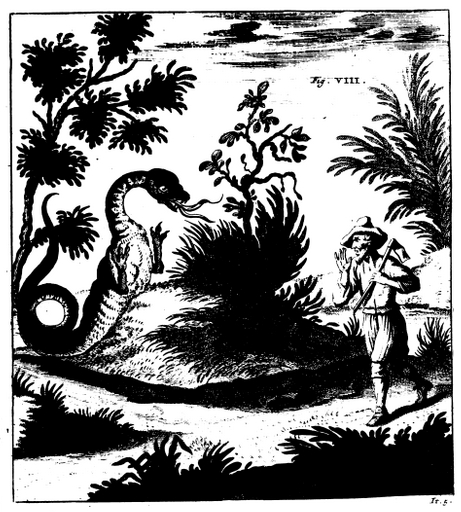
For over a thousand years the high Alps stood for everything that civilised society feared. Medieval maps often showed dragons and monsters in mountainous regions, and people believed that these frozen wastes harboured demons.1 Avalanches struck without warning and buried whole villages. Glaciers groaned and cracked with unearthly sounds, and altitude sickness brought travellers hallucinations and madness. To many, only evil spirits could explain such things.
On Mount Pilatus above Lucerne, the fear was written into law. Local law forbade anyone to climb the mountain until 1585, and those who tried faced imprisonment. The ghost of Pontius Pilate was supposed to live in a lake near the summit, and disturbing it would bring devastating storms. Six priests had been punished in 1387 for trying to visit the forbidden lake. When the Lucerne authorities finally permitted an ascent, they insisted that a priest go with the party, in case an exorcism proved necessary.
The theological argument ran deeper. Mountains were wastelands that produced nothing useful, so they must be corruptions of God’s perfect creation and evidence of humanity’s fall. Theologians of the period saw the Alps as monuments to human sin, swept up after the biblical Flood. Even the ordinary crossings filled travellers with dread. The major passes had fearsome reputations, and travellers made their wills before attempting them. Many never returned.
The Romantic revolution
The change began, improbably, with a novel. In 1761 Jean-Jacques Rousseau’s Julie, ou la Nouvelle Héloïse took the salons of Europe by storm.2 The story is told in letters between two lovers, and it is set in the Alps around Lake Geneva. It showed mountain people not as barbarians but as noble savages, uncorrupted by the vices of civilisation. Rousseau’s lovers walked in Alpine meadows and found a moral clarity that was impossible in the polluted streets of Paris. The mountains, he suggested, brought people closer to their natural state, and so closer to virtue. The idea overturned centuries of theological thinking. The book became perhaps the best-selling novel of the eighteenth century, and it helped to start what became the Romantic movement.
Young aristocrats, inspired by Rousseau, began to travel into the Alps in search of real experience. Poets followed them, and found in mountain storms not God’s anger but what Edmund Burke called ‘the sublime’.3 This was a mixture of terror and exhilaration that overwhelms the senses. The philosophers Burke and Kant refined the idea and gave educated readers a way to admire nature’s raw power. Beauty was harmonious and pleasing, while the sublime was vast, terrible and awe-inspiring. It made people feel small, and yet somehow raised them up. Mountains were no longer cursed wastelands but natural cathedrals, where one could feel something beyond oneself.
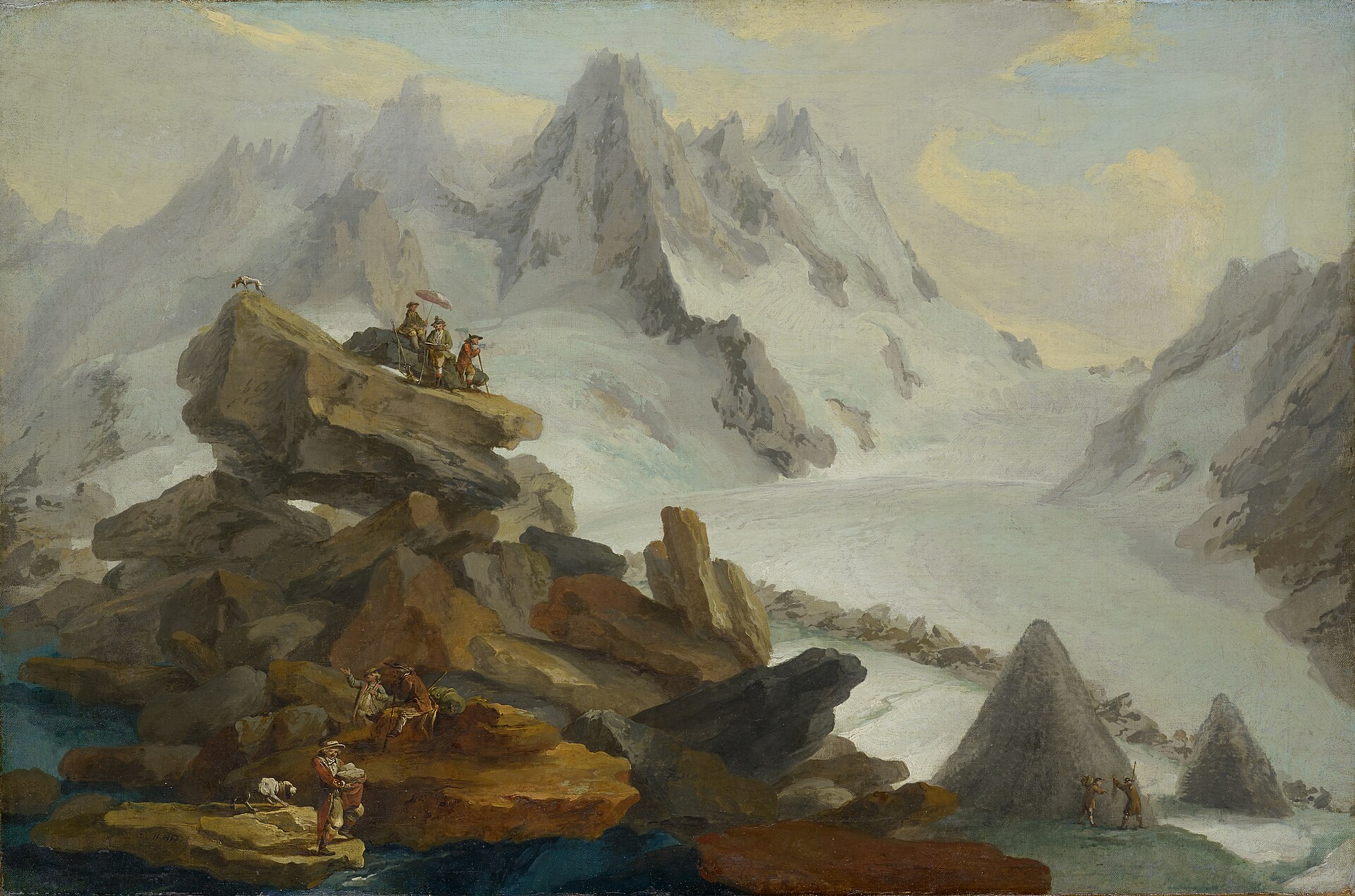
Lord Byron, escaping scandal in England, found inspiration in the Alps in 1816.4 In his drama Manfred he wrote: “Mont Blanc is the monarch of mountains; They crown’d him long ago / On a throne of rocks, in a robe of clouds, / With a diadem of snow.” His friend Percy Shelley was equally moved, and wrote his own ode to Mont Blanc. British artists joined the pilgrimage. J. M. W. Turner returned to Switzerland year after year in the 1840s, carrying his painting equipment up steep paths to catch the dawn breaking over the peaks.5 His swirling, atmospheric canvases, such as Snow Storm: Hannibal and his Army Crossing the Alps (1812), conveyed the overwhelming experience of high altitude.
The Victorian season
By the 1840s what had been an aristocratic eccentricity had become middle-class fashion. The railways brought the Alps within reach of British professionals. Thomas Cook saw the opportunity, and in 1863 he organised his first Swiss tour, leading 60 ladies and gentlemen to Geneva.6
Many Victorians came to stay for months, and part of the reason was what they left behind. In 1858 London suffered the “Great Stink”, when the Thames had become an open sewer. Parliament suspended its sessions because members could not bear the smell. Temperatures reached 35°C, and Queen Victoria abandoned a cruise on the river because of the stench. Against that, a summer in clean mountain air needed little advertising.
Reliable national figures for visitors in this period are hard to find, but a single valley can be counted. At the end of July 1880 Le Progrès, the local paper of the Pays-d’Enhaut, reported on the season. “Le superbe mois de juillet a amené un très-grand concours d’étrangers dans notre pays, et il semble que leur nombre va encore en croissant. Actuellement, on en compte près de 600.” That was nearly six hundred foreign visitors in one Alpine valley, and the number was still rising. The same was happening, season after season, in the resorts of the Bernese Oberland, the Vaud Riviera and the Valais.
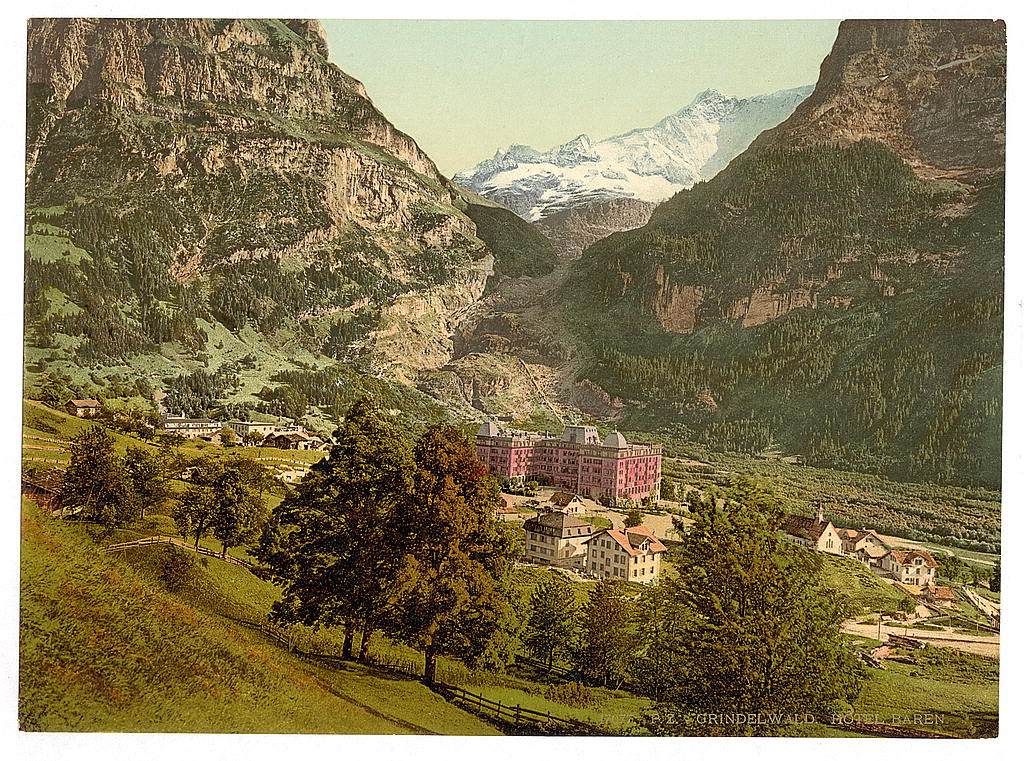
Whole families moved to Swiss resorts for months at a time. They brought servants and governesses, and all the arrangements of a Victorian home. Hotels in Grindelwald, Meiringen and Château-d’Œx became homes away from home, with English breakfasts, lending libraries and Anglican services.
Sent for their health
For a great many travellers there was a second reason to go, and for some it was the only one. Consumption, which is tuberculosis of the lungs, caused roughly one in four deaths in England by the early nineteenth century. It was not a rare misfortune but the likeliest way for an adult to die, and it struck rich and poor alike. There was no treatment that worked, and antibiotics lay the better part of a century away. Nobody even knew what caused the disease until Robert Koch identified the bacterium in 1882. What a doctor could offer, before and after Koch, was air. If the disease was in the lungs, then the lungs should be given the best air obtainable, and as much of it as possible. That idea, that climate was medicine, is why a comfortable English family might spend six months of the year in a foreign hotel. For such families, travel was the treatment.
At first the answer was to go somewhere warm. Sir James Clark’s Influence of Climate in the Prevention and Cure of Chronic Diseases (1829) sent British invalids to Madeira, Hyères, Nice, Cannes and above all Menton. A whole kind of guidebook grew up to serve them. Switzerland was colder and higher, and seemed exactly wrong for a diseased lung. It won a share of the trade partly on results. At Davos, Alexander Spengler noticed that the local people did not seem to get consumption.7 He concluded that altitude protected them, and he treated patients with mountain air, long walks, cold water and milk.
It won the rest because the science changed. In 1877 Downes and Blunt showed that light killed bacteria, and in 1890 Koch showed that sunlight killed the tubercle bacillus. In 1903, at Leysin, Auguste Rollier opened his Institute of Heliotherapy. Cold, dry, brilliantly lit high air now had a reason behind it. Doctors did not simply change their minds and send the invalids from the Riviera to the Alps. The two schools competed for the same patients for decades. Montreux, mild and low and on a lake, sat in an interesting position between them. It offered the warm south’s climate at a Swiss address.
This is what brought visitors to the mountains in winter. At Davos in 1875, winter guests outnumbered summer guests for the first time. Two writers are remembered among its invalids, Robert Louis Stevenson and the critic John Addington Symonds. The dates usually given for their stays we have not been able to confirm.8 These invalids were not tourists in any sense a modern reader would recognise. They were households in exile, and they were there in the months when a holidaymaker would not have been.
Not every Alpine resort was a place of cure, and the difference mattered at the time, even where it has since been blurred. Leysin was a cure village. It joined the chaplaincy list of the Colonial and Continental Church Society in 1891. That was the point when, in Paul Schniewind’s words, it “began to be an important place for tuberculosis patients”. An English sanatorium was inaugurated there in December 1907, with fifty beds for British and American patients.
Château-d’Œx was not a cure village, though not for want of an early ambition. In February 1895 its own paper reported the first winter that the Hôtel Berthod had ever opened. It hoped that “chaque année un plus grand nombre de malades” would come to the village “pour y chercher et y trouver la guérison, comme à Da[vos] ou à Leysin”. Nothing came of it. In June 1912 a Vaud visitors’ paper surveyed the region’s stations, describing four of them on a single page in the same format. Its neighbours each named the conditions they treated. Aigle-les-Bains named the “anémiques” and “neurasthéniques”, Bex-les-Bains “les nerveux et les excitables”, and Montbarry-les-Bains the “rhumatisants”. Château-d’Œx named none, and offered instead mountain air, excursions, and trout fishing in the Sarine. No sanatorium was built there. The nineteenth-century words for consumptives, phtisie, phtisiques and poitrinaires, never appear alongside it in the Vaud press.
The difference shows in the churches. Where a resort drew the sick, the Anglican presence followed the patients: Leysin’s chaplaincy was listed in 1891, and its chapel opened in 1906. Where a resort drew the healthy, it followed the season. Either way the building was much the same, with the same prayer book. But the congregations inside had arrived for very different reasons, and some of them were not going home.
Churches of their own
For Victorians, Sunday worship was not optional. It was the cornerstone of respectability, and missing church marked a person as either dangerously radical or morally suspect. The local Reformed churches held their services in German or French, which most visitors could not follow. The hotels understood this well, and an English service was something to advertise. In March 1912 the Grand Hotel at Aigle courted English readers of The Gentlewoman. Among its attractions, alongside the golf and the trout fishing, it listed “Resident English Chaplain. English Church in Grounds”. Why the hotels paid for chaplains at all is told on our page about the Colonial and Continental Church Society.
The Anglican churches of the Alps grew up in a remarkably consistent way. First came services in the hotels. Some hoteliers arranged English services in their dining rooms, led by whatever Anglican clergyman happened to be on holiday, and chaplains held communion there with sideboards for altars. This makeshift arrangement satisfied no one for long. As the British community in a favourite resort grew, so did the movement for a proper church.
In Zermatt it began in 1862, when the Monte Rosa Hotel allowed services in its dining room. By 1871 the English Church stood on land given by the local commune, its spire a familiar sight against the Matterhorn. In Montreux, services started in the 1860s at the Grand Hotel. By 1877 St John’s Anglican Church had opened its doors, built in the English Gothic style with funds raised from across the Empire. It was designed by George Frederick Bodley, a well-known Gothic Revival architect. At Vevey, Anglican services began in hotel lounges in the 1870s. All Saints Church, with its fine stained-glass windows, was consecrated on 22 August 1882. It was designed by George Edmund Street, another leading Victorian church architect.
The money for these churches came from across the Empire. Appeals would appear in The Times, and donations arrived from India, Canada and Australia, wherever British families had connections. The churches were built in the familiar English Gothic style, with pointed arches, decorated tracery and bell towers. Inside, brass plaques remembered loved ones and the prayer books bore familiar stamps. The hymns were Ancient and Modern and the liturgy was strictly Prayer Book. For homesick Victorians these churches gave spiritual comfort and a sense of community far from home.
Anglican churches in the Alps still serve international congregations today, and they welcome British visitors and people from around the world. Some, like All Saints in Vevey, serve thriving international congregations, while others keep smaller but devoted communities. They host concerts and community events, and they still provide English-language worship in the mountains. During the First World War some of them took on new work. St Peter’s at Château-d’Œx ministered to interned soldiers, British prisoners of war interned in neutral Switzerland.
We would like to know more about the English who came to the Alps, and especially about those who came to Château-d’Œx. If you have letters, diaries, photographs or family stories from their visits, please write to us at info(a)stpeters.ch.
Primary sources at St Peter’s
St Peter’s holds a press-cutting archive covering its chaplaincy from 1885 to 1999, and publishes it as full transcribed text. Its largest group documents the First World War years, when the church at Château-d’Œx ministered to British prisoners of war interned in neutral Switzerland. It holds the arrival of the first party in The Times, 31 May 1916. It holds the chaplain’s appeal for a memorial organ in The Times, 17 August 1916, and the visits of the soldiers’ wives that October.
Sources:
- Burke, Edmund. A Philosophical Enquiry into the Origin of Our Ideas of the Sublime and Beautiful. London, 1757.
- Byron, Lord. Manfred. 1817.
- Electronic Enlightenment Project. “Thomas Gray and Horace Walpole, on the Grand Tour, 1739-1741.” Bodleian Libraries, University of Oxford.
- Kant, Immanuel. Critique of Judgment. 1790.
- Rousseau, Jean-Jacques. Julie, ou la Nouvelle Héloïse. 1761.
- Thomas Cook Archives. Documentation of first Swiss tour, 1863.
-
Jim Ring, How the English Made the Alps (John Murray, London, 2000), read in the Faber & Faber ebook of 2011; the locators are Kindle locations, not pages, locations 135–238, for the medieval and early-modern dread of the mountains — John de Bremble on the Great St Bernard, Evelyn, Berkeley, and the Alps as the home of “gods, demons, witches and trolls”. The dragons had a serious naturalist behind them: Johann Jakob Scheuchzer, a Zürich physician and a Fellow of the Royal Society, catalogued them from eyewitness report in his Itinera per Helvetiae alpinas regiones (Leiden, 1723). ↩
-
Rousseau’s novel is dated here to 1761, the Amsterdam edition of Marc-Michel Rey. Ring gives 1760, which is at best the year of printing; the bibliographic record and the surviving-edition census both give 1761. ↩
-
Edmund Burke, A Philosophical Enquiry into the Origin of our Ideas of the Sublime and Beautiful (1757), which argued that terror is the ruling principle of the sublime, but only when it is met at a safe remove. Ring sets out what Burke was arguing against: an age that judged mountains by the classical standards of purity, order and proportion, and so found them disordered and uncouth (Jim Ring, How the English Made the Alps (John Murray, London, 2000), read in the Faber & Faber ebook of 2011; the locators are Kindle locations, not pages, locations 227–238). ↩
-
Jim Ring, How the English Made the Alps (John Murray, London, 2000), read in the Faber & Faber ebook of 2011; the locators are Kindle locations, not pages, locations 363–399, for Byron and the Shelleys at Geneva in the summer of 1816 and the pilgrimage to the Nouvelle Héloïse sites. The lines from Manfred quoted here we have not traced to a first-hand text; the drama was published in 1817. ↩
-
Jim Ring, How the English Made the Alps (John Murray, London, 2000), read in the Faber & Faber ebook of 2011; the locators are Kindle locations, not pages, locations 538–779, for Turner in the 1840s, and for Dickens in 1845 and Albert Smith from 1851. Turner’s first visit to Switzerland is sometimes dated to 1802. That date is not from Ring, and we have not traced it to a source. ↩
-
Jim Ring, How the English Made the Alps (John Murray, London, 2000), read in the Faber & Faber ebook of 2011; the locators are Kindle locations, not pages, locations 1250–1417. Ring dates the first Swiss tour precisely, 26 June to 15 July 1863, with sixty people, going to Geneva and Mont Blanc — by rail to Geneva, diligence to Chamonix and mule to Martigny. ↩
-
Jim Ring, How the English Made the Alps (John Murray, London, 2000), read in the Faber & Faber ebook of 2011; the locators are Kindle locations, not pages, locations 1086–1117, for Alexander Spengler, the alpine air cure, Davos and its apparent freedom from tuberculosis, and the first English sufferers arriving there in the early 1860s. Spengler is sometimes said to have noticed this from 1853. That date is not in the passages we hold, and we have not traced it further. Ring also gives tuberculosis as one death in six in mid-century Britain; the figure of one in four used earlier on this page is for England in the early nineteenth century, and the two are not necessarily in conflict. ↩
-
Jim Ring, How the English Made the Alps (John Murray, London, 2000), read in the Faber & Faber ebook of 2011; the locators are Kindle locations, not pages, locations 1848–2033, for Symonds at Davos, where he founded the Davos Tobogganing Club in 1883. The dates usually given for the two men are these: Stevenson in residence from November 1880 to the following April, and again from October 1881 to April 1882; Symonds going for eight months in 1877 and staying sixteen years. They are not in the passages we hold, and we have not traced them. Stevenson does not appear in the passages we hold at all. ↩
Questions answered
- Why are there English churches in the Swiss Alps?
- Because Victorian British families spent whole seasons in Alpine resorts, and for them Sunday worship was the cornerstone of respectability. Local Reformed churches held their services in German or French, which most visitors could not follow. The pattern was consistent: first came services in hotel dining rooms, then, as the British community grew, the movement for a church of its own.
- When did the English start visiting the Alps?
- Eighteenth-century travellers on the Grand Tour crossed the Alps with dread rather than pleasure. By the 1840s what had been an aristocratic eccentricity had become middle-class fashion, and the railways brought the Alps within reach of British professionals. Thomas Cook organised his first Swiss tour in 1863, leading 60 ladies and gentlemen to Geneva.
- Why did the English stop fearing the Alps?
- Through the Romantic revolution in taste. Rousseau’s novel Julie, ou la Nouvelle Héloïse (1761) portrayed mountain people as uncorrupted by civilisation, and the concept of the sublime, refined by Burke and Kant, gave educated readers a way to admire nature’s raw power. Mountains were no longer cursed wastelands but natural cathedrals.
- Why did Victorians go to Switzerland for their health?
- Because climate was medicine. Consumption, tuberculosis of the lungs, caused roughly one in four deaths in England by the early nineteenth century, and there was no treatment that worked. What a doctor could offer was air: if the disease was in the lungs, the lungs should be given the best air obtainable. That idea is why a comfortable English family might spend six months of the year in a foreign hotel, and for such families travel was the treatment. Not every Alpine resort was a place of cure, though. Leysin was a cure village, while Château-d’Œx named no condition at all.