History of English Churches in Switzerland – Aigle
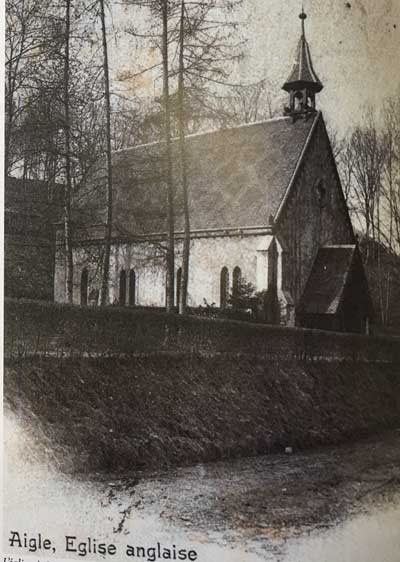
In the first week of 1932 the Feuille d’avis de Lausanne printed a short, affectionate piece about the English chapels of the canton, signed only “Pierre”. In the towns, he wrote, there were proper Anglican churches. Others were seasonal: they opened and closed with the hotels beside them, and their congregations came and went with the arrivals and departures. The one he chose to describe was “la toute petite chapelle anglaise, à Aigle, à deux pas du Grand Hôtel”. Like the hotel, it slept now that autumn had come.1
He found it in a small wood, its slender bell turret rising among the trees like the tip of a fir. Leaves and branches had piled up by the porch, and the wooden door had been doubled with a wire grille. A pointed window on the north side had lost all its glass, so he could look in. The red kneelers were stacked in a corner, and the altar, stripped of its embroidered cloths, looked like a frame of pine. A large Bible still lay on the lectern between choir and nave. “L’autel suit ici les destinées de l’hôtel,” he wrote: the altar shares the fortunes of the hotel, “ils se vident ensemble, pour renaître ensemble”. They empty together, to come back to life together. He ended by telling the chapel to sleep.1
It never came back to life, but for a quarter of a century before the First World War it had been the church of one of the Rhône valley’s spas. The chapel was St John the Evangelist, opened beside the Grand Hôtel in June 1888.56
The spa above the town
The Grand Hôtel des Bains stood on a plateau above Aigle. It was designed by the architect Louis Bezencenet and inaugurated on 12 August 1872, with more than a hundred rooms. Its bathhouse, joined to the hotel by a footbridge, opened to the public the following May. Its speciality was hydro-electrotherapy: patients sat in wooden baths through which a mild electric current was passed, a treatment then prescribed for nervous complaints.2
That is what drew the English. In June 1912 the visitors’ paper of the Swiss Riviera recommended a stay at Aigle-les-Bains “aux anémiques, aux neurasthéniques, aux affaiblis et aux convalescents”. It listed the baths, the hydrotherapy, the cold-water cure, the grape cure and the golf links. The same autumn an English magazine, The Gentlewoman, gave its readers the same advice in its own way. “Do not make your headquarters in the village,” it said, “but go up to the Grand Hotel, built on a high plateau, overlooking Aigle. There you will be above the smoke and dust, with the advantage of full sunshine, and the purest of air.” The air was said to be very good for anaemic people. There was milk from a farm next door for anyone taking the milk cure, and an electric tram down to the station. Vineyards ran all round the hotel, and the Montreux golf course was within reach.3
The English were at Aigle early. The Colonial and Continental Church Society had placed it on its list of chaplaincies before 1868. In 1885 the Revd R. B. Carson began holding services in the hotel each summer.4
Two and a half months
The chapel came three years later, and it came quickly. The hotel then belonged to Ami Chessex and Alexandre Emery. These were the brothers-in-law who did more than anyone to build the hotels and railways of the Montreux shore, and Wintering on the Swiss Riviera tells their story. Le Messager des Alpes, the Aigle paper, announced the opening on 20 June 1888. The inauguration would take place on Thursday the 21st at half past three in the afternoon, and two English clergymen, Mr Hordern and Mr Tasker, would preside. The chapel, the paper went on, had been put up by Chessex and Emery “avec l’aide de la colonie anglaise et de quelques habitants d’Aigle et de la contrée”. That is, with the help of the English colony and a few people of Aigle and the district. It had gone up in two and a half months, under the direction of the architect Jaquerod. It was “loin d’être parachevée”, far from finished, but services would begin officially on the Thursday. The Lausanne and Montreux papers repeated the notice. By September the chapel had its place in the Aigle paper’s weekly list of services, between the Free Church and the Wesleyan chapel. The morning service was at half past ten, the evening service at five.5
It was a small building. It was named St John the Evangelist, seated eighty to a hundred people, and stood in a corner of the hotel’s grounds, where the stables had been.6
Chaplains for the season
The visitors’ paper of Montreux listed hotel guests with their occupations, and it names several chaplains of the English church at Aigle. Its lists show where a man was staying rather than where he took services. Even so, Carson is there year after year from 1892 to 1895, always with Mrs Carson. Others came for a month or a season, and the lists name at least six of them between 1892 and 1910.7
The chapel also took its part in local life. In the spring of 1892 a collection at the English church of the Grand Hôtel raised 110 francs towards a temperance café at Ollon. In August 1894 the hotel held a musical evening for the infirmary and the English church, entrance two francs and half price for children.8
The Society for the Propagation of the Gospel took on the patronage, and in 1912 The Gentlewoman could still promise its readers “a resident chaplain during the season”.9
After 1914
The chapel closed in 1914 and never reopened. The hotel closed during the war, opened again in 1919, but never won back its old clientele. In the 1920s the SPG wrote to the hotel’s proprietor about services, and was told there were no English guests. English visitors who still came to the district could go up to Leysin, where the English church was still open.10
The commune bought the hotel, used it for refugees and, during the Second World War, as quarters for troops, and in 1947 sold it for demolition. In 1949 the SPG recommended handing the chapel to the Swiss Protestant Church. Schniewind records a sale completed in 1968, but by the 1980s the chapel belonged to the commune and was used as a store for timber.11
In February 1985 the commune put its demolition to public inquiry. The syndic said the back wall was cracked and the roof was falling in. The plan met opposition in Aigle, and twelve objections were lodged, arguing that the chapel was part of the town’s past, as the Grand Hôtel had been. The local Junior Chamber of Commerce began raising money to save it. The municipality agreed to keep it, and in February 1986 workmen began making it safe. At midday on Wednesday 5 February they stopped for lunch, and a quarter of an hour later the roof was alight. The roof and the bell turret were lost, and in April the commune decided to demolish what remained.12
Two years later the English chapel at Meiringen, in the Bernese Oberland, was to be restored. The regional paper headed its report “Sœur de la chapelle anglaise d’Aigle”, the sister of Aigle’s English chapel, and had to explain that Aigle’s was already gone.13
Today
Nothing of the Grand Hôtel or its chapel survives. In November 1989 the Junior Chamber of Commerce of the Chablais handed over the keys of a log refuge it had built at the Fahy. The refuge stood “sur l’emplacement de l’ancienne chapelle anglaise d’Aigle”, on the site of the old English chapel. The commune still lets a Refuge du Fahy for gatherings, on the Chemin de Fahy above the town. A walker who goes up there can stand roughly where the English sang their hymns in the summer.14
We would like to know more about the chapel’s chaplains, about Mr Hordern and Mr Tasker who opened it, and about the years between the wars. If you have a photograph of the interior, a memory of the building, or family papers from the Grand Hôtel, please write to us at info(a)stpeters.ch. The other English churches of Vaud, including our neighbour at Bex, are described in our guide to the English churches in Switzerland.
-
Pierre, “Paysages et sanctuaires”, Feuille d’avis de Lausanne, 7 January 1932, p. 2 (Scriptorium item 25772), read on the page image; the quotations are from the article, with our translation. The article gives no date for the visit. ↩↩
-
notreHistoire.ch, “Grand Hôtel des Bains d’Aigle”, citing Catherine Schmutz-Nicod, “Le Grand Hôtel des Bains d’Aigle, construit par l’architecte Louis Bezencenet”, Revue historique du Mandement de Bex XXXIII (2000), pp. 28–40, and Geneviève Heller, Propre en ordre (1979), for the electric bath. The page gives “plus de cent chambres (120 lits)” and the opening of the baths on 15 May 1873. ↩
-
“Aigle-les-Bains”, in a survey of the region’s summer stations, Journal et liste des étrangers de Montreux, de Vevey, 22 June 1912, p. 3 (Scriptorium item 428935), read on the page image; “In the Beautiful Rhone Valley”, The Gentlewoman, 28 September 1912, p. 35 (British Newspaper Archive BL/0003340/19120928, art. 174), read on the page image. The visitors’ paper’s English-language guide of November 1913 said the same: “Residence at Aigle is particulary [sic] recommended to those suffering from anæmia, neurasthenia and general debility” (Journal et liste des étrangers, 8 November 1913, p. 3, item 429155). ↩
-
Paul W. Schniewind, Anglicans in Switzerland (Berne, 1992), p. 100. Being “placed on the list” meant the bishop had given permission for a chaplaincy; it does not date the first services (Schniewind, p. 100). ↩
-
Le Messager des Alpes, 20 June 1888, p. 3 (Scriptorium item 622592), read on the page image, and its paid notice on the same page: “Jeudi 21 courant à 3 1/2 heures de l’après-midi aura lieu l’inauguration de la chapelle anglaise d’Aigle-les-Bains ; la cérémonie sera présidée par les réverends anglais M. Hordern et M. Tasker.” the same text, credited to the Tribune, in the Nouvelliste vaudois, 21 June 1888, p. 3 (item 115753), and the Feuille d’avis de Montreux, 23 June 1888, p. 4 (item 503761); list of services for Sunday 2 September 1888, Le Messager des Alpes, 1 September 1888, p. 1 (item 622580). notreHistoire.ch describes the architect as a descendant of the Aigle architect François Jaquerod; his forename is not given in the 1888 reports. Schniewind (p. 100) dates the chapel 1889; the contemporary press settles it as 1888. ↩↩
-
Schniewind, p. 100, for the name and the seating; The Gentlewoman, 28 September 1912, for the corner of the grounds; Feuille d’avis de Lausanne, 7 January 1932, for the stables. ↩↩
-
Carson appears in September 1892 as “Le Révérend Carson, Chapelain de l’Eglise angl. Aigle-les-Bains”, and again in the springs of 1893, 1894 and 1895, always with Mrs Carson. The others are a Mr Parrett, “Chapel. anglais pour la saison”, in 1892; the Revd Prosser in the summer of 1894; Charles T. Ward in the spring of 1898; and in the new century C.-A. Mackonochie, Dr A. Caldecott and Canon Boot, each listed as chaplain of the English church at Aigle. Journal et liste des étrangers de Montreux, read on the page images: 17 September 1892, p. 4 (item 397840: Carson, and “Le Revd. Parrett, Chapel. anglais pour la saison” at the Grand Hotel, Aigle-les-Bains); 6 May 1893, p. 3 (item 397705: “Le Révérend R. B. Carson, chapelain de l’Eglise anglaise d’Aigle”); 21 April 1894, p. 3 (item 398184); 4 August 1894, p. 2 (item 398188: “Le Revd Prosser, Chaplain de l’église anglaise d’Aigle”); 1 June 1895, p. 2 (item 397926); 23 April 1898, p. 19 (item 397997: “The Rev. Charles T Ward, Chaplain de l’église anglaise d’Aigle”); 12 May 1900, p. 19 (item 397990: “Revd. C.-A Mackonochie”); 11 August 1900, p. 15 (item 397951: “Rev. Gibson Dawis”, as printed); 2 May 1908, p. 27 (item 430013: “Revd. Dr A. Caldecott D.D. Engl. Chaplain at Aigle”); 14 May 1910, p. 30 (item 429742: “Canon Boot Chaplain to the English Church Aigle”). Several of these men were listed at hotels elsewhere on the lake; the lists record where a guest was staying, not where he took services. ↩
-
Le Messager des Alpes, 1 June 1892, p. 3 (item 637499), “La quête faite dimanche dernier, à l’Eglise anglaise du Grand Hôtel d’Aigle pour l’établissement du Café-Chocolat [?] à Ollon, a produit la jolie somme de fr 110” (the word after “Café-Ch” is cut at the column edge); Le Messager des Alpes, 11 August 1894, p. 4 (item 627414), for the “Soirée musicale” of Saturday 11 August 1894. ↩
-
Schniewind, p. 100; The Gentlewoman, 28 September 1912. ↩
-
Schniewind, p. 100; notreHistoire.ch, “Grand Hôtel des Bains d’Aigle”. ↩
-
notreHistoire.ch, “Grand Hôtel des Bains d’Aigle” and “L’église anglaise du Grand Hôtel d’Aigle”; Schniewind, p. 100; 24 Heures, 4 February 1985, p. 22 (item 13040), for the timber store. Schniewind does not name the buyer in 1968, and we have not found the sale in the press. 24 Heures in 1985 put the hotel’s demolition in the 1950s; Le Messager des Alpes of 8 February 1986 gives 1947, which agrees with notreHistoire. Schniewind (p. 100) also reports, from an unnamed source, that the hotel and the English church were both demolished after the Second World War; the local press of 1985–86 shows that the chapel in fact stood until the fire of 1986. ↩
-
24 Heures, 4 February 1985, p. 22 (item 13040), quoting the syndic, Alfred Pirolet; L’Est vaudois, 17 September 1985, p. 5 (item 230089), on the Junior Chamber; “Chapelle en feu”, 24 Heures, 6 February 1986, p. 25 (item 13350): “Il était midi quand le feu a éclaté, pendant des travaux de revêtement des chéneaux. La toiture et le clocher (sans cloche) ont été détruits”; “Aigle: la chapelle anglaise en feu”, Le Messager des Alpes, 8 February 1986, p. 5 (item 625075), for the twelve objections and the quarter of an hour; year’s review, Le Messager des Alpes, 31 December 1986, p. 8 (item 625073), for the decision in April. All read on the page images. ↩
-
“Sœur de la chapelle anglaise d’Aigle. Elle sera restaurée”, L’Est vaudois, 19 February 1988, p. 5 (item 230426), read on the page image. The report dates the Aigle fire to 5 February 1986 and says the commune demolished the chapel afterwards. ↩
-
L’Est vaudois, 1 November 1989, p. 5 (item 271426), “Portes ouvertes au Fahy samedi”, ceremony on Saturday 4 November 1989; the refuge’s location “au lieu dit «Le Fayez», où se trouvait la chapelle anglaise” is also given in L’Est vaudois, 15 April 1989, p. 5 (item 233567); Commune d’Aigle, “Refuge du Fahy”, aigle-reservation-salles.ch, seen 22 September 2026. That today’s refuge is the building of 1989 is our assumption. ↩
Questions answered
- Was there an English church in Aigle?
- Yes. The English chapel of St John the Evangelist stood in a corner of the grounds of the Grand Hôtel des Bains. This was the spa hotel on a plateau above Aigle. The chapel was inaugurated on 21 June 1888. It seated eighty to a hundred people. English services had been held in the hotel itself each summer since 1885, when the Revd R. B. Carson began them.
- Who built the English chapel at Aigle, and who opened it?
- The English chapel at Aigle was put up by Chessex and Emery, proprietors of the Grand Hôtel. They put it up "avec l'aide de la colonie anglaise et de quelques habitants d'Aigle et de la contrée", under the direction of the architect Jaquerod. The chapel went up in two and a half months. Le Messager des Alpes reported that the inauguration would be on Thursday 21 June 1888 at half past three. It said two English clergymen, Mr Hordern and Mr Tasker, would preside over it. It added that the building was still "loin d'être parachevée". The Revd R. B. Carson, who had begun the summer services in 1885, was listed as chaplain of the English church at Aigle from 1892 to 1895.
- Why did the English go to Aigle?
- The English went to Aigle for the cure. The Grand Hôtel des Bains, inaugurated in 1872, specialised in hydro-electrotherapy. In 1912 the visitors' paper of the Swiss Riviera recommended a stay at Aigle-les-Bains to "anémiques", "neurasthéniques", the run-down and the convalescent. An English magazine the same year advised readers to stay not in the town but at the Grand Hotel on its plateau, "above the smoke and dust". It noted the Montreux golf course within reach and a resident chaplain in the season.
- What happened to the English church at Aigle?
- The English chapel at Aigle closed in 1914 and never reopened. The commune bought the Grand Hôtel and in 1947 sold it for demolition; the chapel outlived it and was used as a store for timber. In 1985 the commune proposed demolishing the chapel, twelve objections were lodged, and in February 1986 workmen began making it safe instead. At midday on Wednesday 5 February 1986 it caught fire; the roof and the bell turret were destroyed, and in April the commune decided to demolish what remained. In 1989 a log refuge built by the Junior Chamber of Commerce of the Chablais was opened on the site.