History of English Churches in Switzerland – Caux
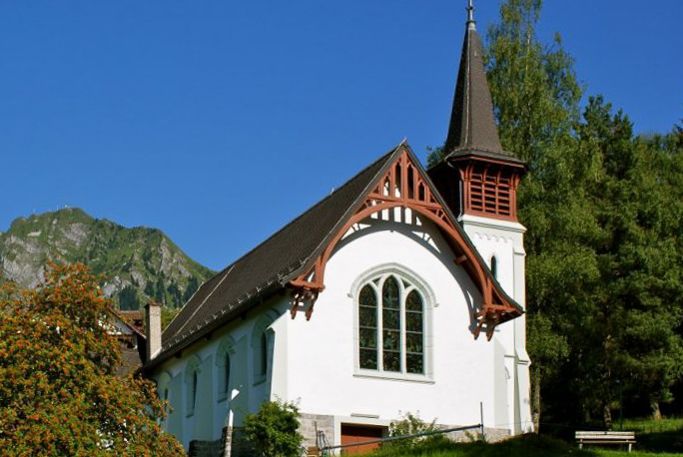
On Wednesday 30 January 1901 the English along the lake were preparing for Queen Victoria’s funeral. That day a memorial service was held high above Montreux, in the English chapel of the Grand Hôtel de Caux. The visitors’ paper recorded it in a line: “Un service solennel a été célébré mercredi dans la chapelle anglaise du Grand Hôtel de Caux.” That week the trains to Caux were still running through the snow. At Caux and Les Avants, the Montreux paper reported, people were tobogganing on well-kept runs in marvellous weather. The chaplain then staying at Caux, according to the guest list, was the Revd Heywood P. Masters.1 Five years later the English at Caux had a church of their own, St Michael and All Angels, dedicated on 1 February 1906.7
Caux stands on a terrace of the mountain at about 1,100 metres, well above Glion, and its hotels filled in winter as well as summer. By the time of the memorial service there was the Grand Hôtel de Caux, and a year later the vast Caux Palace opened beside it. How that came about, and why a Montreux doctor held a surgery at Caux every Tuesday, is told on our page Wintering on the Swiss Riviera.2
Services in the hotels
Caux first appears in the minutes of the Society for the Propagation of the Gospel on 24 May 1881. In November 1891 it was entered on the Society’s list of chaplaincies. For the next fifteen years the English worshipped in the hotels, in their salons and then in a room set aside as a chapel. They were looked after by chaplains who came up from Territet or stayed for a season, and the Montreux guest lists show them there in winter as well as summer.3
By 1903 the hotel chapel was no longer enough. A circular of that year was probably written by the chaplain at Territet, the Revd Philip Menzies Sankey. Caux was becoming such a place for English and American visitors, it said, “that the absence of an English church is a conspicuous want of the life here”. The temporary chapel held barely a hundred people and was not set apart enough to keep the services quiet. The new church was to seat two hundred and cost 25,000 francs, or £1,000.4
Caux was still full of visitors from Paris in late September 1904. The Comtesse de Chaumont Quitry got up a “society” entertainment in aid of “the French and English Churches Fund for Caux Palace”. The play, a one-act piece called La Sauterelle, did not impress the Ladies’ Field, but her acting in the principal part, it said, “saved the situation”.5
Building St Michael’s
In April 1905 the Feuille d’avis de Montreux carried a notice headed “SOUMISSION”. Tenders were invited for the construction of a “Chapelle anglaise, à Caux”. Builders were to apply for the plans and conditions to “M. Maillard, architecte, à Vevey”, who would receive their bids until the end of the month. Eighteen years earlier a Maillard of Vevey had designed the English chapel at Glion, a little way down the mountain, and it was very probably the same man. The church was built that year.6
That winter Archdeacon Spens was staying at the Grand Hôtel de Caux. It was during his time as chaplain that the church was dedicated, on 1 February 1906, to St Michael and All Angels. A week before, Caux had beaten Les Avants at ice hockey by seven goals to five. No account of the dedication has yet been found in the local papers.7
The name gave the church its theme. Its stained glass windows form a series on the ministry of angels, from the Old Testament on one side of the nave and from the Gospels on the other. A large three-light window shows Jacob’s ladder. All but one of the windows were given by Mr Herbert Edgar Reid, and they were made in 1906 by A. L. Moore and Sons of London. The carved altar was held up by four angels. Schniewind describes it as oak and probably the work of a Belgian artist. The chapel’s present custodians say that the altar and reredos were carved in boxwood, by the firm of De Wispelaere of Bruges. The reredos at St John’s, Territet is attributed to the same workshop.8
In the seasons before the First World War the church kept a full Sunday round. The Montreux papers listed it in their church directory each week as “English Church, Caux. Sunday during Season 1909-10”. There was Holy Communion at half past eight, Matins and sermon at half past ten, a second Communion at half past eleven and Evensong at a quarter past five.9
Closed and given away
The church was closed during the war and needed a good deal of repair afterwards. Caux no longer drew English visitors as it had, the congregation dwindled, and the church stayed shut. In 1934 the question of selling it arose. The church then formed part of the property of the Hôtel Regina, and any buyer of the hotel was to be bound to keep it up. In June 1937, however, a religious retreat was held at the Hôtel Régina, with English and Swiss speakers. It began its Sunday with a communion service “dans la jolie Chapelle anglaise de Caux”.10
By the early 1940s the building was falling into ruin. The Protestants of Les Avants took some of its fittings into safekeeping. Most of them went back to Caux once the chapel was repaired. Two of the carved angels stayed at Les Avants.11
The Swiss had begun to use the chapel before they owned it. In the summer of 1943 the parish of the Église nationale at Montreux held services there every Sunday in July and August. They were for the people living up the mountain, and for the many tourists. That Ascension Day a sale at Glion raised money partly for the chapel’s restoration. In January 1944 the Montreux paper announced a gift. The Society for the Propagation of the Gospel in London had given the English chapel at Caux to the parish, and the parish council had accepted it “avec reconnaissance”. The condition, it emerged, was that the parish take over the mortgage on the building.12
On Sunday 23 July 1944 the chapel was to be opened for worship again. There was to be a solemn service, to which the English colony of Montreux was invited. M. Kocher, for the Montreux parish council, was to open the ceremony by handing the chapel to the Anglican community of Caux, and their chaplain was then to take the service. On the evening of 25 September a meeting at the Collège du Châtelard founded the Société de la chapelle nationale évangélique réformée de Caux. The chapel was to be transferred to it from the London society, and the new society would restore it. The mortgage company had agreed to give up its claim. The most urgent repairs had already been paid for by the Montreux parish, the English churches and others, among them the public authorities. An architect, M. Jeanneret, had estimated the full repair at 27,000 francs. The work was to start at once, because of the altitude and the lateness of the season.13
Touring Switzerland in 1949, the European secretary of the Society for the Propagation of the Gospel reported: “The Church is in beautiful condition, used regularly. It is quite the most beautiful of the English churches I visited.” In 1981 St Michael and All Angels celebrated its seventy-fifth anniversary, and the Montreux pastor, M. Leuenberger, invited every denomination in the district to the service.14
St Michael’s today
The chapel still stands at Caux, a Reformed chapel since 1944, and Anglicans kept the right to hold services in it. It remains, in the words of its present custodians, a place of meditation and prayer. Its angel windows were restored in 1992 by the glass-painter Jean Prahin, who considered them a set rare in Switzerland. It is also a concert hall. The Saison musicale de Caux holds chamber concerts there, for which its acoustics are well suited. In 2020, during the pandemic, a rosewood Pleyel grand piano of 1921 was given to the chapel, and it now stands in the nave, facing the little organ.15
If you have memories or photographs of St Michael’s, or of English services at Caux, please write to us at info(a)stpeters.ch.
For the other English churches of the district, see our page on the English churches in Switzerland.
-
Journal et liste des étrangers, 2 February 1901, p. 5, “Chronique locale” (Scriptorium item 397798), read on the page image, which also reports the Glion–Naye trains climbing “régulièrement jusqu’à Caux en attendant que les travaux de déblayement de la neige” let them go higher; Feuille d’avis de Montreux, 1 February 1901, p. 4, “On luge” (item 505705), read on the page image, quoted in translation; Journal et liste des étrangers, 5 January 1901 (item 397772), read on a crop of the page image: “The Rev. Heywood P. Masters engl. chaplain at Caux, England”. The funeral was on Saturday 2 February; the Wednesday before was 30 January. ↩
-
Altitude from the hotel list of the Journal et liste des étrangers, 3 February 1906, p. 1 (item 430058): “Palace Hôtel (Alt. 1100 m.)”, “Grand Hôtel de Caux (Alt. 1100 m.)”. The Caux Palace was inaugurated on 5 July 1902 (Der Bund, 30 June 1902, as cited on our page Wintering on the Swiss Riviera). ↩
-
Paul W. Schniewind, Anglicans in Switzerland (Berne, 1992), p. 102, for the SPG minutes, the hotel salons and the chaplains from Territet. The guest lists name, among others, M. Bowen in October 1900, the Revd Heywood P. Masters in January 1901, and the Revd A. J. Collingwood that April; the Revd E. N. Robson over the winter of 1902–3, and the Revd H. Larner in the spring of 1903. Guest lists, Journal et liste des étrangers, all read on crops of the page image: 27 October 1900 (item 397959), “M. Bowen, engl. chaplain at Caux”; 5 January 1901 (item 397772); 27 April 1901 (item 397754), “Rev. A.-J. Collingwood, chaplain at Caux”, listed with “Rev. Th. and Mrs Nolan, chaplain at Caux, Oxford”; 27 December 1902 and 3 January 1903 (items 429974, 397765), “Rev. E. N. Robson … Engl. Chaplain at Caux”; 18 April 1903 (item 397743), “[Rev.] H. Larner English Chaplain at Caux, London”. Also 6 July 1901 (item 397744), “[?] S. Sedgwick, engl. chaplain [at] Caux”; 28 June 1902 (item 429959), “Reverend H. J. Boys, english chaplain at Caux”; 6 September 1902 (item 430001), “Rev. Stephenson, engl. chaplain at Caux”. A search on “Chaplain at Caux” returns 49 guest-list entries between October 1900 and June 1903. The hotel chapel of 1901 is the one the 1903 circular calls “the temporary chapel”. ↩
-
Schniewind, p. 102, quoting the circular; the fuller quotation is on our page Wintering on the Swiss Riviera. ↩
-
Ladies’ Field, 1 October 1904, p. 45, “Paris Artistique” (British Newspaper Archive), read on the page image. Why the fund was described as for both a French and an English church is not explained. ↩
-
Feuille d’avis de Montreux, 19 April 1905, p. 1 (item 456198), read on the page image; the notice ran again on 22, 25 and 28 April. It gives no forename. The Glion architect was Louis Maillard of Vevey (see the Glion page); that the two are the same man is likely but not proved. Schniewind, p. 102, for “built in 1905”. The Saison musicale de Caux says the land was made available by the Société immobilière de Caux, owner of the Palace. ↩
-
Journal et liste des étrangers, 4 November and 9 December 1905 (items 429687, 429645), read on crops of the page image: “Archdeacon Spens, England”, at the Grand Hôtel Caux; 4 June 1904 (item 429652): “Spens, Scotland” (two guests) at the Hôtel Caux. Schniewind, p. 102, for the dedication and “the Venerable Andrew N W Spens, Archdeacon”, as his printed page reads. Feuille d’avis de Montreux, 26 January 1906, p. 4, “Sports d’hiver” (item 456868), read on the page image. Searches of the Montreux papers for January and February 1906 find no report of the dedication, although both papers survive for those weeks. ↩↩
-
Schniewind, p. 102; “La chapelle de Caux : Histoire du lieu”, Saison musicale de Caux (caux-musical.ch), for the Old Testament and Gospel series, the Jacob’s ladder window, the London glass, the boxwood altar and reredos by De Wispelaere of Bruges and Jean Prahin’s restoration in 1992. For the St John’s reredos, Lüthi (2003) as cited on the St John’s page. Schniewind gives the maker of the glass as “Messrs A L Moore and Sons”; that they worked in London is the music society’s statement, not Schniewind’s. ↩
-
Feuille d’avis de Montreux, 8 April 1910, p. 4 (item 455064), church directory, read on the page image; the same notice runs weekly in the Feuille d’avis and the Journal et liste des étrangers through 1910. “Every Song” in the print is evidently Evensong. ↩
-
Schniewind, p. 102, for the war, the closure and the 1934 clause concerning “the Regina Hotel property, which included the church”; Feuille d’avis de Vevey, 8 June 1937, p. 6, “Retraite de Caux” (item 211742), read on the page image: the retreat opened on Saturday 5 June at the Hôtel Régina “avec le concours des représentants du Principal Jeffreys”, and on the Sunday at ten “a eu lieu un culte de Cène assez impressionnant dans la jolie Chapelle anglaise de Caux”. ↩
-
Anne Vallelian, on the chapel at Les Avants, Réformés.ch, 15 June 2026, quoted here from our Riviera page and not read again; “La chapelle de Caux : Histoire du lieu”, Saison musicale de Caux. The two accounts differ on what was taken and when: the first has the altar and four angels in 1941, the second “plusieurs parties du retable, les anges de la nef et quelques objets de bois” in 1944. Both agree that most of it returned and that two angels stayed at Les Avants. ↩
-
Journal de Montreux, 9 July 1943, p. 5, “Cultes en montagne” (item 439140), read on the page image: services “tous les dimanches de juillet et d’août à la Chapelle anglaise de Caux à 9 h. 30”; the services list of 18 September 1943 (item 439015) still has “Chapelle anglaise de Caux, 9 h. 30, culte, M. Anet”. Journal de Montreux, 21 May 1943, “Vente de l’Ascension” (item 438921), for the sale at the Hôtel des Alpes, Glion, on 3 June for the Glion temple’s debt “et, si possible aussi à la restauration de la Chapelle anglaise de Caux”. Feuille d’avis de Lausanne, 24 January 1944, p. 17, “Montreux. — Don d’une chapelle” (item 29474), read on the page image; also Semeur vaudois, 22 January 1944, p. 3 (item 678081). For the mortgage, Journal de Montreux, 26 September 1944 (note 13). The parish’s annual meeting on 12 March 1944 had on its agenda “Achat de la Chapelle anglaise de Caux (Rapport de M. Kocher)” (Journal de Montreux, 8 March 1944, item 440315). ↩
-
Journal de Montreux, 20 July 1944, p. 5, “À la chapelle anglaise de Caux” (item 440342), read on the page image, which adds that the State had granted a first subsidy of 4,000 francs; the same notice in the Feuille d’avis de Vevey of that day (item 204304). The paper of Thursday 20 July says only “dimanche”, which was 23 July. Journal de Montreux, 26 September 1944, p. 5, “Pour la chapelle de Caux” (item 440323), read on the page image: the constituent assembly “a eu lieu hier soir au Collège du Châtelard”; “la Société hypothécaire a consenti à l’abandon de sa créance”; “une étude pour la réparation complète a été entreprise par M. Jeanneret, architecte et le devis des travaux prévus s’élève à fr. 27 000”. The report names those who had paid for the most urgent repairs as the Montreux parish, the English churches, the Société immobilière de Caux, the society of the Glion temple and the public authorities. The same page reports the departure from Caux of “un nouveau contingent d’évadés américains”, escaped American soldiers who had been at Caux for some months. Schniewind, pp. 102–103, gives the same date and cost. ↩
-
Schniewind, p. 103. ↩
-
Saison musicale de Caux, “La chapelle de Caux : Histoire du lieu”, and its note on the piano “qui a rejoint la chapelle en 2020”; Schniewind, p. 103, for the Anglican right of use and the chapel “still left open throughout the day (1992)”. The music society’s page does not say when the concert series began. ↩
Questions answered
- When was the English church at Caux built?
- The English church at Caux was built in 1905. Tenders for it were invited in April 1905, and it was dedicated on 1 February 1906 to St Michael and All Angels. Until then English services had been held in the hotels, latterly in a chapel in the Grand Hôtel de Caux. Caux had been on the list of chaplaincies of the Society for the Propagation of the Gospel since November 1891.
- Who designed the English church at Caux?
- The architect of the English church at Caux has not been identified by name. In April 1905 the Feuille d'avis de Montreux carried a notice inviting tenders for the English chapel at Caux, with the plans and conditions at the office of M. Maillard, architect, at Vevey. A Maillard of Vevey, very probably the same man, had designed the English chapel at Glion eighteen years earlier.
- What are the stained glass windows at Caux?
- The windows of St Michael and All Angels at Caux form a series on the ministry of angels. Those on one side of the nave come from the Old Testament, and those on the other from the Gospels. A large three-light window shows Jacob's ladder. All but one were given by Mr Herbert Edgar Reid, and they were made in 1906 by A. L. Moore and Sons of London. The glass was restored in 1992 by the glass-painter Jean Prahin.
- Who owns the English church at Caux now?
- The English church at Caux has been a Reformed chapel since 1944. In January 1944 the Society for the Propagation of the Gospel gave it to the Montreux parish of the Église nationale, on condition that the parish took over the mortgage. On 25 September 1944 a meeting founded the Société de la chapelle nationale évangélique réformée de Caux, to which the chapel was to be transferred and which would restore it. Anglicans kept the right to hold services there.
- What is the chapel at Caux used for today?
- St Michael and All Angels at Caux remains, in the words of its present custodians, a place of meditation and prayer. It is also a concert hall: the Saison musicale de Caux holds chamber concerts there. A rosewood Pleyel grand piano of 1921 was given to the chapel in 2020 and stands in the nave.