History of English Churches in Switzerland – Chateau d’Oex
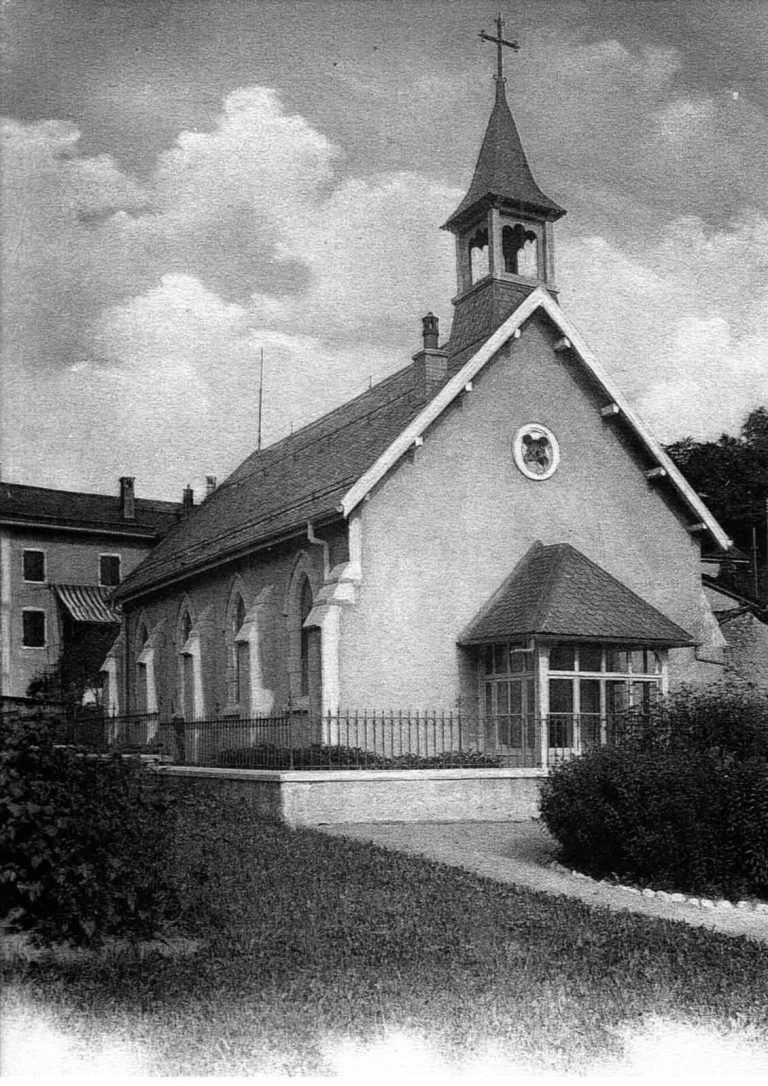
Bishop Thomas Wilkinson came to lay the first stone of an English church at Château-d’Œx in June 1899. He drove the fourteen miles up from Bulle. He arrived, he wrote in his journal, “just as the clock of the little parish church perched on its green knoll chimed mid-night”. On Wednesday 28 June he laid the stone before what the village paper called a considerable crowd of English and local people. He officiated in full robes, with six clergymen from England and Switzerland around him. Their academic dress varied with the universities where each had taken his degree. The Journal de Château-d’Œx admitted that it looked a little strange to Calvinists and Presbyterians used to plainer things.1
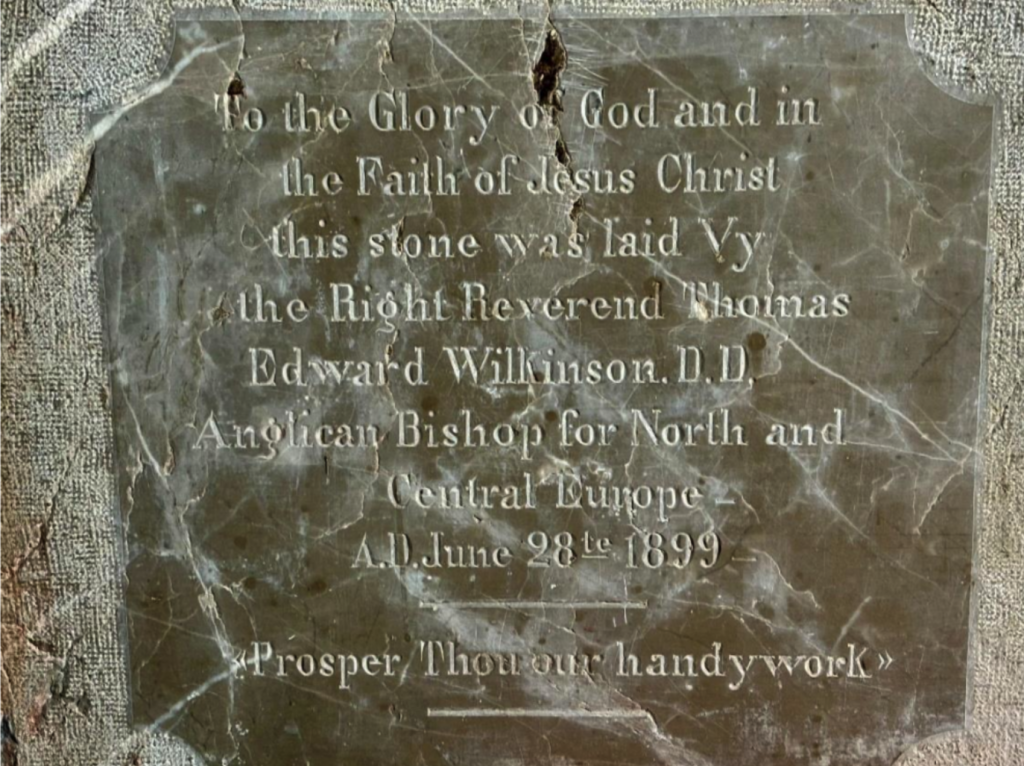
The bishop spoke briefly on Christian brotherhood. Documents and coins were placed in the stone, which was sealed with a silver trowel. While a last hymn was sung, friends of the church laid purses and gold and silver coins in a silver-gilt dish. The collection came to about 550 francs. Afterwards Mrs Scott gave tea in the garden of her Chalet Bellevue to the English and several of the villagers. The English, the paper said, congratulated her on the perseverance that had carried through a project “contestée par plusieurs”, opposed by a number of people. It hoped that the friendly relations between the English and the village would last as before. The stone is inscribed “To the glory of God, and in the faith of Jesus Christ”. It can still be seen at the front of the nave, by the vestry door.2 The church built on that stone is St Peter’s, which held its first service that September and was consecrated in May 1902.1215
Why the English came
The English had been coming to Château-d’Œx for decades by then. The Berthod family had opened the village’s first hotels for visitors. In 1910 the brothers still kept the original visitors’ books, going back to 1850 and signed by many English travellers. “In those days, and for many years afterwards,” a London paper wrote, “the English were the only visitors.” Around 1886 a Londoner told a Lausanne paper that he had been bringing his family to Château-d’Œx or Rossinière for four weeks every year for ten years.3
What they found was a simple, healthy holiday not too far from home. A chaplain of the 1880s, the Revd D. Wheeler, called Château-d’Œx “a favourite resort during the summer months for those who do not wish to go very far from home”. He thought the simple life of the Swiss pensions “very welcome to those who have come for rest”. An English lady writing in 1899 praised its “wonderfully dry climate” and “large amount of sunshine”, its walks and drives in summer and its tobogganing and sleighing in winter. In 1902 The Gentlewoman told its readers that M. Berthod would take them in for six to eight francs a day. Château-d’Œx, it added, “boasts an English church and a good resident doctor”.4
The winter came later. The Hôtel Berthod opened for the first time in winter in 1894–95, and the English founded a club in its billiard room. That winter the Journal hoped that invalids would come in growing numbers “pour y chercher et y trouver la guérison, comme à Davos ou à Leysin”. Château-d’Œx never built a sanatorium, and by 1911 the hotel proprietors had made it a rule that consumptives were not received. The Montreux visitors’ paper surveyed the Vaud resorts in June 1912. Its neighbours advertised cures for nerves, anaemia and rheumatism, while Château-d’Œx named no condition at all, and offered mountain air, excursions and trout fishing in the Sarine. The chaplain, who took boys as pupils in 1907, added to his advertisement: “None very delicate taken as boarders.”5
What the English did come for was sport. Skating, tobogganing and, later, skiing filled the winters. In summer the tennis courts in the grounds of the Berthod had by 1911 staged the championship of the Swiss clubs three times. The winter season was well established before the railway arrived. In January 1900 every chalet was taken by families spending the winter, four years before the line from Montreux reached the village in August 1904. Wintering on the Swiss Riviera tells that part of the story, and our guide to the English churches in Switzerland explains why the resorts needed churches of their own.6
Services in borrowed rooms
Château-d’Œx was placed on the list of the Colonial and Continental Church Society in 1866. Two names are given for its first clergyman. Paul Schniewind’s history of the Anglicans in Switzerland names the Revd G. V. Chichester. The parish’s own record, kept in the chaplains’ books, names John James Coxhead, a curate of Fulham, appointed in June 1866. He was followed by other curates who usually stayed a month or two at the Hôtel Berthod. Neither man has yet been found in the press of the time. The first chaplain the newspapers name is the Revd C. G. Ashwin, in August 1871; that month Rossinière, three miles down the valley, had an English chaplain of its own.7
For more than thirty years the English worshipped in borrowed rooms. The parish record describes services in the lounge of the Hôtel Berthod, and at times in the Pension Rosat and the Pension Morier. That caused its own difficulties. In July 1883 the Revd Doyle “humbly advised all future chaplains not to hold services in Salons where there is a church provided for that purpose”. It favoured one pension over the others. The church he meant was the Swiss one, the Temple on its hill. Wheeler described the arrangement: “The Swiss are early risers, and their service on Sunday is held at 9 a.m. and is over about half-past 10, and as that is their only service on Sunday they very kindly let the English visitors have the use of the building for the rest of the day.” On summer mornings, he wrote, the congregation sometimes numbered nearly 150. In winter the English used the Salle des Catéchumènes, and in 1893 they hired a harmonium for it at fifty francs a month.8
The chaplains changed with the season, often month by month. They were clergymen on holiday from English parishes: a vicar from Durham in 1892, one from Clitheroe in 1894. The Revd E. Dudley Lampen, who would later be the village’s first permanent chaplain, first came for a month in 1896.9
Mrs Scott’s church
The idea of a church of their own is credited to one woman. Mrs Scott of the Chalet Bellevue, who had come to live in the village with her daughters, began collecting in January 1897. A writer in the Society’s magazine in 1899 recalled that “two years ago a lady who is now a resident found that ground had been given for a church”. She had told the Society, and had been “hard at work collecting for the building fund” ever since. The Journal advertised a sale at her chalet for the building fund on 3 and 4 September 1897. In December it advertised a vente-bazar, with objets d’art, flowers, photographs, a buffet and “biscuits thé, gateaux anglais”. The Morning Post was clear about whose church it was: “The movement is entirely due to the interest and energy of Mrs. Scott, of Château d’Oex.”10
The ground came from the Berthod brothers. By a deed of gift dated 25 January 1898 they gave the Society a plot of three ares and nine square metres on the main road. The village paper placed it “au-dessous de la fontaine à occident du village”, below the fountain at the west end of the village. The Society lent the building money free of interest. On 20 May 1899 Le Progrès announced that work would begin the next month. The building would suit the character of the valley, “suffisant tout en demeurant simple et modeste”. The builder was Jean Gippa of Bulle, who had built the church at Montbovon. The Lausanne paper La Revue gave the reason in a line: “Le nombre des Anglais qui séjournent ici croissant d’année en année, on va construire une église anglaise.” By mid-June the site was pegged out and materials were arriving, and Gippa had undertaken to hand over the keys at the end of August.11
The first service in the new church was held on Sunday 10 September 1899, less than eleven weeks after the stone was laid. There was no consecration and the opening was, the Journal said, “tout intime et simple”. The English community sent the paper a letter of thanks. It thanked the authorities, the Swiss churches and the pastors for the years in which the Temple and the Salle des Catéchumènes had been lent so freely. It was a debt of gratitude, they wrote, that they could never repay in full.12
Not everyone admired the result. A correspondent of the Morning Post thought it looked “like a nicely-stuccoed and whitewashed barn”, with “no symbol or sign of Christianity without or within”, and explained that it had been “somewhat hastily completed so that it might be ready for the recent lawn tennis tournament at the Hotel Berthod, in the grounds of which the church is situated”. The same paragraph said the church was dedicated to St John, which it never was. Bishop Wilkinson was kinder: in his view the work had been well done, and the building was “very pretty and suitable to the place”.13
Consecrated in 1902
The church could not be consecrated while it was in debt. The whole cost was £800. Two bazaars raised £42 and £27. Most of the work lay in collecting donations and subscriptions, patiently and persistently. The largest gift was £25, and the great majority were of less than £3. By 1 May 1902 the debt was below £100, and Wilkinson agreed to come back.14
He consecrated St Peter’s on Tuesday 27 May 1902, under a commission from the Bishop of London, who at the time had charge of Anglicans abroad. May had been cold and wet, and there were few visitors in the valley. The Revd F. W. Bourdillon wrote in the Society’s magazine about the day itself. “The whole valley was sparkling with the beauty of ‘clear shining after rain’,” he said, with fresh snow on the mountains all round. Helpers had laid “long trails of fresh, sweet mosses from the fir-woods” on the windowsills and the communion rail, with narcissus from the fields. At half past ten the bishop began, following the old custom, by knocking at the locked doors. There was no sermon. The Journal noted a simple cross shining on the altar, and a notice at the door showing the debt down to 2,500 francs. Before the day was out, the collection and the gift of one lady visitor had cleared it. In the afternoon Mrs Scott held an “At Home” for the bishop, and was warmly congratulated.15
Mrs Scott left Château-d’Œx soon afterwards for the Isle of Wight. The church she had worked for was dedicated, in the words of the consecration, “by the name of Saint Peter”. In 1904 the Feuille d’avis de Lausanne reported the arrival of the railway. It described the English colony wintering in the village, and its “charmante petite église du culte anglican dédiée au vieux Saint-Pierre”.16
Enlarged in 1911
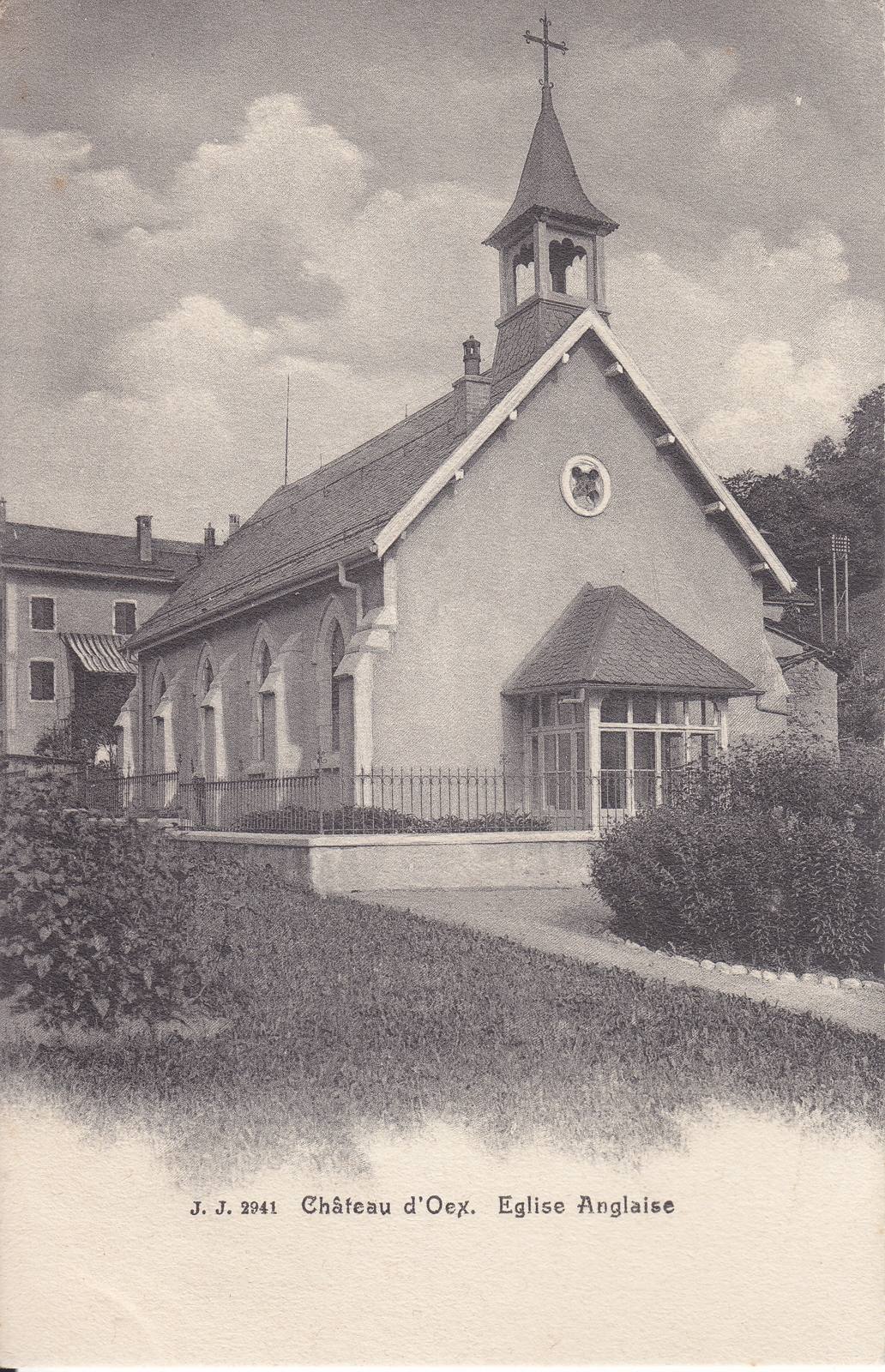
The church soon proved too small. Dudley Lampen came back in the winter of 1907–08 as the first permanent chaplain. At times the congregation was so large that a hall had to be hired as well. The committee began to discuss enlarging the church in 1908. Its first plans ran into a difficulty with the Berthod brothers, who explained that all their land was mortgaged. It decided to do the best it could with the existing site.17
In May 1911 the municipality opened the statutory inquiry into an application by the Lausanne architects Monod & Laverrière, acting for the Society, for “l’agrandissement de la Chapelle anglaise actuelle”. The work began in June, so the service for George V’s coronation that month was held in the Swiss church. On 11 November Le Progrès announced that the enlarged church would be inaugurated the following Wednesday, 15 November, at half past two. The English chaplain of Vevey would take the service, and everyone was welcome. According to the parish record, Bishop Herbert Bury dedicated it on 21 December.18
Lampen told the congregation that the work had meant, in effect, rebuilding the church. A chancel, an aisle, a vestry and an entrance vestibule had been added, with cellars under the vestry for central heating. The outside was rough-cast, the roof repaired on one side and renewed on the other, and electric light put in throughout. A pulpit carved at Brienz was given as a thank-offering, with figures of Christ, St Peter and St Donat. Lampen described St Donat as “the disciple of Columba who first brought the Gospel to Château-d’Œx”. He reckoned the church could now hold 268 people. The parish record gives 260, and Schniewind “175 to 200”, perhaps counting only the fixed seats.19
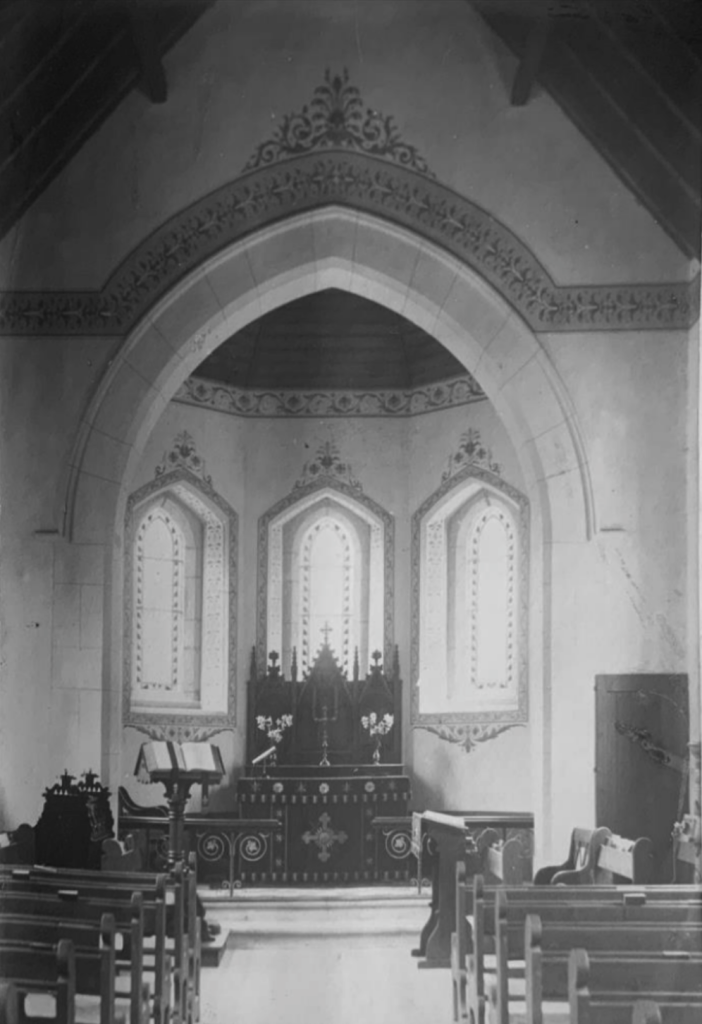
The village shared in the church’s great occasions. When Edward VII died in May 1910, the notice in Le Progrès inviting everyone to the funeral service “à la chapelle anglaise” was signed by the Reformed pastor, Ernest Chuard.20
The war years
On 30 May 1916 the first party of sick and wounded British prisoners of war, exchanged from German camps, arrived at Château-d’Œx to be interned. Lampen chaired the British committee that prepared their welcome, and in June the Swiss authorities approved his appointment to care for the Church of England men. At the memorial service for Lord Kitchener that month about three hundred officers and men filled the church, and many were turned away. A soldier named Lester, who had been organist at the prisoners’ church at Münster, played the funeral marches. Soldiers married their fiancées in the church, and in July 1918 six men who died of influenza were buried here. The story of the internment is told on our page on the 1916 internment, and the newspaper reports are published in full in the Château-d’Œx press archive.21
The internees left the church its organ. In August 1916 Lampen wrote to The Times that hundreds of soldiers were using the church. They sang with all their hearts, but the harmonium was not powerful enough. The organ was built by Goll of Lucerne and dedicated on Thursday 8 March 1917, in a snow blizzard. It was “a lasting memorial to this remarkable historical incident, the sojourn of 750 British soldiers in this valley”, Lampen wrote. Colonel S. C. F. Jackson opened it and handed the keys to Lester. A plaque above the organ records that it was placed as a memorial to the officers, non-commissioned officers and men interned at Château-d’Œx from May 1916 to November 1918. The organ still works by its original pneumatic action.22
Between the wars and after
After the war the English colony was no longer only a seasonal one. At Christmas 1922 about three hundred people packed the church. When the Revd Francis Hamilton retired in 1929, the Journal described the sixty people who said goodbye to him as members of the “colonie anglaise permanente”. In 1932 three stained-glass windows were installed, the gift of Mr and Mrs Kitchin. Their son Brian, a student at Pembroke College, Cambridge, had been killed in a motorcycle accident in May 1930, aged twenty. They show three figures, named Service, Aspiration and Courage, and were fitted by Bordini et fils.23
The chaplaincy grew thinner. The Revd H. W. Teesdale, who took the services from 1935, came up from Blonay to do so and kept at it through illness; he died in 1944. After the war the services were taken by visiting clergy, and in 1949 the post stood vacant. From about 1960 the church was served from the lake: first as one of a group of churches led from Christ Church, Montreux, and from 1973 as “Vevey with Château-d’Œx”. Looking back in 1999, the village paper recalled a visit by the Archbishop of Canterbury in April 1958, and a new roof in 1964.24
St Peter’s also became a church for the village. Swiss families held funerals there: Olga Devaux-Joerin in 1944, Louise Rosat of La Frasse in 1955 and Benjamin-Edward Chance in 1988. It stands on the main road, much easier to reach than the Temple on its hill. When the Catholic parish reopened its church in 1984, representatives of the Anglican church were among the guests.25
On 2 August 1983 the church held the funeral of David Niven, who had died at his chalet at Château-d’Œx on 29 July. The English papers had reported that the service would be held in the larger Reformed church, but it took place at St Peter’s. It was meant to be private, but, as the Daily Express reporter wrote, “nothing could keep the villagers out”. About 150 people found seats and the rest stood on the steps. Yehudi Menuhin, a neighbour for twenty-five years, brought pupils from his music school to play Mendelssohn. Reporting it, the Tribune de Lausanne named the building in English: “St Peter’s Church”.26
St Peter’s today
For the centenary on Sunday 27 June 1999, the village paper announced a service, partly in French, with the Bishop, John Hind, and the British ambassador, Christopher Hulse. Twenty years later, on 2 June 2019, the Bishop in Europe, Robert Innes, came for the 120th anniversary.27
The chaplain of All Saints, Vevey, still comes up the valley every Sunday, and the service is at half past five in the evening, in English. The Goll organ plays for it, and the Kitchin windows are in place. By the vestry door is the stone Bishop Wilkinson laid in 1899, after his drive up from Bulle.28
We would like to know more about St Peter’s between the wars and in the years after 1945, when its records are thin. If you have photographs, papers or memories of the church, please get in touch at info(a)stpeters.ch. The other English churches of Vaud are described in our guide to the English churches in Switzerland.
-
Bishop T. E. Wilkinson’s journal, quoted in Paul W. Schniewind, Anglicans in Switzerland (Berne, 1992), p. 79; Journal de Château-d’Œx, 1 July 1899, “Eglise anglaise” (parish cutting, St Peter’s Notion archive), read on the image: “l’évêque anglican Wilkinson officiait en grand costume, entouré de six révérends venus d’Angleterre et de Suisse … Ces costumes … paraissaient un peu étranges aux yeux des calvinistes et des presbytériens, habitués à plus de simplicité.” Paraphrased in translation. ↩
-
Journal de Château-d’Œx, 1 July 1899, as note 1. The parish record gives the collection as 504 fr. 55 and says the silver trowel was presented by “Mrs Archibald Scott”; the newspaper gives “550 fr. environ”. The inscription is from Wilkinson’s journal (Schniewind, p. 79); the stone’s position is from the parish record (Janet Daenzer, Heritage 1866–1919, drawn from the Chaplain’s Book and church register). Much of what is known about the parish’s first fifty years comes from this record, which is cited throughout these notes as “parish record”. ↩
-
London Evening Standard, 13 May 1910, p. 11, “Chateau d’Oex” (British Newspaper Archive BL/0000183/19100513), read on the page image; Nouvelliste vaudois, 17 September 1886, p. 1 (Scriptorium item 115208): “allez à Château-d’Ox ou à Rossinières, me disait déjà il y a dix ans un Anglais de Londres, qui chaque année se rend dans ce petit paradis avec sa famille pour y faire un séjour de quatre semaines.” The whereabouts of the Berthod visitors’ books today is unknown. ↩
-
Revd D. Wheeler, “The Chateau d’Oex Chaplaincy”, Greater Britain Messenger, p. 31 (St Peter’s Notion archive, dated there 1885; the issue date is not on the page); “Château-d’Œx: from a lady correspondent”, Greater Britain Messenger, 1899, pp. 252–254; The Gentlewoman, 22 November 1902, p. 34 (British Newspaper Archive BL/0003340/19021122), read on the page image. ↩
-
Journal de Château-d’Œx, 2 February 1895, p. 2 (Scriptorium item 472228); London Evening Standard, 10 June 1911, p. 19, “An Ideal Summer and Winter Resort” (British Newspaper Archive BL/0000610/19110610): “consumptives are not received at Château d’Oex; the hotel proprietors have made this rule in justice to their guests”; Journal et liste des étrangers de Montreux, 22 June 1912, p. 3 (item 428935); the same, 2 November 1907, p. 14 (item 429328), Lampen’s advertisement. ↩
-
London Evening Standard, 17 December 1912, p. 15, and 24 August 1910, p. 3 (BNA), read on the page image; for January 1900 and the railway, see the Riviera article and its notes; the line was formally opened to Château-d’Œx on 18 August 1904 (Journal de Château-d’Œx, 20 August 1904, p. 1, Scriptorium item 474200). ↩
-
Schniewind, p. 78; the parish record (Daenzer), for Coxhead; The Record, 11 June 1869, p. 5, for the 1869 season beginning on 6 June; Sun & Central Press, 3 August 1871, p. 2, for Ashwin and for the Revd J. H. Gregory at Rossinière. Both BNA, read on the page image. A search of the British press for Coxhead at Château-d’Œx found nothing. ↩
-
Parish record (Daenzer), for the hotel lounges, Doyle’s advice, the Salle des Catéchumènes and the harmonium; Wheeler, as note 4. The Journal de Château-d’Œx (30 September 1899) and Bourdillon (note 14) both describe the English using the Swiss church for years before 1899. ↩
-
For the Revd H. E. Fox, vicar of St Nicholas, Durham (August 1892), The Record, 5 August 1892, p. 18; for the Revd H. L. Bellhouse of Clitheroe (June 1894), Clitheroe Advertiser and Times, 9 June 1944, p. 6, reprinting its issue of 15 June 1894; for Lampen (June 1896), Bristol Times and Mirror, 2 June 1896, p. 6. All BNA, read on the page image. A fuller succession is kept in the parish’s own files. ↩
-
Parish record (Daenzer), for Mrs Claudine Scott and her daughters and the start of collecting; “Château-d’Œx: from a lady correspondent”, as note 4, p. 254; Journal de Château-d’Œx, 28 August 1897 (item 475361) and 11 December 1897 (item 475337); Morning Post, 7 July 1899, p. 7 (British Newspaper Archive BL/0000174/18990707), read on the page image. Bourdillon (note 14) calls her “Mrs. A. C. Scott”. ↩
-
Sentence of consecration, 27 May 1902 (London Metropolitan Archives; facsimile and transcript on St Peter’s original documents), for the deed of gift and the plot; Journal de Château-d’Œx, 17 June 1899, for the site, the pegging-out and the keys; Le Progrès de Château-d’Œx, 20 May 1899, p. 2 (item 468270); La Revue, 22 May 1899, p. 2 (item 144186); Bourdillon (note 14) for the interest-free loan. The parish record dates the contract 17 June 1899 and speaks of a horse trough beside the site. ↩
-
Bourdillon (note 14), for Sunday 10 September 1899; Journal de Château-d’Œx, 30 September 1899, “Eglise anglaise”, read on the image; the letter is paraphrased in translation. ↩↩
-
Morning Post, 15 September 1899, p. 6 (British Newspaper Archive BL/0000174/18990915), read on the page image. The dedication is settled by the Bishop of London’s commission of 10 May 1902 and the sentence of consecration, both “by the name of St. Peter”. Wilkinson’s comment is quoted in the parish record. ↩
-
Revd F. W. Bourdillon, “St. Peter, Château d’Oex”, Greater Britain Messenger, 1902, pp. 114–115 (St Peter’s Notion archive), read on the image. An 1899 report in the same magazine gives £600 as the sum needed; Bourdillon’s £800 is the final figure. ↩
-
Commission of Arthur Foley, Bishop of London, 10 May 1902, and sentence of consecration, 27 May 1902 (London Metropolitan Archives; see the commission and the consecration document); Bourdillon, as note 14; Journal de Château-d’Œx, 31 May 1902, “Eglise anglaise”, read on the image. Bourdillon names the assisting clergy as the chaplains of Lausanne, Clarens and Vevey and the acting chaplain of Château-d’Œx. ↩↩
-
Parish record (Daenzer), for Mrs Scott’s departure; Feuille d’avis de Lausanne, 19 August 1904, p. 8 (item 16329). ↩
-
Parish record (Daenzer); The Record, 1 August 1913, p. 730 (British Newspaper Archive BL/0006265/19130801), read on the page image: “Chateau d’Oex: Rev. E. D. Lampen, Permanent Chaplain”; Crockford’s Clerical Directory (1929), p. 822: “Chap. at Chateau d’Oex 1907-19”. ↩
-
Journal de Château-d’Œx, 6 May 1911, p. 4 (item 473828), reprinted 10 and 13 May; parish record (Daenzer), for the coronation service of 22 June 1911 and the dedication by Bishop Bury; Le Progrès de Château-d’Œx, 11 November 1911, p. 2 (item 469896), read on the page image: “L’inauguration de l’église anglaise de Château-d’Œx, nouvellement restaurée et agrandie, aura lieu mercredi à 2 ½ h. Le culte sera fait par M. le pasteur anglais de Vevey.” No press report of the December dedication has been found. ↩
-
E. Dudley Lampen, “To the Residents and Visitors, S. Peter’s Church, Château-d’Œx”, annual report, October 1911 (St Peter’s Notion archive), read on the image; parish record (Daenzer); Schniewind, p. 79. Lampen’s figure is 104 more fixed seats and room for 54 chairs, “158 more than in the old church i.e. a total of 268 persons”. ↩
-
Le Progrès de Château-d’Œx, 18 May 1910, p. 2 (item 470275). ↩
-
Parish record (Daenzer), for the arrivals of 30 May 1916, Lampen’s appointment of 14 June and the burials of July 1918; Revd Isaac Hutchinson, “With the British Wounded in Switzerland”, The Record, 26 October 1916, p. 13, read on the page image; Derby and Chesterfield Reporter, 23 June 1916, p. 5, read on the page image; Western Mail, 22 June 1917, p. 1, for the marriage of Rifleman E. N. Manville and Lilly Groves “at the English Church, Chateau d’Oex”. ↩
-
E. D. Lampen, “Soldiers at Château d’Oex”, The Times, 17 August 1916, and his report in the Greater Britain Messenger, p. 60, both transcribed in the press archive; parish record (Daenzer), for Goll and the handing over of the keys; the plaque as photographed for the centenary in 2016 (eyewitness accounts); Dr David M. Elliott, report to the churchwardens, February 2019, for the pneumatic action. Elliott notes that the organ is listed as Goll’s opus 462, of ten stops. The sources give Lester’s rank differently, as Bandsman and as Lance-Corporal. ↩
-
Schniewind, p. 79, for Christmas 1922; Journal de Château-d’Œx, 28 June 1929, p. 2 (item 473483); Journal de Château-d’Œx, 11 May 1932, “Des vitraux”, and the memorial inscription on the windows, “In memory of Brian Kitchin, born April 1st 1910, died May 28th 1930”; Daily Mirror, 29 May 1930, p. 2 (BNA), read on the page image. The maker of the glass is not known. ↩
-
Journal de Château-d’Œx, 8 December 1944, p. 3 (item 431410), Teesdale’s obituary; Crockford’s Clerical Directory, 1939, 1949–50, 1961–62, 1967–68 and later editions; “Centenaire de l’église anglaise”, Journal du Pays-d’Enhaut, 24 June 1999, for the visit of 1958 and the roof of 1964. The paper names neither the archbishop nor the source of these details, and no report of either from the time has yet been found. ↩
-
Feuille d’avis de Lausanne, 23 December 1944, p. 28 (item 29758); Journal de Château-d’Œx, 21 January 1955, p. 3 (item 433610); 30 December 1988, p. 2 (item 432162); 31 August 1984, p. 2 (item 434733). Wheeler (note 4) describes the Temple as the church “which crowns the top of the little hill in the centre of the village”. ↩
-
Express and Star (Wolverhampton), 1 August 1983, p. 10; Daily Express, 3 August 1983, p. 2, Geoffrey Levy (both BNA, read on the page image); 24 Heures, 2 August 1983 (item 12583); Tribune de Lausanne, 13 August 1983, p. 2 (item 81428). The Lausanne papers give his age as 74, the English papers as 73. ↩
-
Journal du Pays-d’Enhaut, 24 June 1999, as note 24; St Peter’s 120th birthday. An extensive restoration in 2017 and 2018 has been reported, but we have not yet found a record of it. ↩
-
The Revd Mark Fletcher, stpeters.ch, and the Intercontinental Church Society’s chaplaincy page, September 2026. ↩
Questions answered
- Why is there an English church in Château-d’Œx?
- English visitors had been coming to Château-d’Œx for decades, and by 1899 their numbers were growing every year. The village was placed on the list of the Colonial and Continental Church Society in 1866. For more than thirty years the English worshipped in borrowed rooms: hotel lounges, pensions and the Swiss church, the Temple, which the Swiss lent them after their own Sunday service. In 1899 a Lausanne paper gave the reason for building in one line: “Le nombre des Anglais qui séjournent ici croissant d’année en année, on va construire une église anglaise.” The Berthod brothers gave the land, and St Peter’s was built that summer.
- When was St Peter’s Anglican Church in Château-d’Œx built?
- St Peter’s, Château-d’Œx, was built in the summer of 1899. Bishop Wilkinson laid the foundation stone on Wednesday 28 June 1899. The builder, Jean Gippa of Bulle, who had built the church at Montbovon, had undertaken to hand over the keys at the end of August. The first service in the new church was held on Sunday 10 September 1899, less than eleven weeks after the stone was laid.
- When was St Peter’s Château-d’Œx consecrated?
- St Peter’s, Château-d’Œx, was consecrated on Tuesday 27 May 1902. It had opened in September 1899, but it could not be consecrated while it was in debt. Bishop Wilkinson, who had laid the foundation stone, came back to consecrate it under a commission from the Bishop of London. It was dedicated “by the name of Saint Peter”.
- Who paid for St Peter’s to be built?
- The English colony at Château-d’Œx, led by Mrs Scott of the Chalet Bellevue. The Morning Post wrote in July 1899 that “the movement is entirely due to the interest and energy of Mrs. Scott, of Château d’Oex”. She began collecting in January 1897, and a sale and a vente-bazar were advertised for the building fund that year. The Colonial and Continental Church Society lent the building money free of interest. The whole cost was £800; the largest gift was £25, and most were of less than £3. By 1 May 1902 the debt was below £100, and on the day of the consecration the collection and the gift of one lady visitor cleared it.
- When was St Peter’s Château-d’Œx enlarged?
- St Peter’s, Château-d’Œx, was enlarged in 1911. The committee began to discuss it in 1908, but the Berthod brothers explained that all their land was mortgaged, so it made the best of the existing site. The work began in June 1911, and Le Progrès announced that the enlarged church would be inaugurated on Wednesday 15 November. The chaplain, Dudley Lampen, said the work had meant, in effect, rebuilding the church: a chancel, an aisle, a vestry and an entrance vestibule were added. He reckoned it could now hold 268 people; the parish record gives 260, and Paul Schniewind “175 to 200”.
- What happened at St Peter’s during the First World War?
- From 30 May 1916 Château-d’Œx received sick and wounded British prisoners of war, exchanged from German camps, to be interned there. The chaplain of St Peter’s, Dudley Lampen, chaired the British committee that prepared their welcome. In June 1916 the Swiss authorities approved his appointment to care for the Church of England men. About three hundred officers and men filled the church for the memorial service for Lord Kitchener that month, and many were turned away. Soldiers married their fiancées in the church, and in July 1918 six men who died of influenza were buried. The internees left St Peter’s its organ, built by Goll of Lucerne. It was dedicated on 8 March 1917 as a memorial to the men interned at Château-d’Œx from May 1916 to November 1918.
- Was David Niven’s funeral held at St Peter’s, Château-d’Œx?
- Yes. David Niven died at his chalet at Château-d’Œx on 29 July 1983, and his funeral was held at St Peter’s on 2 August 1983. The English papers had reported that it would be held in the larger Reformed church, but it took place at St Peter’s. About 150 people found seats and the rest stood on the steps, and Yehudi Menuhin brought pupils from his music school to play Mendelssohn.
- Is St Peter’s Château-d’Œx still in use?
- Yes. St Peter’s, Château-d’Œx, holds a service in English every Sunday at half past five in the evening. The chaplain of All Saints, Vevey, comes up the valley every Sunday to take it, and the Goll organ plays for it.