History of English Churches in Switzerland – Villars
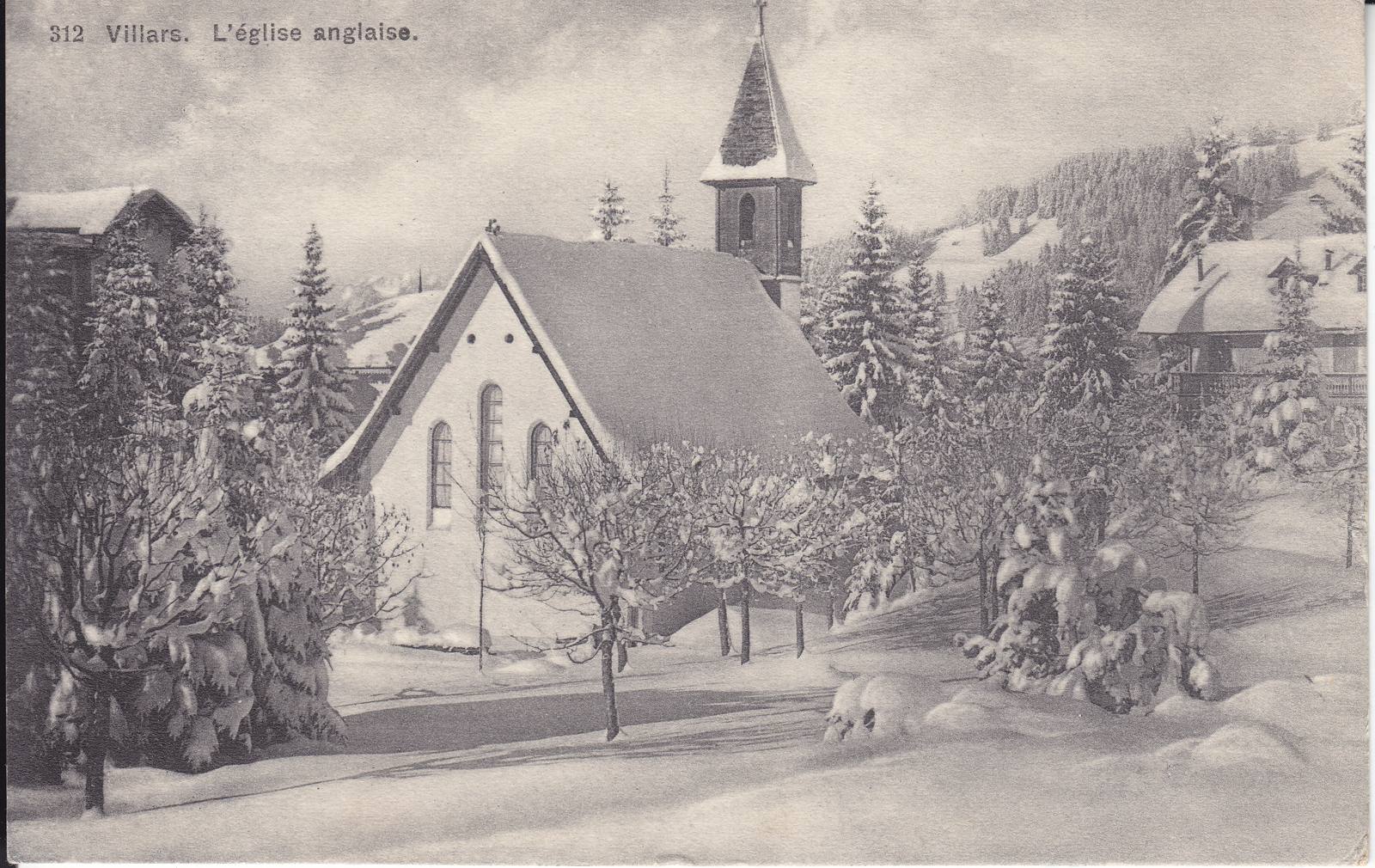
On Friday 27 July 1883, at three in the afternoon, about two hundred people climbed to the plateau above Ollon for the dedication of a new church at Villars. It stood on open meadow beside the Hotel Grand Muveran, with the woods of the Chamossaire behind it and, across the valley, the Dent du Midi. The Semeur vaudois thought it “modeste et de bon goût, blanche comme une robe de mariée”, with a slender spire that could be seen from far off. Pastor Vannod of Yvorne presided. Pastor Vallotton of Gryon spoke of an international church in the best sense of the word. In it, he said, Anglicans, Baptists, Congregationalists and members of both the Vaud churches would set aside their differences. Then Mr Bines, the English chaplain of the Grand Muveran, spoke “dans sa langue”. He reminded the congregation of the old bonds between the Reformed churches of Switzerland and the Protestant churches of his own country. The collection went towards the debt.1
The English had been coming to Villars for more than a decade by then. In August 1871 the Colonial and Continental Church Society already had a chaplain there, the Revd H. de C. Collyer. Villars was one of thirty Swiss stations on the Society’s list for that month.2 The man who made the most of the plateau was the proprietor of the Grand Muveran, a Villars hotelier the papers call Petter. In 1880 he opened new salons in the hotel, where a concert for the poor of the district drew amateur performers from many countries. That season, although he had enlarged the hotel again, he had to turn a great many guests away.3
A church beside the hotel
It was Petter who gave Villars its church. The Semeur vaudois reported the dedication “de l’Eglise anglo-suisse construite à Villars par les soins dévoués de M. Petter-Genillard, le sympathique propriétaire de l’Hôtel du Grand-Muveran”. It added that the new church had cost about fifteen thousand francs, of which at least four-fifths had still to be found. A correspondent writing from Chesières to La Revue gave the same date and hour. He noted that at 1,275 metres it was now the highest church in the canton, taking the title from Leysin.4 Paul Schniewind’s history of the Anglican chaplaincies dates the church to 1880 and says it was demolished and rebuilt in 1954, but we have found no evidence of either.5
A church for two congregations
From the beginning the church belonged to two congregations. The Revue’s correspondent wrote that all the Reformed services would be held there in summer. In September 1886 the Vaud church paper Évangile et liberté looked back on the summer. The Union vaudoise évangélique, it reported, had held regular Sunday worship through July and August “dans la chapelle construite à Villars sur l’initiative de la Société anglaise”. In June 1887 the same paper reported that the Union had obtained “la co-jouissance de la Chapelle anglaise de Villars sur Ollon”, with congregations of up to two hundred.6 The hotel advertised the arrangement. A letter from the Grand Muveran to the Society in February 1887 carried a printed list of the amenities at the guests’ disposal. Among them were “cultes anglais, français et catholique”.7
The debt was slow to clear. In July 1890 the chaplain, the Revd Albert E. Crotty, got up a “Scratch Bazaar (no raffles)” in the Grand Muveran. There was an English stall and a French one, the latter run by three Roman Catholic French ladies. Most of the goods came out of the visitors’ luggage. It raised 375 francs, or £15, which Crotty handed to the Society “towards the extinction of the debt on Villars Anglo-Suisse Church”.8
By the summer of 1898 the building was showing its age. The Montreux visitors’ paper described the chapel where “le culte anglican et le culte protestant français se célèbrent”, and it described it with some relish. The roof leaned in a distinctly unorthodox manner, the bell grated, and the organ groaned “à faire pleurer”. The door refused to turn on its misaligned hinges. The guests put on a musical and literary evening on 2 August, and the whole proceeds went to its repair.9
A visiting chaplain left a picture of the church in August 1909. It stood in the hotel grounds, “originally built for the Swiss Protestants” and now the property of the Society. The Union Nationale Évangélique Vaudoise still held a service there every Sunday. It seated about two hundred and was “plainly built of brick”, with “a quaint red tower” and a small organ. A lady resident played voluntarily, and the visitors formed a choir that practised on Saturdays. One Sunday there were fourteen at the early Communion, sixty-four at Morning Prayer, twenty-five at the second celebration and forty-five at Evening Prayer. The afternoon service was interrupted by the tennis court next door, the sermon “punctuated by sundry cries of ‘deuce,’ ‘fifteen-thirty,’ ‘trente-quarente.’”10
Like him, the chaplains were summer visitors, usually English or Irish parish clergy who came out for a month. The Society’s lists and the Montreux visitors’ paper name eight of them between 1890 and 1913.11
Winter, and the Palace
Villars became a winter resort as well. Schniewind names it among the places Henry Lunn was the first to open to winter tours from Britain, and Lunn always expected church services to be provided for his groups.12 By 1912 the Grand Muveran belonged to the Société des Hôtels de Villars, which also owned the Belle-Vue and the Villars-Palace. That July its shareholders decided to raise 700,000 francs to build a new Hotel Villars Palace of 206 beds on the company’s twenty-five hectares.13 That is why the church built beside the Grand Muveran now stands next to the Palace.
Two plaques
The two wars left their mark on the walls. On the right-hand side of the aisle are two plaques. The first commemorates the British curlers who gave their lives in the First World War. The second commemorates the thirty-one British skiers who died “in the cause of freedom” in the Second. The college’s history notes that it is hard to say how closely those named were tied to the church. One of the skiers was Paul Chaning-Pearce, whose father Melville founded Alpine College at Arveyes in 1925.14
On the opposite wall a third plaque remembers Thomas Amos Davies (1880–1941) and his wife Sophie Henrietta (1882–1961). They are named as those “through whose loving care over long years this church was maintained and beautified to the glory of God”. Mrs Davies kept the Hotel Marie-Louise at Villars. She died suddenly on 11 May 1961, and her funeral was held in the church four days later.15
The school takes it on
One of Alpine College’s pupils was John Corlette, sent there for his health in the late 1920s. He came back to the plateau as a schoolmaster in 1947, and in January 1949 he founded his own school, Aiglon College, in the Chalet Chantecler at Chesières. From its foundation the college used the chapel for Sunday worship.16 In the mid-1950s the chapel was given a new wooden ceiling. It was made with timber from the Palace Hotel to save on heating, and it closed off the windows behind the altar.17
For a time Villars was looked after from Leysin. The Anglican directories of the 1960s list the Revd Sidney Baggott, chaplain at Leysin, for Villars too, and he visited the college from his home there.18 In May 1963 a Revd MacNeill “de l’Eglise anglicane de Villars” spoke at a gathering of the local Reformed clergy. In January 1966 the Reformed parish of Villars-Chesières-Arveyes held a joint service with the Anglican church.19 As Aiglon grew, the chapel became too small for the whole school, and its services moved to the Reformed and occasionally the Roman Catholic church.20
In 1980 the Revd Timothy Barlow of All Saints, Vevey, reopened services at Villars at Easter, and it has been served from Vevey since.21 Barlow, who was also a visiting preacher and Religious Knowledge teacher at Aiglon, started voluntary services in the chapel for those in the school who wanted them. Bill Linton, head of mathematics, preached, his wife Bette shared the pastoral work, and Dolly Johnson played the piano. Their generosity went into the fabric, which badly needed repair; a large loan from All Saints paid for the rest. Aiglon’s history adds that All Saints has at times of need taken Villars under its wing, “as it has St. Peter’s Château d’Oex”.22
Joan Hudson was the daughter of Thomas and Sophie Davies. She took over the Marie-Louise from her mother and served Aiglon for many years as a governor, and she died at Geneva on 20 January 1995. Her funeral was held in the church five days later.23 The next year Aiglon College bought the chapel from the Intercontinental Church Society, as the Colonial and Continental had become. In the mid-1990s it needed a new belfry urgently. One was flown up from Bex by helicopter, arriving, as the warden put it, as an Easter gift “dropped from heaven”. The chapel was rededicated on Friday 17 May 1996, with clergy of the Roman Catholic, Reformed and Anglican churches of the district taking part.24
Today
The church stands beside the Palace Hotel, and since 1996 it has belonged to Aiglon College as its chapel. Four stained-glass windows designed by the college’s head of art were added. When the college wrote its history in 2002, a group of Dutch Protestants of the Léman region also held services there. A panorama of the plateau as it once was hung in the porch, with the little church standing almost alone above the meadows.25
We would like to know more about the chapel’s Swiss congregation, its chaplains before 1914, and the curlers and skiers on its walls. If you can help, please write to us at info(a)stpeters.ch. Its neighbours in the Alps are Leysin and Les Diablerets. Why the Swiss resorts needed English churches at all is told on Wintering on the Swiss Riviera. The other English churches of Vaud are described in our guide to the English churches in Switzerland.
-
“Inauguration de la chapelle de Villars-sur-Ollon”, Le Semeur vaudois, 3 August 1883, pp. 246–247 (Scriptorium item 679272, page 7 of the item), read on the page image; the same event reported by “Un auditeur” from Chesières, La Revue, 30 July 1883, p. 2 (item 139307), reprinted in the Feuille d’avis du district d’Aigle, 1 August 1883, p. 3 (item 341919), read on the page image. The Revue report names the Gryon pastor and lists the churches. The two reports differ slightly on who said what; the account here follows the Semeur vaudois. ↩
-
Sun and Central Press, 3 August 1871, p. 2, “The Foreign Chaplaincies in August” (British Newspaper Archive BL/0002261/18710803), read on the page image. Schniewind, p. 81, dates Villars on the Society’s list from 1867. Where the chaplain held services before 1883 is not known. ↩
-
Nouvelliste vaudois, 10 August 1880, p. 3 (item 113322), and Nouvelle Feuille d’avis des districts de Vevey, Aigle …, 9 August 1880, p. 4 (item 248342), for the salons and concert; Nouvelle Feuille d’avis, 20 August 1880, p. 5 (item 248248), “M. Peter”. Read in OCR text, so nothing is quoted from them here. ↩
-
Semeur vaudois, 3 August 1883; La Revue, 30 July 1883, via the Feuille d’avis du district d’Aigle, 1 August 1883 (“Son altitude indique l’église la plus élevée du canton (1275m), tandis que jusqu’ici c’était celle de Leysin (1264m)”). The Semeur vaudois prints the name “Petter-Genillard”; Schniewind gives “Petter-Gueuillard”. A Charles Genillard of Villars was buried from the English chapel in January 1922 (Feuille d’avis du district d’Aigle, 13 January 1922, p. 2, item 343884, OCR text), but we do not know whether the families were connected. ↩
-
Paul W. Schniewind, Anglicans in Switzerland (Berne, 1992), p. 81, says that the proprietor of the Grand Muveran built a church next to the hotel in 1880 and gave it to the Society, and that the chapel was later demolished and a new English church put up in 1954. Aiglon College, which owns the building, says that it was established and inaugurated on 27 July 1883 and belonged to the Society for well over a century: Aiglon College, History of the English Church Villars (since 1996, the Aiglon College Chapel), by Theodore Senn, Warden, 12 December 2002, p. 1. The reports of 1883 (note 4) bear out Schniewind on the builder and Aiglon on the date. We have found nothing in the press of 1880 about a church at Villars, and nothing about a demolition or a new church in the 1950s. Schniewind’s “new English church erected in 1954” has not been traced to any source; the college describes one continuous building from 1883. ↩
-
Évangile et liberté, 17 September 1886 and 10 June 1887 (Scriptorium; item 714747 for 1887). We have not yet checked these two quotations against the page image. ↩
-
Schniewind, p. 81, citing the Society’s file. ↩
-
King’s County Chronicle, 31 July 1890, p. 4, “Religious News” (BNA BL/0001376/18900731, art. 066), read on the page image. The bazaar was on 16 July. ↩
-
Journal et liste des étrangers de Montreux, de Vevey, 30 July 1898. We have not yet checked these quotations against the page image. ↩
-
The Record, 13 August 1909, p. 9, “Villars-sur-Ollon” (BNA BL/0006265/19090813, art. 037), read on the page image. The brick and red tower of 1909 sit oddly with the Semeur vaudois’s “blanche comme une robe de mariée” of 1883; the church may have been rendered and painted at first, but we have not found out. ↩
-
The Society’s lists name A. E. Crotty in 1890 (note 8) and T. S. Treanor in July 1898 (The Record, 1 July 1898, p. 10). C. P. Plumptre came for three weeks in July 1907, when the station was styled “Villars-sur-Ollon-with-Gryon” (East Anglian Daily Times, 20 June 1907, p. 7: “English Church, Villars-sur-Ollon-with-Gryon, Switzerland, July 7th–28th”). C. J. Watkins followed in July 1913 (London Evening Standard, 3 July 1913, p. 11), and G. C. Daw, vicar of St Mark’s, Dalston, in August that year (The Record, 1 August 1913, p. 730). The Montreux visitors’ paper printed each hotel’s guests with their callings, and it adds three more: Journal et liste des étrangers de Montreux, 6 August 1892 (item 397830), “Révd. Alford chaplain de Villars, Londres”; 15 July 1893 (item 398032), “Revd Sumers, English Chaplain at Villars”; 11 June 1910 (item 429798), “Rev. H. A. Bull, Chaplain de Villars”. Crotty, the bazaar organiser of 1890, came back in July 1898 to take the services at Les Diablerets: same paper, 30 July 1898 (item 397621), “Rev. A. E. Crotty, chaplain for July”. All read on the page image. The guest lists give the name as printed and nothing more, so the forenames are not known. ↩
-
Schniewind, p. 16. ↩
-
Prospectus of the Société des Hôtels de Villars sur Ollon, Feuille d’avis du district d’Aigle, 23 September 1912, p. 4 (item 348251), read on the page image, citing the shareholders’ meeting of 10 July 1912. When the Palace opened has not been checked. ↩
-
Aiglon College history, p. 1. The names on the curlers’ plaque have not been transcribed. ↩
-
Aiglon College history, n. 1; death notice, Feuille d’avis du district d’Aigle, 12 May 1961, p. 3 (item 342548), read on the page image: “Culte en l’église anglicane de Villars-sur-Ollon le lundi 15 mai à 14 heures … Domicile mortuaire : Hôtel Marie-Louise”. The notice was placed by, among others, General and Mrs Hugh Stott and Colonel and Mrs Selby Phipson. ↩
-
Aiglon College history, p. 1. ↩
-
Aiglon College history, n. 6. ↩
-
Crockford’s Clerical Directory 1961–62, table of overseas chaplaincies (“Villars S. J. Baggott”); Aiglon College history, n. 2 (“Canon Sidney Baggot … from his pied à terre in Leysin”); Schniewind, p. 81. Crockford’s 1967–68 lists A. B. Green at Villars, and Aiglon’s list of college chaplains includes a Tony Green, but whether they are the same man is not known. ↩
-
Feuille d’avis de Lausanne, 30 May 1963, p. 17 (item 49029), and Feuille d’avis du district d’Aigle, 21 January 1966, p. 3 (item 341407), both in OCR text. Aiglon’s list of college chaplains includes an Edward McNeil; whether he is the “révérend Mac’Neill” of 1963 is not known. ↩
-
Aiglon College history, p. 1. ↩
-
Schniewind, p. 81. In 1992 he listed the Villars service as Holy Communion or Evensong at six in the evening, served from Vevey (p. 137). ↩
-
Aiglon College history, pp. 1–2 and n. 3. ↩
-
Aiglon College history, n. 1 and p. 2; death notice, 24 Heures, 23 January 1995, p. 32 (item 35103), read on the page image: “Madame Joan Mary Hudson-Davies … La cérémonie religieuse aura lieu en l’église anglicane de Villars-sur-Ollon (VD), le mercredi 25 janvier, à 14 h 30. L’inhumation suivra au cimetière de Huémoz (VD).” ↩
-
Aiglon College history, p. 2 and n. 6. The college history names the Revd Howell Sasser of St John’s, Territet, as the representative of the diocese at the rededication. ↩
-
Aiglon College history, pp. 1–2. The windows were designed by Martin Roberts and made by Jan Colette. The college history describes the chapel as it was in 2002; we have not checked what has changed since. ↩
Questions answered
- When was the English church at Villars built?
- The English church at Villars was dedicated on Friday 27 July 1883. The papers of that week report that it was built through the efforts of M. Petter-Genillard, proprietor of the Hotel Grand Muveran, beside his hotel, and that it cost about fifteen thousand francs, of which at least four-fifths had still to be found. Paul Schniewind's history dates the church to 1880 and says it was demolished and rebuilt in 1954, but no evidence of either has been found.
- Yes, from the start. At its dedication in 1883 the Semeur vaudois called the church at Villars the "Eglise anglo-suisse". La Revue's correspondent wrote that all the Reformed services would be held there in summer. In 1887 the Union vaudoise évangélique obtained joint use of it, and in 1909 a visiting English chaplain found the Swiss still holding a service there every Sunday.
- What are the war memorials in the English church at Villars?
- The English church at Villars has two plaques on the right-hand side of the aisle. One commemorates the British curlers who gave their lives in the First World War. The other commemorates the thirty-one British skiers who died in the Second. Among the skiers is Paul Chaning-Pearce, whose father Melville founded Alpine College at Arveyes in 1925. On the opposite wall a third plaque remembers Thomas Amos Davies (1880–1941) and his wife Sophie Henrietta (1882–1961). The plaque names them as those "through whose loving care over long years this church was maintained and beautified to the glory of God".
- Who owns the English church at Villars now?
- Aiglon College owns the English church at Villars. It bought it from the Intercontinental Church Society in 1996 and rededicated it on Friday 17 May that year. The college had used the chapel for Sunday worship from its foundation in 1949 until the school grew too large for it. In 2002 the college recorded that a group of Dutch Protestants of the Léman region also held services there.
- What is the connection between Villars and All Saints, Vevey?
- The English church at Villars has been served from All Saints, Vevey, since the Revd Timothy Barlow reopened services there at Easter 1980. A large loan from All Saints helped to repair the building. Aiglon College's history adds that All Saints has at times of need taken Villars under its wing, "as it has St. Peter's Château d'Oex".