History of English Churches in Switzerland – Les Diablerets
In September 1897 a correspondent at Les Diablerets sent a note to the London Daily Telegraph. The season had been a good one, with “a large number of English visitors at this favourite Swiss resort”, and now they were dispersing. The weather had turned. On the Sunday morning the mountains were covered with snow low down and there was a sharp frost, though the day was brilliant. “The English Church services, conducted by a chaplain appointed by the Colonial and Continental Church Society, have been well attended.” Two days later the Grande-Eau burst its banks and flooded the valley. Visitors thinking of coming next year were advised to book early, since many had been turned away that summer. The hotels were open from 1 May to the end of September, “and the English chaplaincy is open from June 1 until the end of the season”.1
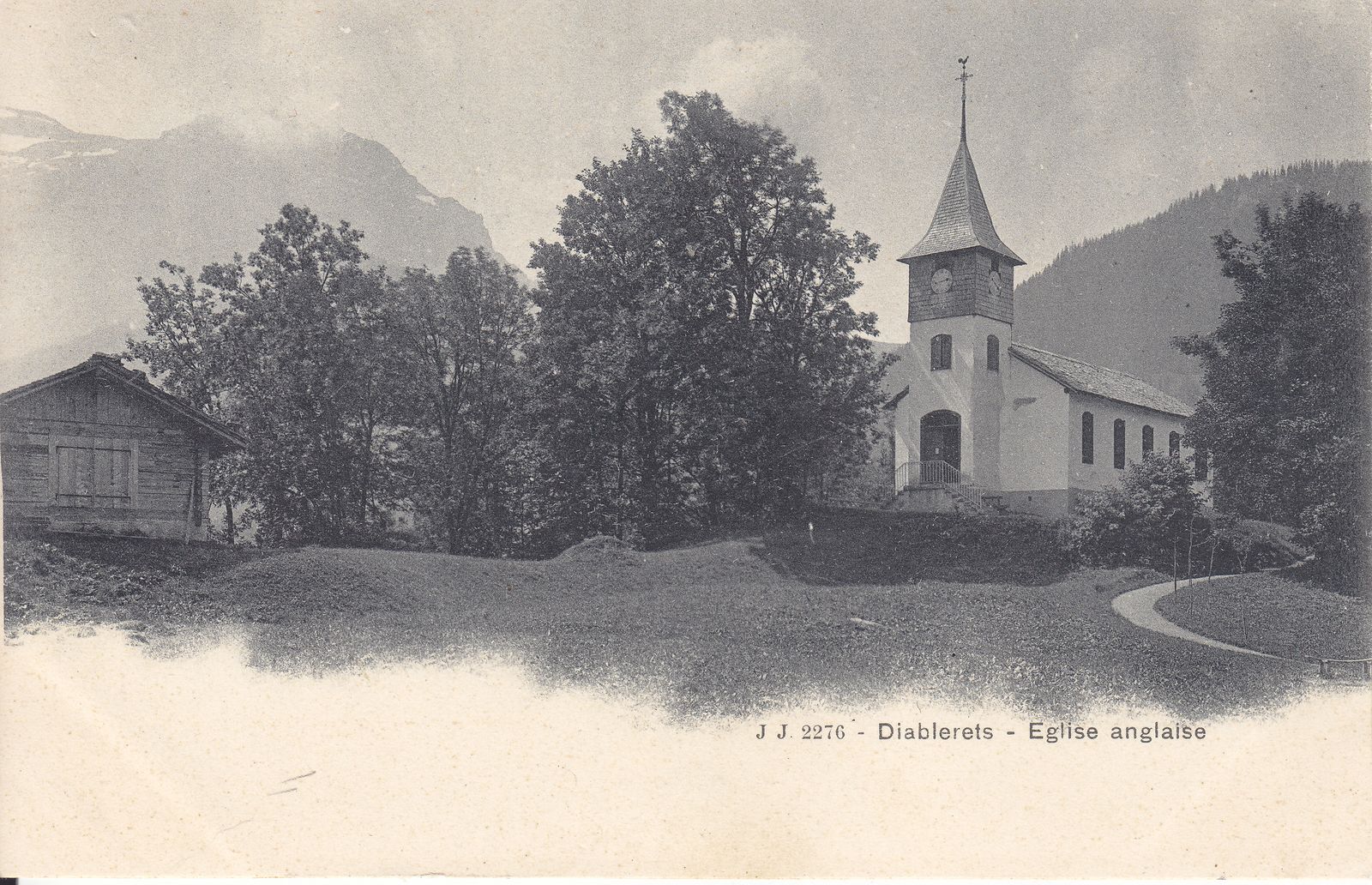
Les Diablerets lies at the head of the Vallée des Ormonts, where the valley ends under the glaciers of the mountain that gives the village its name. The English came for the summer, to walk and climb. The Grand-Hôtel des Diablerets advertised itself in London as a first-class house “situated at the foot of magnificent glaciers”.2 In the early 1880s the hotel built an English chapel on the slope above it.4
The chaplaincy at Les Diablerets is older than the church. A chaplaincy was a post abroad, filled by a clergyman sent out from home, and the Colonial and Continental Church Society put Les Diablerets on its list in 1866. Its first chaplain, the Revd G. Hale, came out in 1867. In August 1871 the Society’s chaplain there was the Revd D. T. Barry.3
A chapel for the hotel
The Grand-Hôtel built a chapel for Anglican worship, to meet the needs of a growing English clientele. A subscription among English visitors paid for a large part of the cost. The chapel was built in the early 1880s. A local history gives 1881, but the Society’s report of May 1884 counts Les Diablerets among the churches “built, or at least nearly completed during the past year”. A photograph of about 1890 shows it standing on the slope above the Grand-Hôtel.4
In 1893 the young société d’embellissement of Ormont-Dessus bought a clock from the town of Aigle and put it in the chapel’s little belfry. It had been made in 1754 for the church at Aigle by the clockmaker Abram Dupertuis. He was killed at the combat of the Pont de la Tine in 1798.5 That clock has since disappeared. A new mechanism replaced it in 1964.6
Summer chaplains
There was never a resident chaplain. The Society sent English and Irish parish clergy out for a fortnight or a month each summer, and they lodged in the hotel with the people they served. The Montreux visitors’ paper printed the guests of each hotel with their callings, and it names several of these chaplains in the 1890s. Others appear in English newspapers, down to a vicar from near Leeds in August 1913, and one of them moved on from here to Villars.7 This was the usual arrangement in the smaller resorts; how the societies staffed and paid for their chaplaincies is told in our guide to the English churches.
The Reformed parish used the chapel too. In July 1918 the Semeur vaudois reported a large congregation in “la chapelle anglaise, aux Diablerets” for a jubilee service with the parish’s pastor, Bornand.8
After the First World War the visitors came back. In August 1923 the Feuille d’avis de Montreux found the Grand-Hôtel looking as it had before the war, almost without an empty room. There were English, French, Belgian and Swiss guests, young people on excursions, at tennis and dancing the foxtrot. On Friday 17 August a “Grand Concert au profit de la Chapelle Anglaise des Diablerets” was held to mend its leaking roof.9 But the English chaplaincy was fading. In 1930 the Society listed Les Diablerets with the note “date when right of appointment claimed though no chaplaincy that year”.10
To the parish
As the British clientele dwindled, the Grand-Hôtel decided at the end of the Second World War to turn the chapel into a utility building. The parish did not want it to lose its purpose. On Sunday 18 March 1945, after the service at the temple of Vers-l’Église, the parish assembly met with the “Achat de la Chapelle anglaise des Diablerets” on its agenda. That year an extraordinary assembly of the parish, supported by the members of the Free Church, decided to buy it. The idea was to have at Les Diablerets a place of worship for both the National and the Free Church, as an annex of the temple at Vers-l’Église. The deed of sale was signed in 1946, for 6,000 francs.11
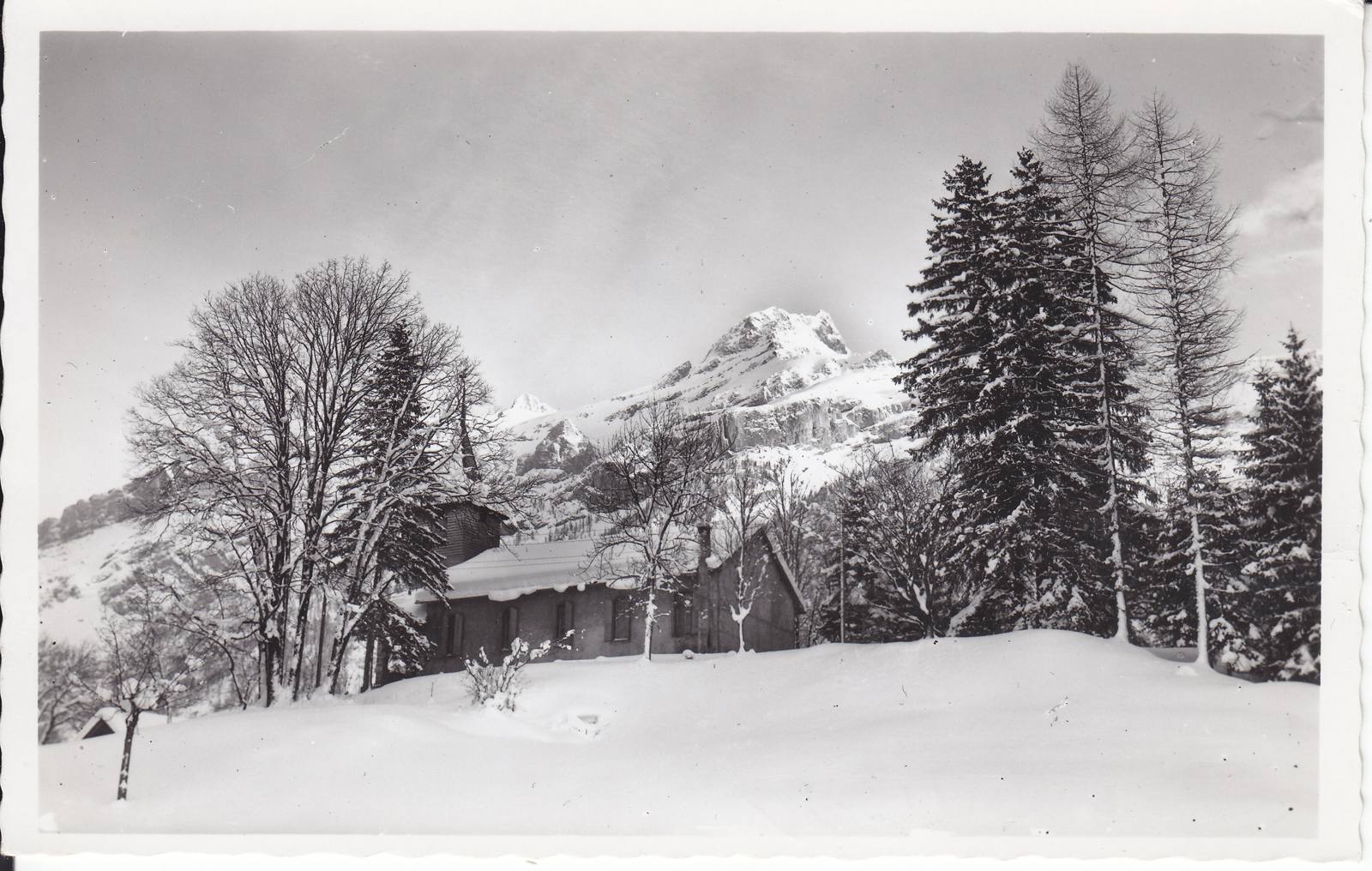
The parish put in electric light and improved the heating. It replaced the old entrance on the axis of the nave with a vestibule and a porch at the side. From 1947 the building served as a Reformed church, at first only for preaching, and from 1950 for Communion and baptism as well.12 In the 1960s the Revd Sidney Baggott, the chaplain at Leysin, still came over from time to time to hold Anglican services.13
By the 1970s the chapel was falling into ruin and had to be restored. On the first Sunday of February 1976 it was dedicated again. The mixed choir L’Avenir sang a spiritual and a song by Gilbert Bécaud. The parish council thanked Mme Combremont, its organist for nearly half a century, and the guests went down to the parish hall at Vers-l’Église for raclette.14
The local history of the Ormonts shows the building with a plain caption: “L’église anglaise, devenue église réformée après 1947”.15
We know little about the English congregation at Les Diablerets beyond the names of its summer chaplains. If you have memories, photographs or family papers from the Grand-Hôtel or its chapel, please write to us at info(a)stpeters.ch. The other English churches of Vaud are described in our guide to the English churches in Switzerland.
-
“Diablerets”, Daily Telegraph & Courier (London), 10 September 1897, p. 5 (British Newspaper Archive BL/0001112/18970910, art. 052), read on the page image. ↩
-
Advertisement, Illustrated London News, August 1885, p. 16. Whether the same advertisement offered an English service is not established. ↩
-
Paul W. Schniewind, Anglicans in Switzerland (Berne, 1992), p. 104; Sun and Central Press, 3 August 1871, p. 2 (BNA BL/0002261/18710803), read on the page image. ↩
-
Ormont-Dessous, Ormont-Dessus, La Vallée des Ormonts, p. 266, “L’Eglise anglaise”, and fig. 533 (“Vers 1890. L’église anglaise domine le Grand-Hôtel; la Villa des Sports n’existe pas encore”). The book’s author and date are not established, and only this one page has been consulted. The Society’s report: The Record, 9 May 1884, p. 31 (BNA BL/0006265/18840509, art. 062), read on the page image. Its reports of May 1883 and May 1885 do not mention Les Diablerets. ↩↩
-
Echo de la Montagne, 5 August 1897, p. 3 (Scriptorium item 656518), read on the page image: “Il fit en 1754 une fort belle horloge pour l’église d’Aigle (elle était plutôt au Bourg). Elle a été achetée en 1893 pour être placée à la chapelle anglaise des Diablerets par la Société d’embellissement d’Ormont-dessus.” The same story was retold in the Echo de la Montagne of 30 April 1987 (item 653774, OCR text). The Pont de la Tine and the date of Dupertuis’s death are from the Ormonts history, p. 266. ↩
-
Ormonts history, p. 266. ↩
-
Hollins: Journal et liste des étrangers de Montreux, de Vevey, 1 September 1894 (item 398141); Dolman: 4 September 1897 (item 398214); Crotty (“chaplain for July”) and Stoney (“Chaplain for Diablerets”): 30 July 1898 (item 397621) and following weeks; all read on the page image. Stubbs: Bristol Times and Mirror, 2 June 1896, p. 6. Crotty’s parish: The Record, 1 July 1898, p. 10, which names him for Diablerets that month. Plumptre: East Anglian Daily Times, 20 June 1907, p. 7. Stapleton: The Record, 1 August 1913, p. 730. All roster items read on the page image. A September 1912 roster naming C. Berney Hall is known only from a search snippet and is not used here. The chaplains named in these sources are: the Revd W. Hollins, “English Chaplain for Diablerets”, in September 1894; the Revd D. Holland Stubbs in June 1896; H. A. Dolman, “chaplain des Diablerets”, in September 1897; the Revd A. E. Crotty, rector of Moyliscar, who took the services in July 1898, and Canon Stoney, who stayed on as chaplain into September; the Revd C. P. Plumptre, rector of Woodham Ferrers, from 16 to 30 June 1907, before moving on to Villars; and the Revd H. Stapleton, vicar of Calverley near Leeds, in August 1913. ↩
-
Semeur vaudois, 27 July 1918, p. 2 (item 681293), OCR text only; the pastor’s forename and the nature of the jubilee have not been checked. The weekly service notices of the Echo de la Montagne list the “Chapelle anglaise” at Les Diablerets through the inter-war summers (for example item 609057, 24 August 1945); only the 1945 notice has been read. ↩
-
Feuille d’avis de Montreux, 17 August 1923, p. 2 (item 448576), read on the page image; the roof (“dont la toiture laisse passer l’eau”) from the OCR text of the next column. ↩
-
Schniewind, pp. 104–105, quoting the CCCS list. ↩
-
Ormonts history, p. 266; notice of the parish assembly, Echo de la Montagne, 13 March 1945, p. 2 (item 609096), read on the page image, repeated 16 March (item 609149). The Ormonts history says an “assemblée extraordinaire de paroisse, soutenue également par les Libristes, décida son achat en 1945”; whether that was the meeting of 18 March is not known. ↩
-
Ormonts history, p. 266. It dates a further renovation to about 1973–1974. ↩
-
Schniewind, p. 105, which gives the initials only, as “Revd S J Baggott”. The forename is from Aiglon College’s history of the church at Villars, which names “Canon Sidney Baggot” of Leysin. ↩
-
“Les Diablerets — Dédicace de la chapelle anglaise”, 24 Heures, 6 February 1976, p. 31 (item 10308), read on the page image. The first Sunday of February 1976 was the 1st. The architect named is M. Schlaeppi, and the pastor of the parish was M. Egloff. ↩
-
Ormonts history, p. 266, and fig. 534 (“L’église anglaise, devenue église réformée après 1947”). The chapel passed to the Reformed parish of the upper Ormonts; what use it is put to today has not been checked. ↩
Questions answered
- When was the English church at Les Diablerets built?
- The Grand-Hôtel at Les Diablerets built the chapel in the early 1880s, and a subscription among English visitors paid for a large part of the cost. A local history gives 1881. But the Colonial and Continental Church Society's report of May 1884 counts it among the churches “built, or at least nearly completed during the past year”. The chaplaincy is older than the building: the Society put Les Diablerets on its list in 1866, and its first chaplain, the Revd G. Hale, came out in 1867.
- What happened to the clock in the English church at Les Diablerets?
- In 1893 the société d’embellissement of Ormont-Dessus bought a clock from the town of Aigle and put it in the little belfry of the English chapel at Les Diablerets. It had been made in 1754 for the church at Aigle by the clockmaker Abram Dupertuis, who was killed at the combat of the Pont de la Tine in 1798. That clock has since disappeared, and a new mechanism replaced it in 1964.
- What happened to the English church at Les Diablerets?
- As the British clientele dwindled, the Grand-Hôtel decided at the end of the Second World War to turn the English chapel at Les Diablerets into a utility building. The Reformed parish did not want it to lose its purpose. The purchase was on the agenda of the parish assembly of 18 March 1945, and the deed of sale was signed in 1946, for 6,000 francs. From 1947 the building served as a Reformed church. After a restoration it was dedicated again on the first Sunday of February 1976.
- Who were the chaplains at Les Diablerets?
- Les Diablerets never had a resident chaplain. The Colonial and Continental Church Society sent English and Irish parish clergy out for a fortnight or a month each summer. They lodged in the hotel with the people they served. The first, in 1867, was the Revd G. Hale, and in August 1871 the Society's chaplain there was the Revd D. T. Barry. Several later chaplains are named in the Montreux visitors' paper in the 1890s and in English newspapers, down to a vicar from near Leeds in August 1913.