History of English Churches in Switzerland – Mürren
At the end of July 1878 the Berner Volksfreund passed on a piece of news from the Oberland. A new English church stood at Mürren, between the village’s two hotels. The architect Urfer of Interlaken had built it that spring for a society in London. It was to be consecrated, that is, formally set apart for worship, on 11 August. The paper expected many of the English tourists then in Switzerland to make their way up to the mountain village for the day.1 The church was never given a patron saint. St Ursula’s Church Magazine in Berne, which told its story in 2017, wrote that “for unknown reasons no patron saint was ever named”. It has always been simply “the English Church”.2
Visitors before the church
International travellers had found the Lauterbrunnen valley and Mürren, with its view of the mountains around the Jungfrau, long before the end of the century. The first hotel was built in 1857, and more hotels and guesthouses followed in the 1870s. Mürren did well even though it was hard to reach. Visitors faced a climb of two or three hours from the valley, unless they rode a horse or were carried up in a chair.3 Paul Schniewind, in his history of the Anglican chaplaincies, writes that Mürren was already fashionable by the end of the 1860s. In 1869 one tourist complained that it was “crowded in excess with English people”.4
Most of these English visitors came from the upper middle class, and they often stayed for several weeks. They expected Anglican services as a matter of course. In 1875 the Hotel des Alpes was advertising “English Divine Service at the Hotel” in a London paper.5 From 1872 the services were provided by the Society for the Propagation of the Gospel, the SPG. Schniewind records that Mürren was first placed on the Society’s list of chaplaincies that year.6
Street’s church
Soon a chapel was discussed. Money was collected in England, and the owner of one of the hotels made a piece of land available.7 The design came from George Edmund Street, the London architect famous for his Gothic Revival churches. Schniewind, who drew on the Society’s file for Mürren, records that Street agreed in 1876 to provide it. Street had visited Mürren in 1875, so he knew the place at first hand, and his design followed the local building tradition of stone and wood.8 Schniewind also quotes a resolution of the Society’s committee. The Society was to “be prepared to allow the villagers of Mürren, should they desire it, to use the Church at certain times, under such conditions as the Society may enjoin”.9
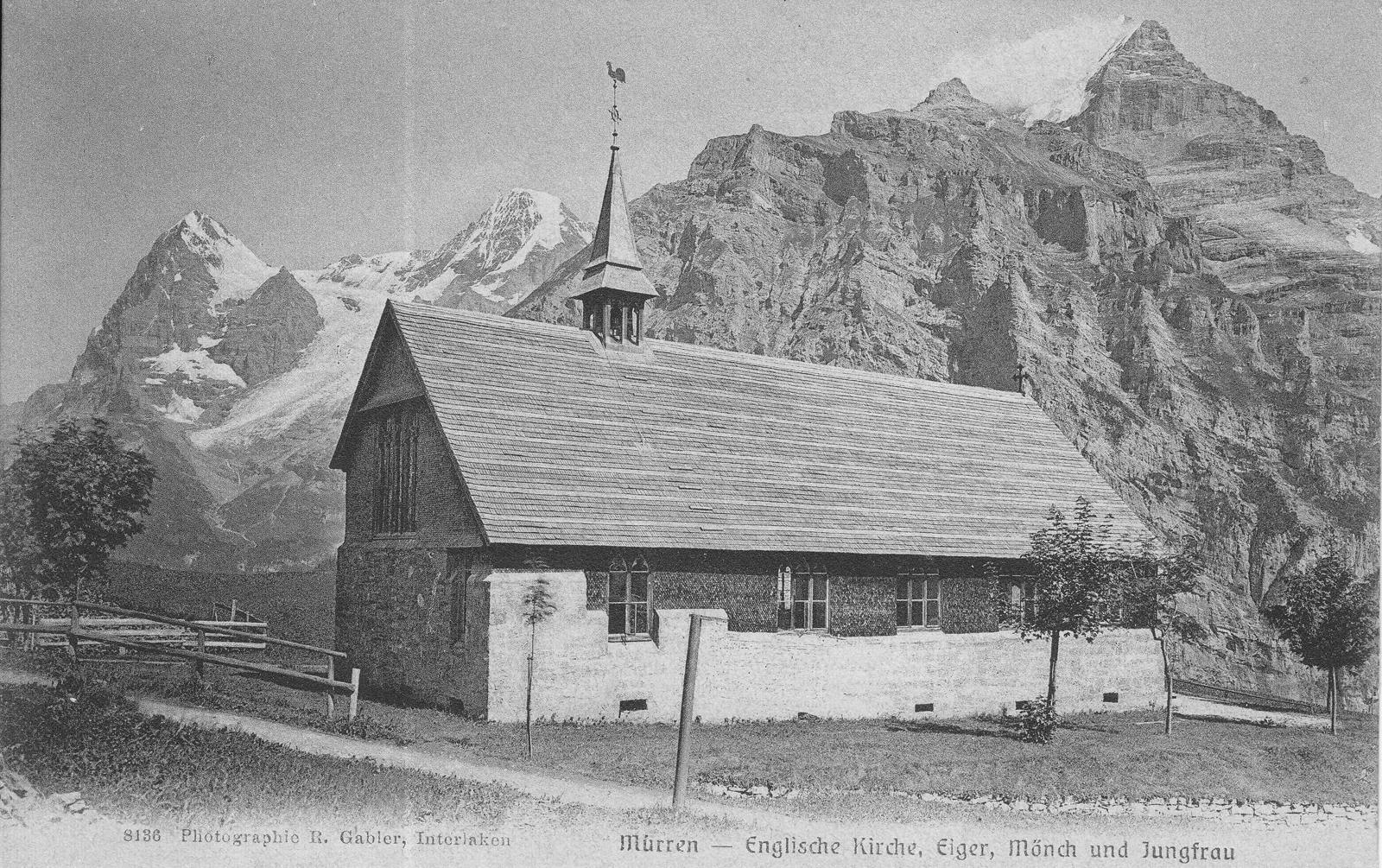
The church went up in the spring of 1878. Schniewind names the builder as “H. Ufer from Interlaken”, working to Street’s plans, but the Berner Volksfreund of that summer calls him “Architekt Urfer”. According to Schniewind the church cost £1,500. The SPG took charge of it and provided services in the summer season.10 A postcard by R. Gabler of Interlaken, probably from around 1900, is captioned “Mürren – Englische Kirche, Eiger, Mönch und Jungfrau”. It shows the church with a long, steep roof and a small spire, and the three mountains behind.11
Winter visitors and the war
The funicular and railway from Lauterbrunnen opened in 1891 and brought a new boom in hotels and tourists.12 The winter season came later. Schniewind writes that Henry Lunn opened Mürren as a winter sports resort in 1909, with a series of tours for members of the Public Schools Alpine Sports Club. St Ursula’s magazine says that the winter season was held up for years by a quarrel between the hotels and the railway owners. When it finally arrived, in 1910–11, it was an immediate success.13
Before long five of the ten hotels were fully booked for “an elite segment of British society”. These visitors soon left the hotel ice rinks for skis. At first they explored the country around Mürren in the cross-country style. Then, on the steep slopes, they learnt to slide downhill and to make turns, and in the magazine’s words “alpine skiing was born”. The local mountain guides saw a chance to earn money in winter. In 1912 they formed the Skiklub Mürren and offered themselves to the hotel guests as ski guides and instructors.14
The First World War brought the tourist trade to a halt, and then a different kind of British visitor. From 1916 sick and wounded British prisoners of war were interned in Switzerland, and Schniewind records four hundred wounded men at Mürren. Lord Northcliffe wrote about them for The Times at the end of August 1916. The men, he wrote, had “only arrived at Mürren last week”. He counted “between four and five hundred officers and men” of the Army, together with sailors, living “in the very lap of luxury”.15 The British were then “chiefly at two centres, Château d’Oex and Mürren”. Schniewind places Mürren, with Interlaken and Grindelwald, among the principal places of the “Région anglaise”, the British area of the internment.16 The hotels had stood empty, so the internees helped the local economy as well. Northcliffe thought them “a material boon to districts which have hitherto lived almost entirely on visitors”.17 Schniewind records that the SPG appointed a Mr Campbell-Bell to act as chaplain, and that the communicants’ kneeler in the church was made by the prisoners.18
One of the wounded men was Edward Varley. In 1917 he met and married Anna Huggler, who ran her family’s sports and souvenir shop for Mürren’s many foreign visitors. The Hugglers came from Brienz and Brienzwiler, villages known for their woodcarving. Edward was a Roman Catholic and Anna’s family were Protestant, “quite a hurdle in those days”. There is no record of the marriage in the English church, so the magazine concludes that it must have taken place at the registry office in Lauterbrunnen or Interlaken. After the war Edward stayed in Mürren, and the two of them ran the shop together.19
Between the wars
Mürren recovered quickly after the war, and St Ursula’s magazine puts this partly down to its early place in alpine skiing. The man most responsible was Sir Arnold Lunn, Henry Lunn’s son. He organised the first slalom race there, on Mürren’s nursery slopes, on 21 January 1922.20 In 1924 he founded the Kandahar Ski Club there to promote downhill racing. He also campaigned for alpine skiing to be included in the Winter Olympics, which it was at Garmisch-Partenkirchen in 1936. He started the first Alpine World Ski Championships, held at Mürren in 1931 and again in 1935, with downhill and slalom races for men and women.21
Lunn’s affection for the place is on record in a book about another of the English churches. He wrote the foreword to Zermatt Saga by Cicely Williams, the historian of St Peter’s, Zermatt. After praising the beauty of the Matterhorn country, he added that “the Bernese Oberland is for me what Zermatt is for Mrs Williams.”22 Schniewind records that between the wars the chaplaincy at Mürren opened regularly for both the summer and the winter seasons.23
After the Second World War
Schniewind also records that “after the war” the Hotel des Alpes came into the hands of Sir Henry Lunn’s widow, Lady Mabel Lunn. He does not say which war, and we have not established the date. The SPG then nominated the chaplains for the summer season, and Lunn those for the winter. A report for the Society after the Second World War said: “The chaplaincy at Mürren is one of the most important, especially in winter.”24
For many years the church was served by British clergy on holiday, mostly in the winter season. Chloë Varley, Edward’s granddaughter, remembers many Christmas and carol services there. One of these holiday clergy was George Reindorp, at the time Bishop of Guildford. Schniewind writes that Reindorp had a long connection with Mürren through the Kandahar Ski Club, and went out regularly for Christmas.25 In January 1970 he married Chloë Varley and Beat Hodler in the church. Both were long-standing members of St Ursula’s, Berne, and Beat’s grandparents had bought a chalet in Mürren in 1927. The reception was held at the new revolving restaurant on the Schilthorn, a few months after it opened. In his reply to the wedding invitation, Reindorp wrote that his family thought no wedding reception “since the world began had been held so near to heaven”.26
By the end of the 1970s the upkeep of the building had become too costly, and it needed renovation. In 1982 the USPG, as the Society had become, sold the church to the Swiss Reformed Church. Schniewind describes it as a transfer of ownership, with the right to use the church when required. When he wrote in 1992, relations with the Swiss pastor at Lauterbrunnen were very good, and Mürren continued as an Anglican winter chaplaincy. The church was carefully restored. In 2017 it was part of the Kirchgemeinde Lauterbrunnen, the Reformed parish, and a special clause in the contract allowed English visitors to go on using it.27
We would like to know more about the consecration of August 1878, about Mr Campbell-Bell and the chaplains to the internees, and about the chaplains between the wars. If you can help, please write to us at info(a)stpeters.ch. The other main centre for the British internees was Château-d’Œx, where our own church, St Peter’s, looked after them. The Public Schools Alpine Sports Club also opened Wengen to winter visitors, and its English church has its own page. The British winter clubs, whose programme for 1924–25 listed an Oxford and Cambridge ice hockey match at Mürren, are described in English clubs and the winter season. The other English churches are described in our guide to the English churches in Switzerland.
-
Berner Volksfreund, No. 91, 31 July 1878, p. 2, “Hotelwesen.” (e-newspaperarchives.ch BVO18780731-01.2.3.6.2), read on the page image: “Am 11. August nächsthin soll, wie „Oberland” mittheilt, die zwischen den beiden Hotels auf Mürren von Hrn Architekt Urfer in Interlaken in Auftrag einer Gesellschaft in London dieses Frühjahr erbaute englische Kirche feierlich eingeweiht werden.” (“On 11 August next, as the Oberland reports, the English church built this spring between the two hotels at Mürren by the architect Mr Urfer of Interlaken, on behalf of a society in London, is to be solemnly consecrated.”) It adds that many English tourists then staying in Switzerland would no doubt come up to “der majestätischen Bergstation”. The OCR text reads the name as “Urser”; the page image has “Urfer”. The same notice appeared in the Thuner Wochenblatt, 27 July 1878 (TWB18780727-01.2.3), which we have seen only as a search extract. The notice announces the consecration; it does not report it. A search of the British Newspaper Archive for July to October 1878 found no report of the service. ↩
-
Ruth Freiburghaus and Chloë Hodler, “Mürren and the Church without a Saint”, St Ursula’s Church Magazine (Berne), December 2017 – January 2018, pp. 8–11, here p. 9: “For unknown reasons no patron saint was ever named, it has always been “the English Church”.” Schniewind (note 4) names no saint either, and the postcard of about 1900 (note 11) calls the building “Englische Kirche”. ↩
-
St Ursula’s Church Magazine, p. 9. ↩
-
Paul W. Schniewind, Anglicans in Switzerland (Berne, 1992), p. 10. On p. 90 he writes that Mürren had been popular with British and American tourists since the middle of the nineteenth century. ↩
-
Advertisement for the Hôtel des Alpes, Mürren, Hour (London), June and July 1875, p. 8: “English Divine Service at the Hotel.—W. Gurter, Proprietor.” We have seen this only as a search extract. ↩
-
St Ursula’s Church Magazine, p. 9: “from 1872 these services were provided by the Society for the Propagation of the Gospel (SPG)”. Schniewind, p. 91: “Mürren was first placed on the SPG list in 1872.” The magazine may have taken its date from Schniewind. ↩
-
St Ursula’s Church Magazine, p. 9. The Berner Volksfreund of 1878 (note 1) says only that the church stood between the two hotels and was built for a society in London. It does not say who gave the land or how the money was raised. ↩
-
Schniewind, p. 91, citing the Society’s file on Mürren: “In 1876 the famous London architect, George Edmund Street, consented to furnish the design”. The year 1876 rests on Schniewind alone. St Ursula’s Church Magazine, p. 9, for the visit of 1875 and “the local building tradition of stone and wood constructions”. ↩
-
Schniewind, p. 91. His note gives the source as a meeting of the Society’s committee in 1876. We have not seen the minutes. ↩
-
Schniewind, p. 91: “The Chapel was erected in 1878 by H. Ufer from Interlaken according to the plans of Street. It cost £ 1,500.” The Berner Volksfreund, 31 July 1878 (note 1), read on the page image, has “von Hrn Architekt Urfer in Interlaken” and gives no initial. The paper calls Urfer the architect, while Schniewind has him building to Street’s plans; the two may both be right. St Ursula’s Church Magazine, p. 9: “The church was finished in 1878, it was in the charge of the SPG which provided services in the summer.” The cost rests on Schniewind alone. ↩
-
St Ursula’s Church Magazine, p. 8, which prints the card: “Postcard published by R. Gabler, Interlaken, probably around 1900.” The card itself is marked “Photographie R. Gabler, Interlaken”. The date is the magazine’s estimate. ↩
-
St Ursula’s Church Magazine, p. 9. The Times, 30 August 1916 (note 15), confirms that there was a railway up from Lauterbrunnen by then: “at Lauterbrunnen we take the steep mountain railway up”. ↩
-
Schniewind, p. 16. St Ursula’s Church Magazine, p. 9, for the quarrel and the date 1910–11, and for “Sir Henry Lunn with his Public School Alpine Sports Club”. The two sources differ on the year. Jim Ring, How the English Made the Alps (London, 2000), names Mürren among the resorts that the Public Schools Alpine Sports Club opened. We read Ring in the Faber ebook of 2011, which has Kindle locations instead of page numbers; this passage falls between locations 2173 and 2651. ↩
-
St Ursula’s Church Magazine, p. 9. ↩
-
Lord Northcliffe, “With our Prisoners. Life at Mürren. Alpine Luxury. A Suggestion.”, The Times, 30 August 1916, read on the page image: “The bluejackets, with between four and five hundred officers and men of his Majesty’s Army, are prisoners of war, interned here, and interned, I may say, in the very lap of luxury.” Schniewind, p. 91, gives 400. On p. 17 he gives 4,081 British internees in Switzerland between early 1916 and 11 November 1918. St Ursula’s Church Magazine, p. 8, has “several hundred other prisoners of war”. Northcliffe does not mention the church or a chaplain. ↩
-
The Times, 30 August 1916: “Unlike our men, who are at present chiefly at two centres, Château d’Oex and Mürren, the French are scattered in little companies throughout the Oberland.” Schniewind, p. 91, and p. 17, where he places the British internees “in the “région anglaise” in the Mürren-Interlaken-Grindelwald area as well as in Château d’Oex, Rougemont, Rossinière and Leysin”. The Times does not mention Interlaken or Grindelwald. ↩
-
St Ursula’s Church Magazine, p. 8: “Because of the war hotels were empty, so this helped the local economy, too.” The Times, 30 August 1916: “In a way, our internés constitute a material boon to districts which have hitherto lived almost entirely on visitors.” ↩
-
Schniewind, p. 91. We have found no other record of Mr Campbell-Bell. He is not in Crockford’s Clerical Directory for 1929 or 1949–50, and a search of the British press for May 1916 to December 1918 did not find him. The one chaplain to the Mürren internees we have found named was a Presbyterian, the Revd Donald Matheson: Forres Elgin and Nairn Gazette, 30 May 1917, p. 2, seen only as a search extract; and On the March, May 1917, p. 85 (British Newspaper Archive BL/0003278/19170501), read on the page image, where he “arrived from the camp at Murren” to speak at a meeting at Château-d’Œx. ↩
-
St Ursula’s Church Magazine, pp. 8–9: “The marriage must have taken place in the registry office of Lauterbrunnen or Interlaken as there is no record of it in the English church.” This is a family account: Chloë Hodler, one of the two writers, is Edward Varley’s granddaughter. ↩
-
Ring, between Kindle locations 3336 and 3357: “the slalom invented on Mürren’s nursery slopes, 21 January 1922”. St Ursula’s Church Magazine, p. 10: “He organised the first slalom race in Mürren in 1922”. ↩
-
St Ursula’s Church Magazine, p. 10. Schniewind, p. 90, calls Lunn “the founder of the Kandahar (K) Ski Club in Mürren”, without a date. For 1931, World Ski Book (1949; archive.org item bwb_S0-BXC-571), where Walter Prager recalls “Murren, Switzerland, 1931, date of the first FIS downhill”; the Usborne Book of Skiing (1986) agrees. The year 1924, the championships of 1935 and the Olympic games of 1936 rest on the magazine alone. ↩
-
Schniewind, pp. 90–91. His note cites the German edition, Williams’s Zermatt Geschichten, p. 8. We have not seen the foreword ourselves. ↩
-
Schniewind, p. 91. ↩
-
Schniewind, p. 91, citing the Dixon Report for both statements. He introduces the Lunn arrangement with the words “After the war” and places it before his sentence on the years between the wars. Elsewhere (p. 126) he dates the Dixon Report to 1949, and the arrangement speaks of Sir Henry’s widow. We have therefore placed it after the Second World War, but we have not established the date. ↩
-
St Ursula’s Church Magazine, p. 10. Crockford’s Clerical Directory 1961–62 records that George Edmund Reindorp was consecrated Bishop of Guildford on 25 March 1961, and the 1967–68 edition still lists him there. Schniewind, p. 91, for the Kandahar Ski Club and the Christmas visits. ↩
-
St Ursula’s Church Magazine, pp. 8 and 10–11: “In his reply to the wedding invitation he said the Reindorp family was of the opinion that no wedding reception since the world began had been held so near to heaven as that of the future Mr. and Mrs. Hodler.” The reception was at Piz Gloria, the restaurant at the top of the Schilthorn cableway. This too is a family account. ↩
-
Schniewind, p. 91: “In 1982 the ownership of the Mürren Chapel was transferred to the Swiss Reformed Church with the right to use it when required. The cooperation with the Swiss Pfarrer in Lauterbrunnen is very good and Mürren continues as Anglican winter chaplaincy.” St Ursula’s Church Magazine, p. 10, for the upkeep, the sale, the restoration and the clause in the contract. We have not checked the church’s present use. ↩
Questions answered
- Who designed the English church at Mürren?
- George Edmund Street, the London architect famous for his Gothic Revival churches. He had visited Mürren in 1875, and his design followed the local building tradition of stone and wood. The church was built in the spring of 1878 by the architect Urfer of Interlaken, whom Paul Schniewind's history calls H. Ufer. Schniewind gives the cost as £1,500.
- Why does the English church at Mürren have no patron saint?
- Nobody knows. St Ursula's Church Magazine wrote in 2017 that for unknown reasons no patron saint was ever named, and that the building has always been "the English Church".
- Were British soldiers interned at Mürren in the First World War?
- Yes. Schniewind records four hundred wounded British prisoners of war at Mürren. When Lord Northcliffe wrote about them in The Times on 30 August 1916, they had arrived the week before, and he counted between four and five hundred officers and men, together with sailors. He named Château-d'Œx and Mürren as the two main British centres. Schniewind records that the SPG appointed a Mr Campbell-Bell as chaplain, and that the prisoners made the communicants' kneeler in the church.
- What happened to the English church at Mürren?
- By the end of the 1970s its upkeep had become too costly and it needed renovation. In 1982 the USPG, as the Society had become, sold it to the Swiss Reformed Church, and it was carefully restored. In 2017 St Ursula's Church Magazine reported that it belonged to the Kirchgemeinde Lauterbrunnen, and that a clause in the contract allowed English visitors to go on using it.
- What is the connection between Mürren and alpine skiing?
- British winter visitors began skiing there before the First World War, and St Ursula's Church Magazine writes that alpine skiing was born on the steep slopes. The local guides formed the Skiklub Mürren in 1912. Sir Arnold Lunn organised the first slalom race at Mürren on 21 January 1922, founded the Kandahar Ski Club there in 1924, and started the first Alpine World Ski Championships, held at Mürren in 1931.