History of English Churches in Switzerland – Zermatt
On 14 July 1865, soon after midday, Edward Whymper’s party stood on the summit of the Matterhorn, the first people ever to do so. With him were the Revd Charles Hudson, Lord Francis Douglas and Douglas Hadow, and three guides: Michel Croz of Chamonix and Peter Taugwalder and his son, of Zermatt. On the way down, just above the shoulder, one of the party slipped and the rope broke. Hudson, Hadow, Douglas and Croz fell to their deaths down the north face.1 About a month earlier, a book had been opened at Zermatt to collect money for an English church. The church that followed, St Peter’s, was built partly as a memorial to the men who died that day. Hudson lies beneath its altar.2
Services in the hotels
The English had been coming to Zermatt for more than a decade by then. By the middle of the 1850s the Alps had become fashionable, and no place drew the mountaineers more than Zermatt. Cicely Williams, who wrote the church’s history, describes what they expected. The Victorian gentleman abroad liked to have his “accustomed comforts around him, more especially when the family was present”. One of these was divine worship: “full matins and evensong — the latter shortened if the mountains were in good condition!”3 Clergy were easy to find, since some of the best climbers of the day were parsons. Finding room for the congregation was harder. From 1858 services were held in the lounges of the Hotel Monte Rosa and the Hotel des Alpes. From 1862 rooms were set aside at the Monte Rosa and the Mont Cervin, and services moved between the two.4
The Colonial and Continental Church Society supplied the clergy. Paul Schniewind, in his history of the Anglican chaplaincies, says that Zermatt was placed on the Society’s list as a summer chaplaincy in 1857. The earliest list we have found is from the summer of 1864. It names four clergymen who took the duty at Zermatt in turn, “Hotels alternately”.5 Schniewind also records that Dr Miller of the Society came out from London in July 1864 to discuss building a church.6 By May 1865 the first plans had been drawn. As a first step the Society bought a site from the two leading hoteliers of the village, Joseph Clemenz of the Mont Cervin and Alexander Seiler of the Monte Rosa.7
Early in the climbing season of 1865 a contributions book was opened, and the first names in it were Seiler’s and Clemenz’s. The Walliser Bote later recalled that both men were said to be Catholics. The first page announced “an eligible site … nearly west of the Hotel Mont Cervin”. Subscriptions could be paid to either hotelier or to the Society’s offices in Fleet Street, London. The two men carried weight well beyond Zermatt. Clemenz was President of the Grand Council of the Valais and sat in the Federal Assembly, and Seiler was a captain in the Swiss army. The book had been open for about a month when the Matterhorn party set out.8
The Matterhorn, July 1865
At three o’clock that afternoon a boy ran into the Monte Rosa to say that an avalanche had fallen from the Matterhorn. Seiler had already told his guests that the party had been seen on the summit, and he scolded the boy for spreading alarming rumours. The next day Whymper reached the hotel. When Seiler asked him what had happened, he said only: “The Taugwalders and I have returned.”9
The chaplain at Zermatt in July 1865 was the Revd Joseph M’Cormick. He wrote to The Times that the search party had first buried the three bodies where they lay, under the Matterhorn. The place was dangerous and hard to reach. The Swiss government then ordered that they be brought down. On 19 July twenty-one men of Zermatt carried them to the village.10 Croz, Hudson and Hadow were buried in the village churchyard. The body of Lord Francis Douglas was never found.11
Hudson was the vicar of Skillington in Lincolnshire from 1860, and a famous climber. He had served as a chaplain in the Crimea in 1854–56.12 In 1855 he and others had climbed Mont Blanc without guides, and he wrote a book about it. Schniewind adds that in the same year he climbed the Klein Matterhorn and the Breithorn without a guide, and that he spent his honeymoon at Zermatt in 1862.13 The accident was news across Europe. The press called mountaineering absurd, and Queen Victoria is said to have asked whether such a dangerous pastime could not be stopped by law.14
The accident did not end the plans for a church. It gave them a purpose. Ten days afterwards two young English climbers and two British tourists each gave ten francs. On 28 July the Marquess of Queensberry, head of Lord Francis Douglas’s family, sent £50, and on 21 August the parents of Douglas Hadow sent a gift of their own.15 Zermatt had a lean season or two after the accident. Williams notes that Baedeker’s guide of 1868 said of the Matterhorn only: “Has been climbed once — no tariff”. By 1869, however, the village and the mountain were back in favour.16
The church is built
The foundation stone was laid on St Peter’s Day, 29 June 1869, before a large number of English and American visitors. Building went on through the autumn until the November snows stopped it, and began again in April.17 The church was opened for its first service in June 1870. Cicely Williams and Schniewind give St Peter’s Day, 29 June, exactly a year after the stone was laid.18
It was dedicated on Sunday 6 August 1871 by Edward Parry, Suffragan Bishop of Dover. A suffragan bishop is an assistant bishop within a diocese. The Swiss Times printed a full account of the day, and English papers reprinted it.19 At eleven o’clock the Bishop walked in procession through the burial ground to the church door. With him were four clergymen and four laymen, who stood for the English and American visitors. At the door the Revd Francis Moran, assistant secretary of the Society, read the petition asking the Bishop of London to dedicate the church. Then the Bishop of London’s commission to Parry was read. Clergy and people went up the church reading Psalm 24. A lady staying in the village led the singing.20 Parry preached on Psalm 75, and he reminded the congregation that the debt had to be paid off. It came to more than £600, partly because of the extra cost of building on so awkward a site. A collection that day raised £28. The whole bill for land, architect, furniture and building came to £1,575.21 The church was built under the Society’s care and held in its trust. Parry dedicated it to St Peter, because it had first been opened on St Peter’s Day.22
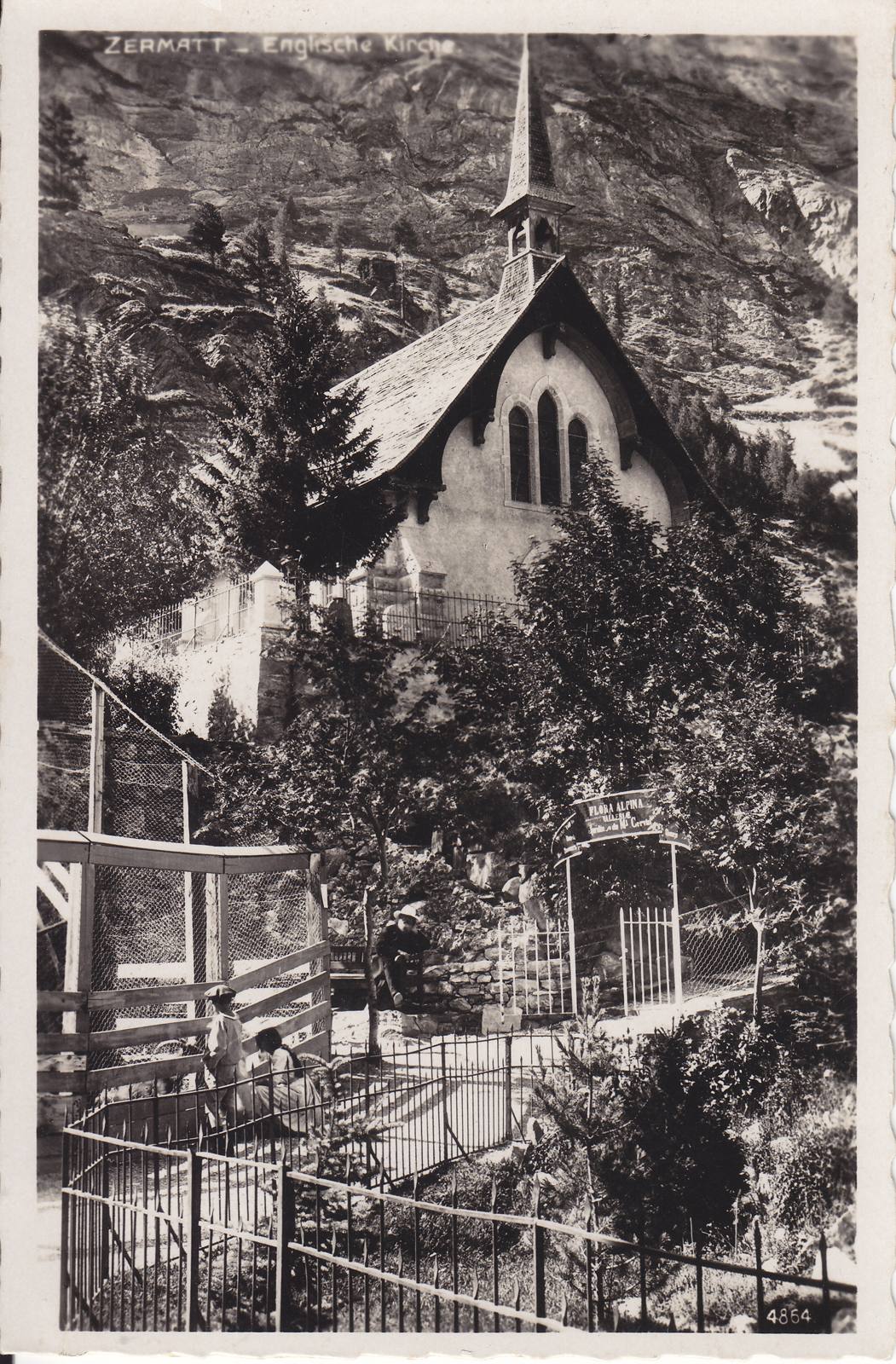
The parish church of the Alpine Club
In the 1870s the visitors were still mostly mountaineers, and the church soon became known in climbing circles as “the parish church of the Alpine Club”. Schniewind thought it the only church in the Swiss Alps that could claim that title.23 Among the climbers who stayed at the Monte Rosa in those years, Williams names W. A. B. Coolidge, Sir Martin Conway, Sir Leslie Stephen and Lucy Walker, the first woman to climb the Matterhorn. In 1894 the young Winston Churchill came too. According to L. S. Amery, he insisted on climbing Monte Rosa because it was the highest summit in Switzerland.24
The church now had a small churchyard of its own, where climbers who died in the mountains could be buried. Visitors to it most often remark on the grave of Edward Broome, a member of the Alpine Club. It carries two lines from Romeo and Juliet: “Night’s candles are burnt out / And jocund day stands tiptoe on the misty mountain tops.”25 Memorial plaques to people bound up with Zermatt and its mountains gradually filled the walls inside.26 In 1913 Charles Hudson himself was brought into the church. He had lain for forty-eight years in the village churchyard. On 13 July, the day before the anniversary of his death, his remains were buried again beneath the altar.27 The church also keeps the service book he had used as an army chaplain in the Crimea. His family gave it to the church, and it is still used on special occasions.28
The early chaplains’ registers survive in the church, and they show the visitors changing. The Society’s lists show the chaplains changing, often from month to month, each a clergyman from England.29 In August 1895 Canon Bardsley noticed “the increased number of clergy and High School teachers who travel”. He added that “the absence of gold on the first three Sundays was in contrast to ‘the old days’”. Even so, he found the general level of giving “higher than I have known it elsewhere”.30 Schniewind records that the church had to be enlarged in 1898 because of the growing congregations, and that it was closed during the First World War.31
Between the wars
Repairs were always needed in such a climate. Schniewind writes that the Society in London could not pay for them in the 1920s, so the church’s friends stepped in. In 1925 members and friends of the Alpine Club gave the church a new roof, and a plaque inside records the gift. In the same year Charles Hudson’s daughter gave new altar rails in memory of her father.32 At the end of the 1920s Zermatt opened for the first time in winter, and a new kind of visitor arrived with skis.33
After the Second World War
After the war Zermatt became a leading ski resort, and British and American visitors asked for the church to open at Christmas. Heating it was the problem. It was officially opened for winter services on 23 December 1953. Electric radiators were installed in 1959, and from then on there were chaplains in charge from Christmas until Easter.34
In summer the church was shared. Swiss Protestants now came to Zermatt in large numbers, and French- and German-speaking Swiss chaplaincies were set up for them. It was agreed that their chaplains could hold services in St Peter’s. Schniewind credits the arrangement to Ronald Williams, who looked after the church for part of every August after the war. He was then Principal of St John’s College, Durham, and became Bishop of Leicester in 1953. He was also a member of the Alpine Club.35 For some years the three chaplains held an evening Epilogue at about nine o’clock on Sundays. Each read from the Bible, prayed and gave a short address in his own language, and each congregation chose a hymn from its own book. Williams recalls that the church was packed to the doors.36
The chaplains were on good terms with the Catholic village. The skier and mountain guide Bernard Perren, for years the best downhill racer in the Swiss national team, was killed in a lorry accident in the late summer of 1960. It happened near the building site at Schönbühl. Schniewind records that Bishop Williams walked, robed, in the funeral procession.37 In March 1963 typhoid broke out in Zermatt, and the Swiss government closed the village. Many of the sick were British. They were housed in the village school, which had been turned into a hospital. Father Franz Fux, the Catholic priest of Zermatt, visited them regularly.38
Two centenaries
In 1957 the Alpine Club kept its centenary, and it chose Zermatt for the gathering. Its president that year was Sir John Hunt, who came with most of the team that had climbed Everest. On the Sunday a crowded service was held in St Peter’s. The Holy Table was decorated with alpine flowers, and before it lay an ice axe and a rope that had been used on the Matterhorn. Hunt read one of the lessons.39
On 14 July 1965, a hundred years after the first ascent, Zermatt was full of climbers from many countries. Among the guests of honour were Hudson’s grandchildren and a nephew, a nephew of Hadow, and Whymper’s daughter. In the morning the priests of Zermatt said an open-air mass in the village square, and the Bishop of Leicester preached. In the evening a procession walked from the Hotel Mont Cervin to St Peter’s, where Hunt was to lay a wreath on the Holy Table above Hudson’s grave. Their Zermatt friends came with them, and the church was full. The Revd Frank Food, the chaplain, took the service.40 In Lincolnshire that month, Skillington held its own service for its vicar who had died on the Matterhorn, and the Bishop of Leicester came to preach there too.41
A hundred years and more
The church kept its own centenary in 1970. For it, Cicely Williams, the Bishop’s wife, wrote the history on which much of this page draws. After the war she noticed something about the visitors who did not go to church at home. Many were “so surprised to find an English church that they decide instantly that they must attend a service”. To judge by the letters that came afterwards, “not a few who began their churchgoing in Zermatt have continued it at home”.42
In the village the church is known simply as the Tempel. It was renovated in 1997 and 2000. St Peter’s kept its 140th anniversary in June 2010. David Healey of the Intercontinental Church Society, as the Colonial and Continental had become, gave a talk on the evening before. The Society still sends out the clergy, priests from England who take the ministry in turn, two weeks at a time. As well as Sunday services, they take baptisms and weddings.43
We would like to know more about the chaplains of St Peter’s before 1914, and about the enlargement of 1898. If you can help, please write to us at info(a)stpeters.ch. Other English churches in the Valais are described on our pages for Belalp and Arolla. How the English came to the Alps in the first place is told in The English experience of the Alps. The other English churches are described in our guide to the English churches in Switzerland.
-
Cicely Williams, A Church in the Alps: a century of Zermatt and the English (6th edition, reprinted by St Peter’s Church, Zermatt, 2006), pp. 14–15. The date is confirmed by the Grantham Journal, 23 July 1965, p. 13 (British Newspaper Archive BL/0000400/19650723), read on the page image. The account of the dedication printed in 1871 (note 19) dates the ascent to “Thursday, July 13, 1865”, which is a slip. ↩
-
Williams, pp. 13–14 and 28, for the contributions book and the memorial purpose. The report of the dedication in 1871 (note 19) says that the church was built “partly as a memorial of the first English travellers who mounted the Matterhorn”, and that “Before the accident a proposal had been made to erect an English church, but the proposal now took a definite form”. ↩
-
Williams, pp. 11–12. The exclamation mark is hers. ↩
-
Williams, pp. 12–13. Schniewind (note 5) gives 1858 and the Monte Rosa and the Hotel des Alpes. The Walliser Bote, 12 July 2010, p. 9 (e-newspaperarchives.ch WAB20100712-01.2.9.9), gives 1862 and the Monte Rosa and the Mont Cervin. Williams describes both, one after the other. ↩
-
Paul W. Schniewind, Anglicans in Switzerland (Berne, 1992), p. 86. The Record, 27 July 1864, p. 1 (BNA BL/0006265/18640727), read on the page image: “Zermatt—Hotels alternately—Rev. T. E. Hodgson, M.A., late Curate of St. James’s, Dover; Rev. J. S. Howson, D.D., Principal of Liverpool College; Rev. J. Kirkman, M.A., Incumbent of St. John’s, Hampstead; Rev. J. Hayes, M.A., Coalbrookdale.” A search of the British press from 1855 to 1864 found nothing for Zermatt on the Society’s list in 1857. ↩
-
Schniewind, pp. 86–87, citing Brian Underwood, Faith at the Frontiers (London, 1974), p. 57, which we have not seen. ↩
-
Walliser Bote, 12 July 2010, for May 1865; Williams, p. 13, for the site. Williams spells the name “Clementz”. ↩
-
Williams, pp. 13–14; Walliser Bote, 12 July 2010: “wie es heisst «obschon beide katholisch waren»” (“as it is said, ‘although both were Catholic’”). The full notice on the first page reads: “An eligible site has been selected for an English Church, nearly west of the Hotel Mont Cervin. Subscriptions will be thankfully received by M. Seiler, Hotel Monte Rosa, or by M. Clementz, Hotel Mont Cervin, or at the offices of the Colonial and Continental Church Society, 9 Serjeants’ Inn, Fleet Street, London.” ↩
-
Williams, p. 15. Whymper had parted from the two Taugwalders at the entrance to the village. ↩
-
Elgin Courier, 4 August 1865, p. 2 (BNA BL/0000457/18650804), read on the page image: “The Rev. Joseph M’Cormick, chaplain at Zermatt, writes to the Times:—‘I mentioned to you in a previous letter that we buried the bodies of Messrs Hudson, Hadow, and Croz, the guide, where we found them, under the Matterhorn, because of their state, the danger of the place and the difficulty of the way to it. Since then, an order came from the Swiss Government that they were to be brought down to Zermatt.’” One reprint gives his forename as James. Williams, p. 15, for 19 July and the twenty-one men. Paul Schniewind, p. 87, calls Hudson “since 1864 the first chaplain to Zermatt”, but the Society’s list for 1864 (note 5) names four other clergymen, and Venn (note 12) records no post at Zermatt. Hudson may still have taken services there as a visitor. ↩
-
Williams, p. 15, who notes the gravestones of Croz, Hudson and Hadow on the east side of the churchyard. Hudson’s remains were later moved into the English church (note 27). Der Oberwalliser, 19 July 1935 (e-newspaperarchives.ch OBE19350719-01.2.12), read on the page image, says that Hadow’s remains were later taken to England. We have not confirmed that. ↩
-
J. A. Venn, Alumni Cantabrigienses, Hudson entry, lists his posts as chaplain in the Crimea 1854–56, curate of St Mary’s, Bridgnorth, 1856–57, and vicar of Skillington 1860–65, with no post at Zermatt. The Grantham Journal, 23 July 1965, p. 13, calls him “Vicar of the parish from 1860 until he met his death”. ↩
-
Venn (note 12): “Famous Alpine climber who, with others, ascended Mont Blanc without guides in 1855. Author, Ascent of Mont Blanc and Monte Rosa without Guides.” Schniewind, p. 87, for the Klein Matterhorn, the Breithorn and the honeymoon, citing Wraight and Williams’s Zermatt Geschichten, neither of which we have seen. ↩
-
Williams, pp. 15–17: “Queen Victoria even enquired whether such a perilous pastime could not be stopped by law.” ↩
-
Williams, p. 17. The Walliser Bote, 12 July 2010, also names Queensberry and Hadow’s relatives among the large donors. ↩
-
Williams, p. 17. ↩
-
Williams, p. 17. The report of the dedication in 1871 (note 19): “on St. Peter’s Day, 1869, in presence of a large number of English and American visitors, the first stone was laid”. ↩
-
Williams, p. 17; Schniewind, p. 87. The Walliser Bote, 12 July 2010, gives 6 June 1870. We have found no report of the first service in the British or Swiss press of 1870. ↩
-
“Opening of the English Church at Zermatt”, Langport & Somerton Herald, 19 August 1871, p. 6 (BNA BL/0004316/18710819), read on the page image, reprinting the Swiss Times. The same report appeared in several other English papers that week. The Society’s list for August 1871 had announced that the Bishop “will consecrate the Zermatt Church on Sunday, August 6”: Sun and Central Press, 3 August 1871, p. 2 (BNA BL/0002261/18710803). The 1871 report itself calls the service a dedication. Parry had been made Suffragan Bishop of Dover in 1870. ↩
-
Langport & Somerton Herald, 19 August 1871. The clergy were the Revd W. Hower of Swingfield, Dover, the Revd C. Hebert of Lowestoft, the Revd G. J. Payne of Drumbeg, Belfast, and the Revd J. Moran. The laymen were Messrs Dod, Lex, Clayton and Wagner. The report gives the secretary’s name as “the Rev. Francis J. C. Moran”. Williams, p. 19, says the lady played the harmonium. ↩
-
Langport & Somerton Herald, 19 August 1871, for the debt, “a sum exceeding £600”, and the collection. The report prints the text as “Psalm 75th, 21st verse”; Williams, p. 19, gives the first verse, “Unto Thee O God, do we give thanks”. Williams, p. 19, for the total of £1,575, which the Walliser Bote of 2010 repeats. ↩
-
Langport & Somerton Herald, 19 August 1871: “the Colonial and Continental Church Society, under the auspices of which society the church has been built, and in whose trust it is now vested”. Williams, p. 19, for the name. ↩
-
Williams, p. 21: “it was not long before it became known throughout climbing circles as ‘the parish church of the Alpine Club’”. Schniewind, p. 87. ↩
-
Williams, p. 21. She writes that the English church “was very much their church”. ↩
-
Williams, p. 27. ↩
-
Williams, p. 27. In 1883 the chaplain, Dr Chadwick, wrote about a memorial in the church to William Gabbett (Dublin Daily Express, 4 August 1883, p. 6), and in 1900 the Dean of Norwich was to place an epitaph there to Mrs Baring-Gould (West Kent Argus, 17 July 1900, p. 5). We have seen these two only as search extracts. ↩
-
Venn (note 12): “his remains, after being for 48 years in the village churchyard at Zermatt, were on July 13, 1913, re-buried beneath the altar of the English Church.” Williams, p. 21, and the Walliser Bote, 12 July 2010, record the move without a date. We have not found a report of it in the press of 1913. ↩
-
Williams, p. 21. The Walliser Bote, 12 July 2010, adds that the church also has Hudson’s Bible. ↩
-
The Society’s lists name, among others, the Revd W. H. Barlow in August 1871 (Sun and Central Press, 3 August 1871), the Revd C. E. Storrs in August 1892 (The Record, 5 August 1892, p. 18), the Revd G. E. Gardner in June 1896 (Bristol Times and Mirror, 2 June 1896, p. 6), the Revd T. C. Des Barres in July 1898 (The Record, 1 July 1898, p. 10), and the Revd F. G. Goddard and the Revd W. Carey Ward in the summer of 1913 (London Evening Standard, 3 July 1913, p. 11; The Record, 1 August 1913, p. 730). ↩
-
Williams, p. 24, quoting the register. Williams calls him “Canon Bardsley, Vicar of Haddingfield”, as the booklet prints it. He was probably the Canon Bardsley, vicar of Huddersfield, who took the services at Interlaken for the Society in August 1892 (The Record, 5 August 1892), but we have not proved it. ↩
-
Schniewind, p. 88. A search of the British press for 1895–1901 found no report of an enlargement. ↩
-
Schniewind, p. 88; Williams, pp. 28 and 30. The plaque reads: “Members and friends of the Alpine Club gave a new roof to this church in 1925.” ↩
-
Schniewind, p. 88, gives 1928. Williams, p. 37, gives 1929: “As far back as 1929 the Visp-Zermatt railway was opened in winter as far as the Riffelalp and the first winter sports season was held in that year.” ↩
-
Williams, p. 37. The church stayed open until 11 January 1954 that first winter. ↩
-
Williams, pp. 33, 38 and 40; Schniewind, p. 88. Crockford’s Clerical Directory 1967–68 records that Ronald Ralph Williams was Principal of St John’s College, Durham, from 1945 to 1953, and was consecrated Bishop of Leicester on 28 October 1953. The Grantham Journal, 23 July 1965, p. 13, says that he had “served over some years the summer chaplaincy of the English church at Zermatt”. ↩
-
Williams, p. 35. She places it “about this time”, after her account of 1949. ↩
-
Walliser Bote, 2 September 1960 (e-newspaperarchives.ch WAB19600902-01.2.8), OCR text: “bei einem Lastwagenunfall in der Nähe der Schönbühlbaustelle … Bernard Perren war während Jahren der beste Abfahrer der Schweizer Skinationalmannschaft”. The death notice in the Walliser Volksfreund of the same day (WVF19600902-01.2.16) and the family’s thanks in the Walliser Nachrichten of 6 September 1960 (WNB19600906-01.2.17) agree. Schniewind, p. 88, places the death in “the summer of 1961” and calls Perren an Olympic skier. His source for the funeral is Williams’s Zermatt Geschichten, which we have not seen. ↩
-
Williams, p. 39. The outbreak and the English cases were reported in the Swiss press that March, for example “Acht Engländer an Typhus erkrankt”, Der Bund, 18 March 1963 (e-newspaperarchives.ch DBB19630318-01.2.30.7.2). We have seen only the headlines. ↩
-
Williams, p. 38. ↩
-
Williams, p. 40. The guests of honour also included a nephew and niece of Whymper and his granddaughter. ↩
-
Grantham Journal, 23 July 1965, p. 13. ↩
-
Williams, pp. 41–43. Sir John Hunt’s foreword to her history is dated 29 June 1970. Williams died in 1985. ↩
-
Walliser Bote, 12 July 2010: “Die aus England stammenden Geistlichen wechseln sich in der Seelsorge alle zwei Wochen ab.” The paper places the anniversary services on “Sonntag, 26. Juni”, but 26 June 2010 was a Saturday, so we give only the month. Williams, pp. 44 and 47–48, for the volunteer chaplains, the weddings and baptisms, and the major repairs completed in 2000. ↩
Questions answered
- Why is there an English church in Zermatt?
- Because of the mountaineers. English climbers came to Zermatt in large numbers from the 1850s, and services were held in the hotels before there was a church. In 1864 the Colonial and Continental Church Society's list shows four clergymen taking turns at Zermatt, in the hotels alternately. Money for an English church was already being collected when the Matterhorn accident happened in July 1865. Afterwards the church was built partly as a memorial to those who died.
- Who is buried in the English church at Zermatt?
- The Revd Charles Hudson, who was killed on the way down from the first ascent of the Matterhorn on 14 July 1865. He was first buried in the village churchyard. According to the Cambridge alumni register, his remains were moved on 13 July 1913 and buried again beneath the altar of the English church. The church also keeps the service book he used as an army chaplain in the Crimean War.
- Was Charles Hudson the first chaplain of Zermatt?
- Paul Schniewind's history calls Hudson Zermatt's first chaplain, appointed in 1864, but the records do not bear this out. The Colonial and Continental Church Society's list for the summer of 1864 names four other clergymen for Zermatt. In July 1865 the chaplain at Zermatt was the Revd Joseph M'Cormick. Hudson was the vicar of Skillington in Lincolnshire from 1860 until his death.
- When was St Peter's Church, Zermatt built?
- The foundation stone was laid on St Peter's Day, 29 June 1869, before a large number of English and American visitors. The church was opened for services in June 1870. It was dedicated on Sunday 6 August 1871 by Edward Parry, Suffragan Bishop of Dover. Land, architect, furniture and building together cost £1,575.
- Why is St Peter's Zermatt called the parish church of the Alpine Club?
- Because the climbers made it their own. Cicely Williams, the church's historian, writes that it soon became known throughout climbing circles as 'the parish church of the Alpine Club'. Members and friends of the Alpine Club gave the church a new roof in 1925, and a plaque inside records the gift.
- Who paid for the English church at Zermatt?
- The first names in the contributions book, opened in 1865, were the hotel pioneers Alexander Seiler and Joseph Clemenz, who also sold the Society its site. After the Matterhorn accident the Marquess of Queensberry, head of Lord Francis Douglas's family, sent £50, and the parents of Douglas Hadow followed. At the dedication in 1871 more than £600 was still owed.