History of English Churches in Switzerland – Wengen
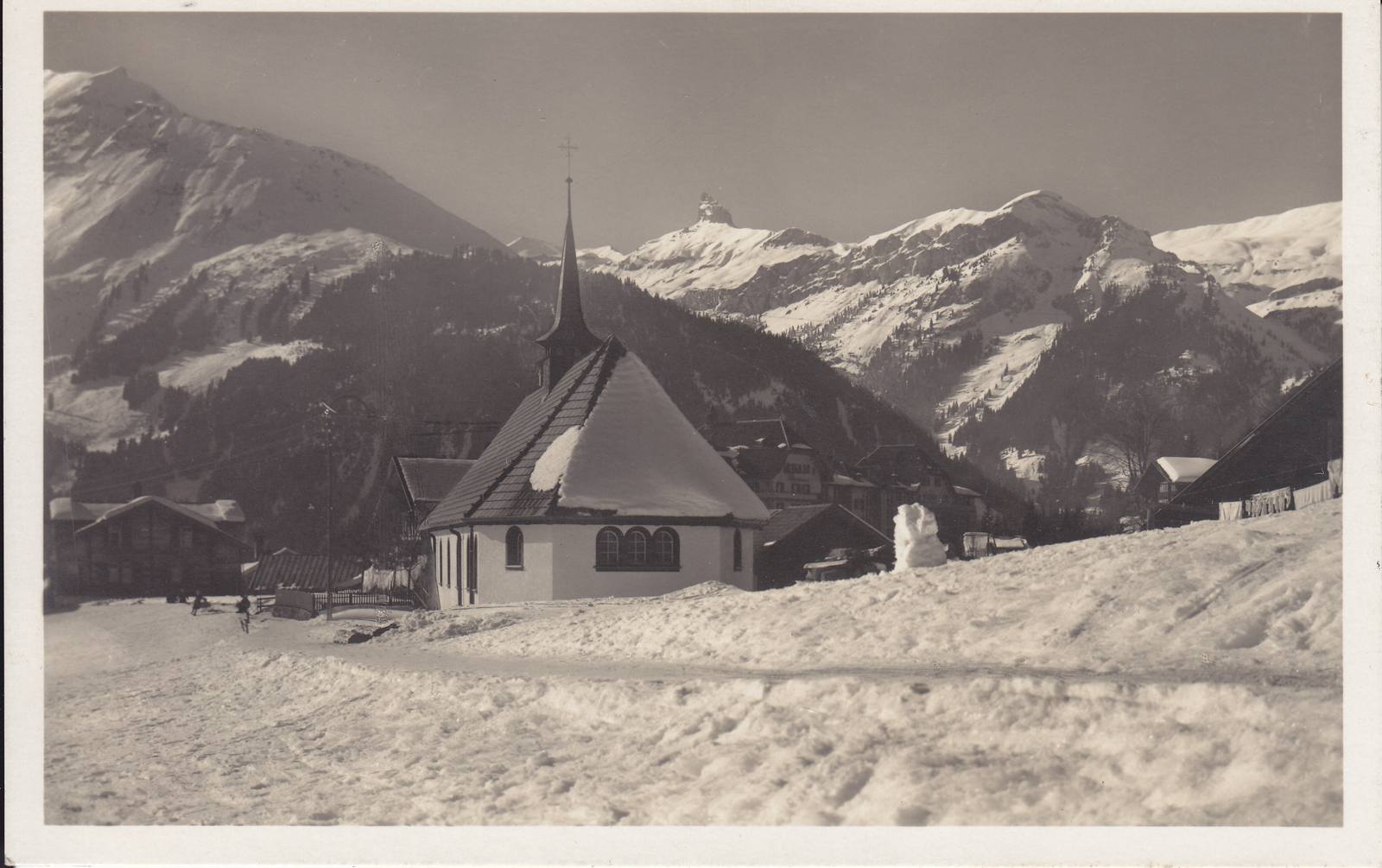
On Sunday 15 January 1928 the Bishop of Fulham, Dr Basil Staunton Batty, came to Wengen to dedicate a new English church. Ten days later the Daily Mirror printed two photographs. One showed the bishop “knocking with his pastoral staff for admission to the new Church of St. Bernard”. The other showed the building from outside: “The new church, erected for the benefit of English and American visitors.”1 The West Middlesex Gazette had announced the visit the day before. It said the church was “greatly needed owing to the large [num]bers of English visitors”.2 The Bishop of Fulham was an assistant bishop. He looked after the Anglican chaplaincies of northern and central Europe for the Bishop of London, and Batty had held the post since 1926.3 The Intercontinental Church Society, which built the church and still runs it, records that some 200 people heard him preach that day on Genesis 28:17.4
Services in the hotels
The English had come to Wengen long before that. Paul Schniewind, in his history of the Anglican chaplaincies, begins his account with Lord Byron. He records that Byron was inspired to write the dramatic poem Manfred on a visit to the Wengernalp in 1816. Ever since, he writes, countless English-speaking tourists have come to see the Jungfrau from the Wengernalp, and Wengen has remained one of the principal attractions of the Bernese Oberland.5
The clergy came from the Colonial and Continental Church Society, which sent chaplains from England to the resorts for the summer. Schniewind records that Wengen was placed on the Society’s list in 1880, and the Wengernalp in 1884. The earliest list we have found with Wengen on it is from August 1892, when the Revd J. Kirkman, vicar of St Stephen’s, Hampstead, went out to “Wengen Alp”. The lists of 1898 and 1913 also name clergymen for Wengen.6 There was no church for them to use. Until one was built, the Society held its services in the hotels.7
A church for the winter visitors
In time the English began to come in winter as well. Jim Ring, in his history of the English in the Alps, counts Wengen among the resorts that the Public Schools Alpine Sports Club opened to winter visitors, along with Mürren.8 The Society’s own history links its decision to build a permanent church to the growth in visitors that followed the opening of “the Ski, Curling and Down Hill Only clubs”. It bought land for the church from Herr Ulrich Fuchs-Lauener in 1915, during the First World War.9
The first design was never built. The Society is not certain who drew the plans. “We think that the architect who designed the Park Hotel also drew up plans for the church in 1923 (these can still be seen in the Park Hotel).” It goes on: “However, his design was considered too costly, so the present timber-framed building was constructed, funded by donations.” The Society records that the church was built in 1927, and it was ready for the bishop the following January.10
The church is dedicated to St Bernard. The Society describes him as “an 11th century saint, famous originally for his hospitality”. It adds that he desired “that many may know and understand the saving work of Jesus Christ on the Cross”. The passes on the Swiss–Italian border are named after him. The church seats over 120 people.11
Later years
In the early 1950s the Swiss Protestant congregation helped to update it, and the Society adds that they “also used St. Bernard’s whilst their new church was being constructed”. The building underwent major repair and refurbishment again between 2002 and 2006.12
By 1992 the Colonial and Continental had become the Intercontinental Church Society. Writing that year, Schniewind described Wengen as a summer and winter chaplaincy of the Society, with services at St Bernard’s English Church.13 The Society’s guide of 2015 describes the same pattern. Services were held twice each Sunday in the winter and summer seasons, and the chaplains were volunteers who normally spent two weeks in the resort. The church is part of the Church of England’s Diocese in Europe, whose bishop licenses the chaplains.14 In 2003 the church kept its 75th anniversary. At the service the lectern Bible was dedicated, given in memory of Dorothy Lawless of Knutsford, a lifelong supporter of the Society.15
We would like to know more about the chaplains who served Wengen before 1914, the hotels where they held their services, and the building of the church in 1927. If you can help, please write to us at info(a)stpeters.ch. For services today, see the Intercontinental Church Society’s page for St Bernard’s, Wengen. Wengen’s ski races and the English winter clubs are described in English clubs and the winter season. Zermatt is another church of the same Society, where in 2010 the chaplains also came out for two weeks at a time. The other English churches are described in our guide to the English churches in Switzerland.
-
Daily Mirror, Wednesday 25 January 1928, p. 11 (British Newspaper Archive BL/0000560/19280125, art. 111), read on the page image. The first caption reads in full: “WENGEN’S ENGLISH CHURCH.—The Bishop of Fulham (Dr. B. S. Batty) knocking with his pastoral staff for admission to the new Church of St. Bernard, which he dedicated at Wengen, Switzerland.” The second is under the photograph of the exterior. ↩
-
West Middlesex Gazette, Saturday 14 January 1928, p. 9 (BNA BL/0002564/19280114, art. 127), read on the page image. The right edge of the column is cut off, and the letters in square brackets are completed from the archive’s index text: “The Bishop of Fulham, Ang[lican] Bishop for North and Central Eu[rope] will consecrate the new Anglican ch[urch] at Wengen to-morrow.” The paper says “consecrate”; the Daily Mirror and the Intercontinental Church Society (note 4) say “dedicated”. The Society’s guide gives the same date, 15 January 1928. We have found no report of the day in the Swiss press. ↩
-
Crockford’s Clerical Directory 1929, Fulham entry: “Cons. Ld Bp Suffr. of Fulham in Westmr. Abbey 25 March, 1926”. The list of suffragan sees in Crockford’s 1961–62 gives “1926 Basil Staunton Batty (res. 1946)”. Paul W. Schniewind, Anglicans in Switzerland (Berne, 1992), p. 19, explains that the Bishop of Fulham was the suffragan appointed by the Bishop of London to administer “the Jurisdiction in Northern and Central Europe” on his behalf. Schniewind, p. 79, records that “the new Bishop of Fulham” visited Château-d’Œx in 1928 as well. The history of All Saints, Vevey, repeats that passage almost word for word. ↩
-
Intercontinental Church Society, “A brief history”, in its Wengen Visitor Guide (2015): “The church was built in 1927 and dedicated on 15 January 1928 by the Bishop of Fulham. Some 200 listened to his sermon on Genesis 28:17.” The guide also says that the church “was built by ICS, an Anglican mission agency, who continue to maintain and staff it”. ↩
-
Schniewind, p. 92. He writes that Byron wrote the poem “while on a visit to” the Wengernalp. Jim Ring, How the English Made the Alps (London: John Murray, 2000), places Byron at Geneva in the summer of 1816. We have not traced the visit to the Wengernalp to a first-hand account. ↩
-
Schniewind, pp. 92 and 121. The Society’s lists: The Record, 5 August 1892, p. 18 (BNA BL/0006265/18920805, art. 098), read on the page image: “Kirkman, the Rev. J., Vicar of St. Stephen’s, Hampstead; to Wengen Alp.” The Record, 1 July 1898, p. 10 (BNA BL/0006265/18980701), read on the page image: “A. V. W. Carden, V. St. Andrew’s, Hastings, to Wengen; J. G. Watson, Asso. Sec. C.M.S., to Kl. Scheidegg Wengernalp”. London Evening Standard, 3 July 1913, p. 11 (BNA BL/0000183/19130703, art. 266), read on the page image: “Wengen, Rev. R. French”. The Record, 1 August 1913, p. 730 (BNA BL/0006265/19130801, art. 092), read on the page image: Canon Dawson of St Mary’s, Edinburgh, for Wengen, and the Revd G. H. Lancaster for the Kleine Scheidegg. Wengen does not appear on the Society’s list for August 1871 (Sun and Central Press, 3 August 1871, p. 2, BNA BL/0002261/18710803) or for June 1896 (Bristol Times and Mirror, 2 June 1896, p. 6, BNA BL/0000984/18960602). The years 1880 and 1884 rest on Schniewind alone. ↩
-
Intercontinental Church Society, Wengen Visitor Guide: “To cater for people’s spiritual needs ICS (then the Colonial and Continental Church Society) held church services in hotels.” The guide does not say which hotels, or when the services began. ↩
-
Ring, How the English Made the Alps, Kindle locations 2173–2651 of the Faber ebook (2011), which has no page numbers. Schniewind, p. 16, records that Henry Lunn organised winter tours for members of the Public Schools Alpine Sports Club, and that in this way he opened Mürren as a winter resort in 1909. ↩
-
Intercontinental Church Society, Wengen Visitor Guide: “As visitor numbers increased following the opening of the Ski, Curling and Down Hill Only clubs, ICS decided to build a permanent church and acquired land from Herr Ulrich Fuchs-Lauener in 1915.” The guide places the opening of the clubs before the purchase of the land. We have not checked when each club was founded, so we tie the clubs to the decision to build and not to the date of the land. ↩
-
Intercontinental Church Society, Wengen Visitor Guide. The attribution to the Park Hotel’s architect is the Society’s own guess (“We think”), and we have not found another source for the design of 1923. ↩
-
Intercontinental Church Society, Wengen Visitor Guide. The Daily Mirror of 25 January 1928 (note 1) already calls it “the new Church of St. Bernard”. ↩
-
Intercontinental Church Society, Wengen Visitor Guide: “The church became well used and, in the early 1950s, the Swiss Protestant congregation (who also used St. Bernard’s whilst their new church was being constructed) helped update it. It again underwent major repair and refurbishment between 2002 and 2006.” ↩
-
Schniewind, p. 92: “Wengen is a summer and winter chaplaincy of the Intercontinental Church Society (ICS). Services are held at St Bernard’s English Church.” On p. 31 he names Zermatt, Interlaken, Wengen and Lucerne as the chaplaincies staffed by the Society, and in his Zermatt section he gives about 10,000 worshippers at the four in the season of 1990–91. ↩
-
Intercontinental Church Society, Wengen Visitor Guide: “All our ‘seasonal chaplains’ are volunteers who normally spend two weeks serving in the resort.” The guide describes the church as it was in 2015. ↩
-
Intercontinental Church Society, Wengen Visitor Guide: the Bible “was given in memory of Dorothy Lawless, a lifelong and faithful supporter of ICS from Knutsford (UK). It was dedicated in 2003 at the church’s 75th Anniversary Service.” ↩
Questions answered
- When was St Bernard's Church, Wengen, built?
- The Intercontinental Church Society, which built the church and still runs it, records that it was built in 1927. It was dedicated on Sunday 15 January 1928 by the Bishop of Fulham, Dr Basil Staunton Batty, and English papers reported the event. The Society records that some 200 people heard him preach on Genesis 28:17. The land had been bought from Herr Ulrich Fuchs-Lauener in 1915.
- Why did Wengen need an English church so late?
- Before the church was built, the Colonial and Continental Church Society held its services at Wengen in the hotels. Paul Schniewind records that Wengen was placed on the Society's list in 1880, and the Wengernalp in 1884. The Society's own history links its decision to build a permanent church to the growth in visitors after the ski, curling and Down Hill Only clubs opened. An English paper of January 1928 said that the church was greatly needed because of the large numbers of English visitors.
- Who designed St Bernard's, Wengen?
- The Intercontinental Church Society thinks that the architect of the Park Hotel drew up plans for a church in 1923, and says that the plans can still be seen in the Park Hotel. His design was considered too costly. The church that was built instead is a timber-framed building, paid for by donations. It seats over 120 people.
- Who is St Bernard, the patron of the church at Wengen?
- The Intercontinental Church Society describes him as "an 11th century saint, famous originally for his hospitality and desire that many may know and understand the saving work of Jesus Christ on the Cross". It adds that the passes on the Swiss–Italian border are named after him. The church already bore his name when it was dedicated in 1928.
- What is Wengen's connection with Byron?
- Paul Schniewind opens his account of Wengen with it. He records that Lord Byron was inspired to write the dramatic poem Manfred on a visit to the Wengernalp in 1816, and that countless English-speaking tourists have come since to see the Jungfrau from there.