Soldiers at Château d'Oex — The Times, 17 August 1916
The Times, 17 August 1916. One of St Peter’s First World War documents, from the years when British prisoners of war were interned at Château-d’Œx, 1916–17. Transcribed in full from a cutting made available by The Times Archive.
In this report: the chaplain’s appeal to readers for £300, on top of the £40 already in hand, to buy an organ for the church at Château-d’Œx as a memorial to the interned men.
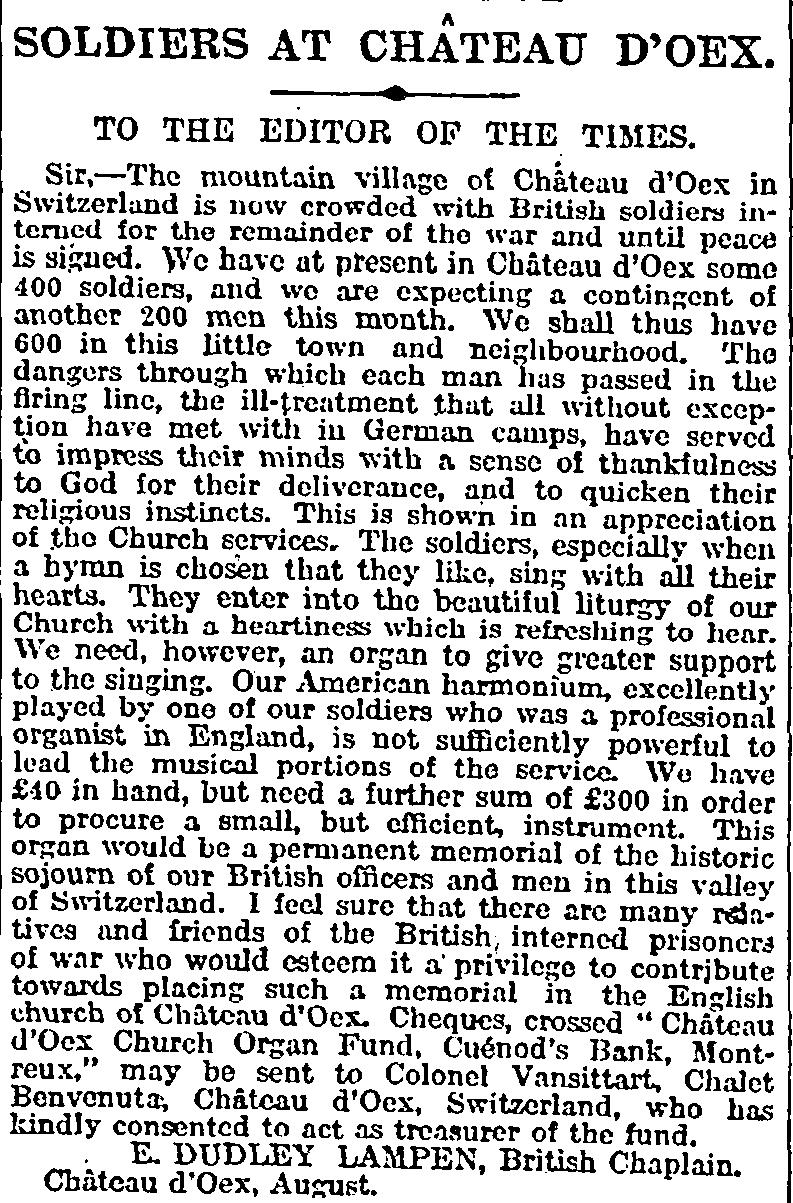
Sir,—The mountain village of Château d’Oex in Switzerland is now crowded with British soldiers interned for the remainder of the war and until peace is signed. We have at present in Château d’Oex some [?]00 soldiers, and we are expecting a contingent of another 200 men this month. We shall thus have [?]00 in this little town and neighbourhood. The dangers through which each man has passed in the firing line, the ill-treatment that all without exception have met with in German camps, have served to impress their minds with a sense of thankfulness to God for their deliverance, and to quicken their religious instincts. This is shown in an appreciation of the Church services. The soldiers, especially when a hymn is chosen that they like, sing with all their hearts. They enter into the beautiful liturgy of our Church with a heartiness which is refreshing to hear. We need, however, an organ to give greater support to the singing. Our American harmonium, excellently played by one of our soldiers who was a professional organist in England, is not sufficiently powerful to lead the musical portions of the service. We have £40 in hand, but need a further sum of £300 in order to procure a small, but efficient, instrument. This organ would be a permanent memorial of the historic sojourn of our British officers and men in this valley of Switzerland. I feel sure that there are many relatives and friends of the British, interned prisoners of war who would esteem it a privilege to contribute towards placing such a memorial in the English Church of Château d’Oex. Cheques, crossed “Château d’Oex Church Organ Fund, Cuénod’s Bank, Montreux,” may be sent to Colonel Vansittart, Chalet Benvenuta, Château d’Oex, Switzerland, who has kindly consented to act as treasurer of the fund.
Facsimile — The Times, 17 August 1916, page 9. Scanned by the News UK Archive & Record Office and supplied to St Peter's in April 2016. Reproduced with acknowledgement to Times Newspapers Limited. Open the full-size scan.
End of the transcribed document
Questions answered
Why did St Peter’s Château-d’Œx need an organ in 1916?
In a letter to The Times of 17 August 1916, the British Chaplain E. Dudley Lampen wrote that the interned soldiers, “especially when a hymn is chosen that they like, sing with all their hearts”, but that “our American harmonium, excellently played by one of our soldiers who was a professional organist in England, is not sufficiently powerful to lead the musical portions of the service.”
How much money did the organ appeal ask for?
Lampen wrote: “We have £40 in hand, but need a further sum of £300 in order to procure a small, but efficient, instrument.” Cheques crossed “Château d’Oex Church Organ Fund, Cuénod’s Bank, Montreux” were to be sent to Colonel Vansittart, Chalet Benvenuta, Château d’Oex, who had consented to act as treasurer of the fund.
What was the organ intended to commemorate?
Lampen wrote that the organ “would be a permanent memorial of the historic sojourn of our British officers and men in this valley of Switzerland”, and that many relatives and friends of the interned prisoners “would esteem it a privilege to contribute towards placing such a memorial in the English Church of Château d’Oex.” Note that the two troop figures in this letter are not recoverable from the surviving scan; only “another 200 men this month” is legible with certainty.