Why did a British soldier write to his fiancée from Château-d'Œx in 1916?
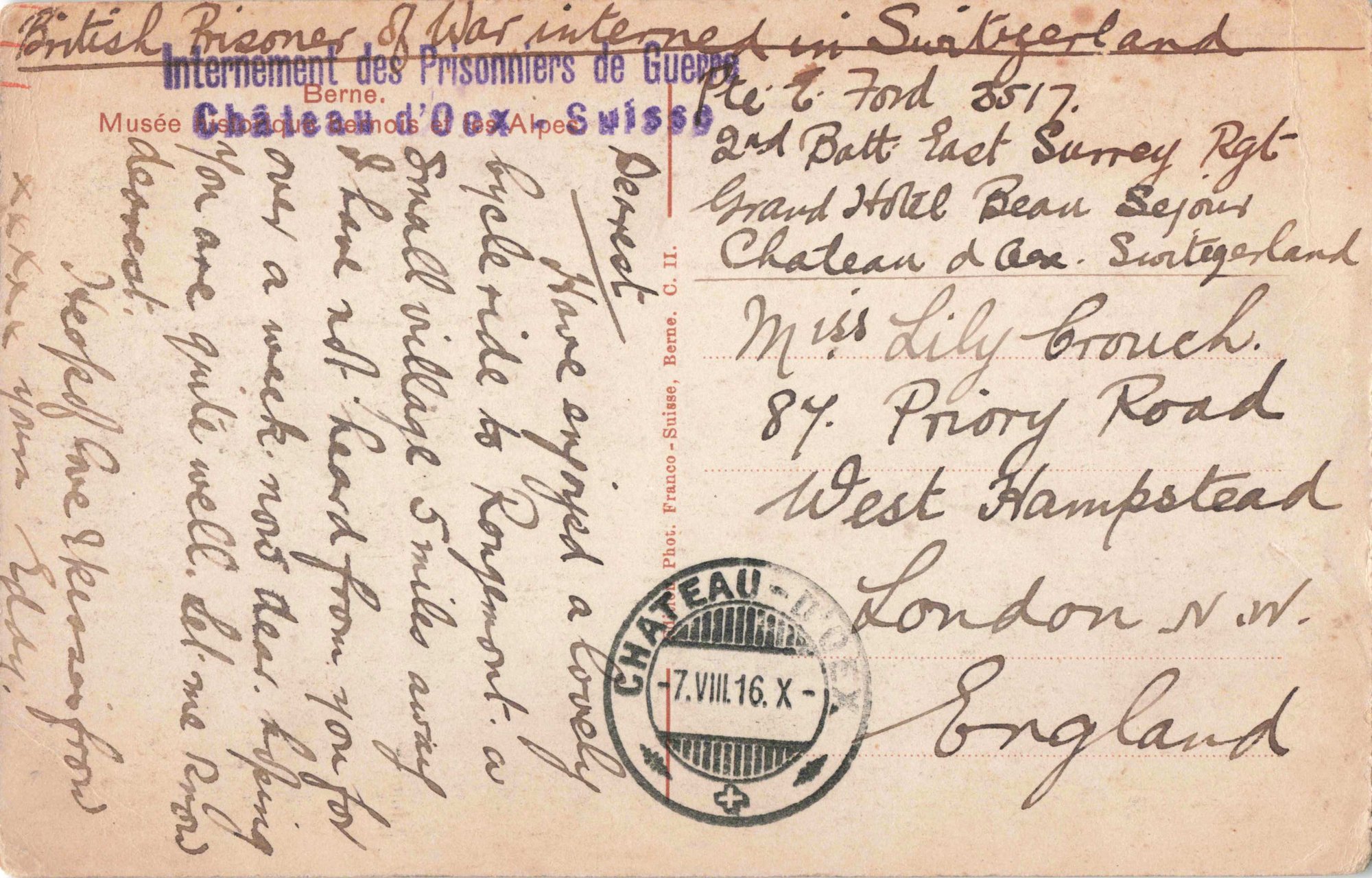
Look at the back of this postcard. The handwriting is careful, the stamp mark reads Château-d’Œx, 7.VIII.16, and the message is about a bicycle ride. It was written by a British soldier who was, at that moment, still technically a prisoner of war.
His name was Edward Ford, and almost everything we know about him we know because his grandson drove here from Essex in August 2026 and put fourteen of his postcards on a table in this church.
Edward
He was Pte Edward Ford, 3517, of the 2nd Battalion, East Surrey Regiment — “Eddy” to Lily Crouch of 87 Priory Road, West Hampstead, who was his fiancée and would become his wife. His battalion had been in India when the war began, and landed in France in January 1915. That spring it was in the fighting around Ypres, where the German army first used chlorine gas against British troops. The family believes that is where he was gassed. His grandson is careful about it: “I assumed it was 1915.”
Chlorine does not kill cleanly. A sergeant who survived it described it as “a flooding of the lungs — it is an equivalent death to drowning only on dry land.” Men who lived through it often never got their breath back.
He was taken prisoner. Where, and when, we do not know.
One official record of him survives. The National Archives catalogue lists his Medal Index Card — East Surrey Regiment, regimental number 3517, private (WO 372/7/107905). That number is the one he wrote at the head of every postcard he sent home.
The village that took them in
In 1916 the warring governments agreed to move sick and wounded prisoners out of German camps into neutral Switzerland. Château-d’Œx, whose hotels stood empty because the war had killed the tourist trade, was given the British.
The first train reached Zurich on the evening of 30 May 1916 with 304 men aboard, 32 of them officers; a second convoy of 150 arrived, as The Times put it, “24 hours after the first”. Its correspondent counted “450 odd now lodged (and most comfortably lodged) in the various hotels and pensions of the village, all within five minutes’ walk of each other.” Eddy was among them within days; his own hand puts his address at the Grand Hôtel Beau Séjour.
The village was delighted with them. By the following Sunday their arrival was showing at the Cinéma Luna, top of a seven-part bill — Arrivée des internés anglais à Château-d’Œx, billed as an Actualité, above the President of the Republic and General Joffre receiving King George V and the Prince of Wales, and a Max Linder comedy. Seventy centimes in the cheap seats.
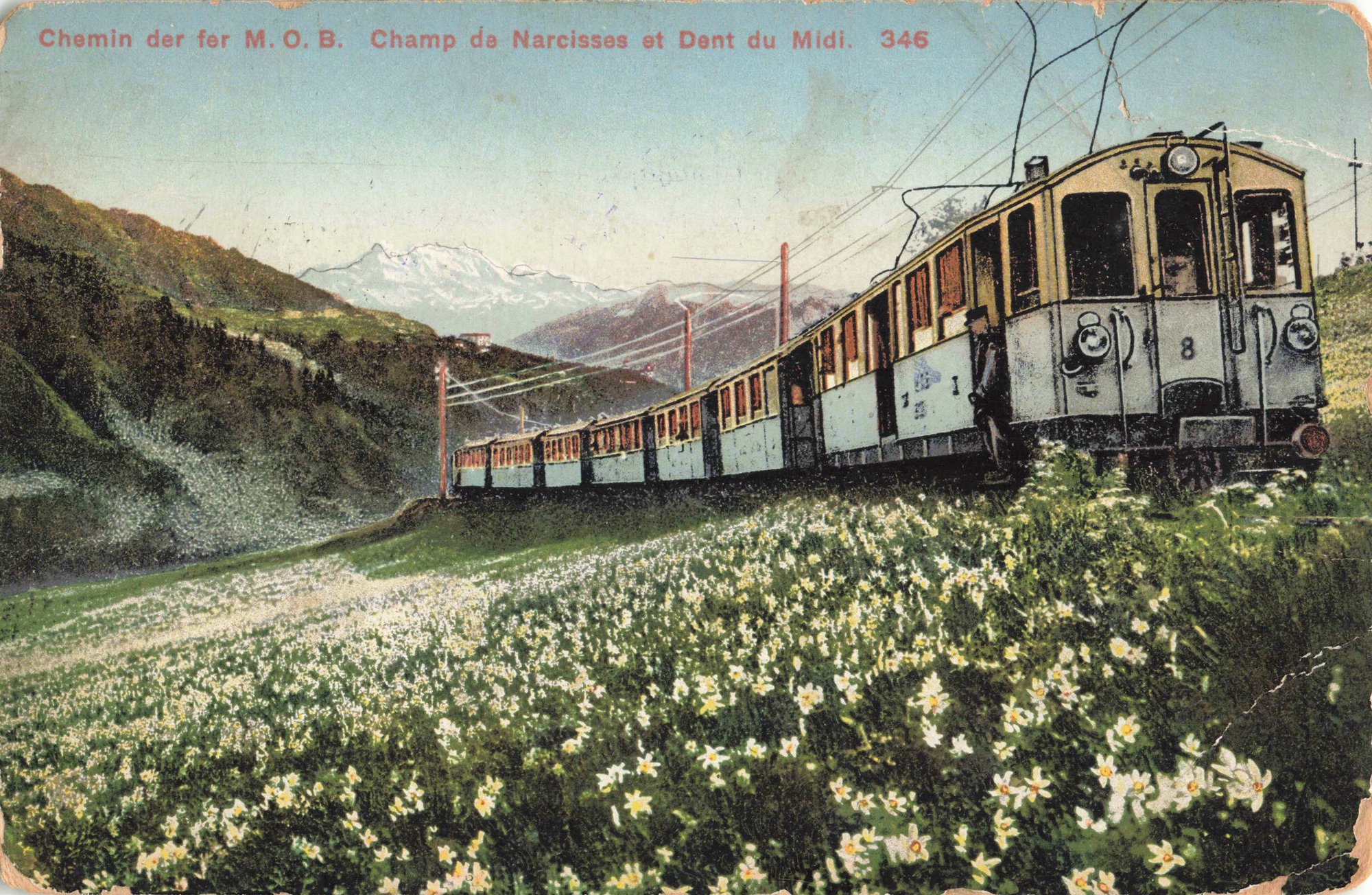
Then the cards begin, and Eddy tells the rest himself.
3 June. Four days in, he wants news, not food: “Should like you to send me a local Paper, dear, Willesden Chronicle also a daily Paper, do not send food parcels.” He underlined the not. In the German camps the weekly bread parcel from Berne had been what kept men alive — without it, the men told The Times, “things would have gone very badly”. He is out, and he would rather have his local paper.
6 June. “I am feeling champion.” He has walked on the mountainside, the tops still under snow: “We had a snow fall yesterday fancy in June.”
29 July. A crack in it. “Pleased you had a good time at Eastbourne. I have been rather poorly this week. so could not sit down to write.”
1 August. “Am just going to do a bit of work.” He was a sign writer by trade. What the work was, he does not say.
7 August. The card at the top of this page: “Have enjoyed a lovely bycle ride to Rougemont. a small village 5 miles away I have not heard from you for over a week.”
August, before the 14th. “Please do not send any more Cigarettes dear. until I get the others.”
3 September, a Sunday: “Sunday just going to Church.” The men used this church — there had been a thanksgiving service here that first summer, with the chaplain preaching and several hundred Englishmen singing “God save the King” to the tune the Swiss use for their own anthem.
5 October. A fund had been raised at home to send wives out to Switzerland to see their husbands. Sixteen arrived that week, and thirty couples were in the village by the 9th. Eddy writes: “Am just going to greet the wives. Expected today. Only wish you were coming dear.” The scheme was for wives. Lily was a fiancée.
1 December, from Montreux, with a ten-centime stamp on it — the only one of the fourteen he did not send through the internment post: “Just fancy me sitting down to a 7. course dinner.”
The grandson
He came home and married Lily. When, exactly, is the one thing the records almost tell us. The marriage index has an Edward Ford marrying a bride surnamed Crouch at Hampstead in the first quarter of 1918 — the only such match in those years. It may not be them: indexes give surnames rather than first names, and there is no way to tell from the entry alone. But if it is, he was back in London well before the men at Château-d’Œx went home in November 1918 — and we do not know how. Only the certificate would settle which of those two things is true.
Marjorie Edith Ford was born at Willesden in June 1919 — her birth is in the index too, mother’s maiden name Crouch — and a second daughter followed about a year and a half later. Peter gives his mother’s birthday as 21 June 1919 — the day itself, where the index gives only the quarter, and consistent with a marriage early in 1918 without confirming one. There were no more children. He never got his health back. “He never really recovered from the war at all,” Peter Murray says, repeating what his mother told him. “He was always very chesty — quite weak. He didn’t have much energy.” He died in the late 1920s.
Most of what the family had of him went in the next war, when the London house was bombed. “There wasn’t a lot left because they got bombed in the Second World War,” Peter says. “They lost some of the stuff.” Lily died at home after an air raid, in about 1942 or 1943, and was found in the kitchen by Marjorie, home from her work at the Air Ministry. Peter never met either of them.
So the fourteen cards are the survivors of something much bigger. They say so themselves: he is forever acknowledging letters and promising more — “I hope you have received Letters & P.C.”, “Just received your loving letter”, “Will write a long letter today dear.” Those letters are gone. The postcards lasted because they are small and stiff, and because Lily kept them, and Marjorie kept them after her.
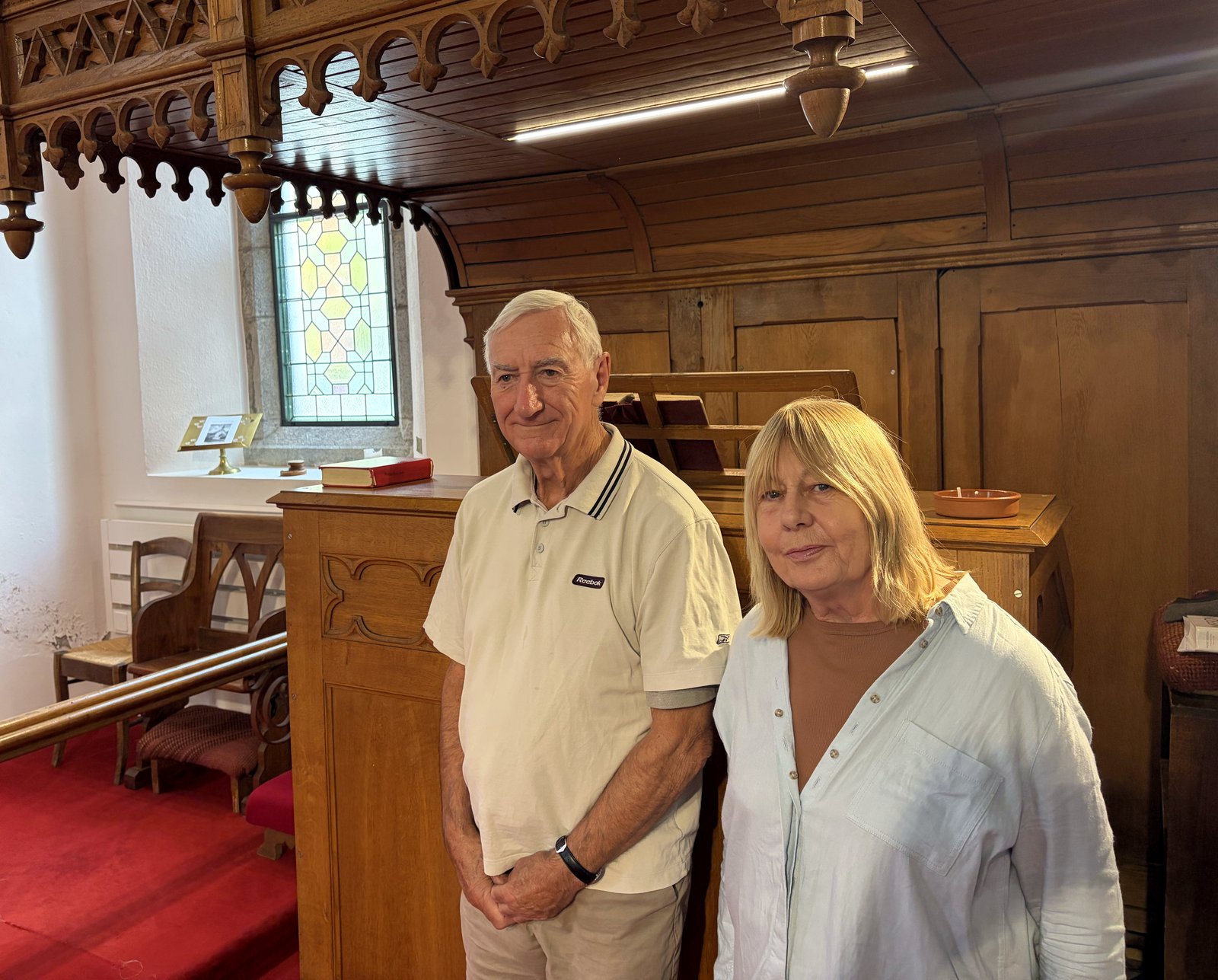
On 21 August 2026 Peter and his wife Carol drove up from Leigh-on-Sea and laid out what is left: the three medals, and the cards, stamps still on them. Twelve his grandfather posted to Lily; one he wrote on and never sent; and one a friend sent to him, posted at Guttannen in the Bernese Oberland that August. Peter gave the fourteen to the church. “They will be passed down to my son, and kept within the family,” he had said of the medals, “but obviously the further we get away from it, the less it will be.”
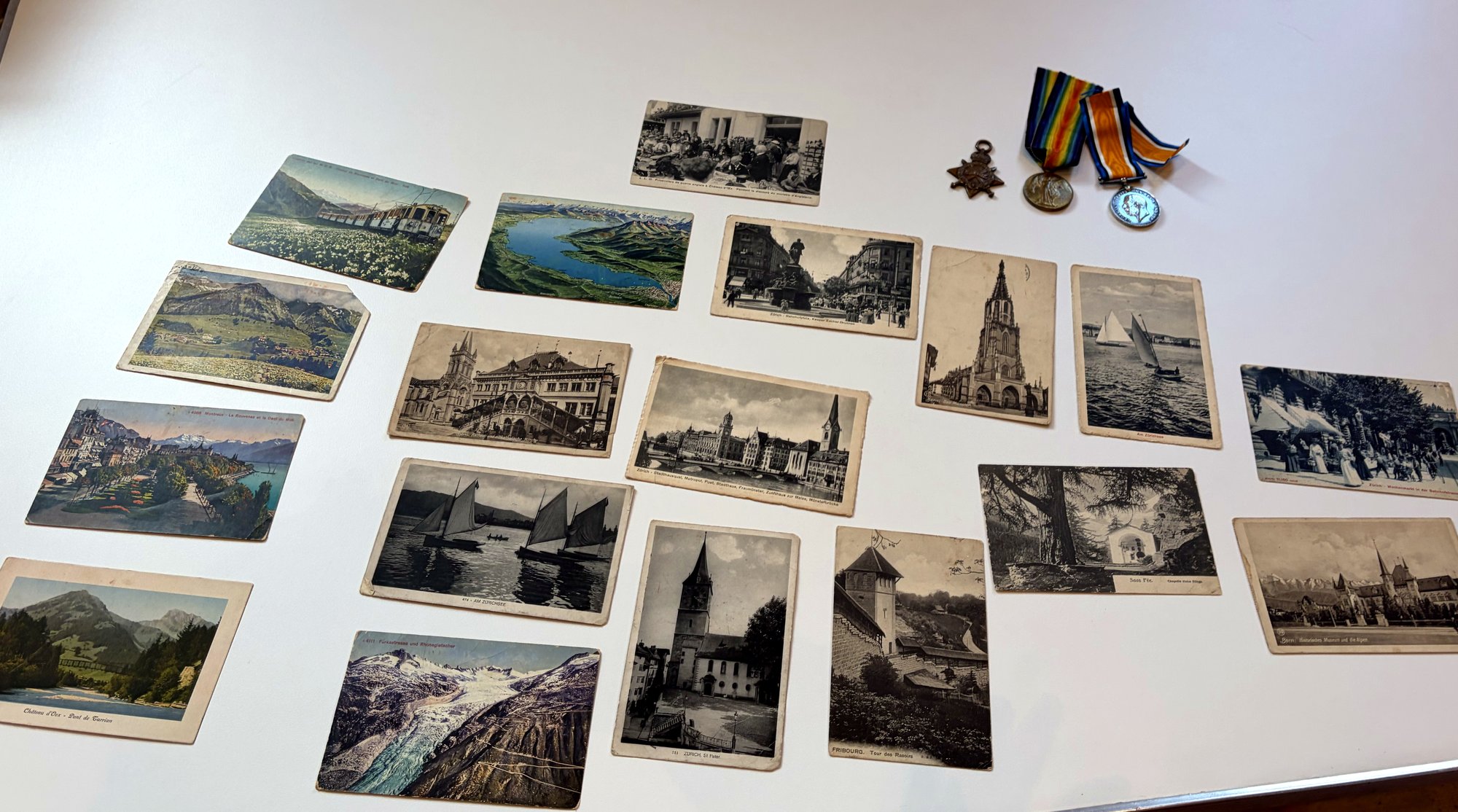
The cards are back in the village they were written in.
What we would still like to know
What was the work? His daughter said all her life that the sign writer “did something in the church”, and never explained it. Peter is honest that he is “putting two and two together”, and the parish has no record either way.
And when, exactly, did he die? His grandson says “about 1928”. The death index has too many Edward Fords in those years to pick him out, and unlike the birth index it carries no spouse’s name to narrow them by. A certificate would settle it.
Both of those could be settled by a certificate — the marriage and the death are each an index entry away from being confirmed, for anyone in the family who wants to order one.
If you know of work done in this church by an interned soldier between 1916 and 1918, or if you are researching an ancestor of your own who was interned here, please get in touch.
Sources
Everything about Edward Ford himself comes from his grandson Peter Murray, recorded at St Peter’s on 21 August 2026 and published with his agreement. The postcard dates and quotations are read from 600 dpi scans of the originals, which the church now holds. The internment is described from St Peter’s own archive of contemporary press reports, published as full transcribed text:
- Captives from Germany — The Times, 31 May 1916: the first train, and the names of all 32 officers.
- Our Wounded in Switzerland: arrival of the second party — The Times, 13 June 1916: the second convoy, the 450 in the village, the bread parcels from Berne, and the thanksgiving service in this church.
- Tears and smiles at Château-d’Œx and Cheerful wives — The Times, 7 and 10 October 1916: the wives’ visits.
- St Peter’s organ dedication — the organ given as the internees’ memorial, dedicated 8 March 1917.
- Browse the whole archive →
The Cinéma Luna programme is from Le Progrès de Château-d’Œx and the Journal de Château-d’Œx, both of 31 May 1916, in the Scriptorium archive of the Bibliothèque cantonale et universitaire de Lausanne.
The official records are Edward Ford’s Medal Index Card at The National Archives (WO 372/7/107905), and the England and Wales civil registration indexes for the marriage (Hampstead, first quarter 1918) and for Marjorie’s birth (Willesden, June quarter 1919). An index entry is a pointer, not a proof: the certificates themselves would confirm both.
For the fuller story, see British WWI Soldiers in Château-d’Œx and ‘Like dropping right into heaven from hell’: eyewitnesses to the 1916 internment.
To see the footage: Julie Hunt’s video report for swissinfo.ch, filmed here for the centenary — ‘A safe haven: when Switzerland opened its arms to POWs’, 22 June 2016.
Questions answered
- Who was Edward Ford?
- Pte Edward Ford, service number 3517, served with the 2nd Battalion, East Surrey Regiment. His family believes he was gassed at Ypres in the spring of 1915. He was later brought out of German captivity into neutral Switzerland and interned at Château-d'Œx, where he lived at the Grand Hôtel Beau Séjour and wrote home to his fiancée, Lily Crouch. He married Lily, and died in the late 1920s.
- Why were British soldiers living in a Swiss village in 1916?
- Under an agreement between the warring governments, sick and wounded prisoners of war were moved out of German camps into neutral Switzerland. The first train reached Zurich on the evening of 30 May 1916 carrying 304 men, and a second convoy followed a day later. The village's empty hotels housed them; by mid-June about 450 men were lodged in Château-d'Œx.
- What do Edward Ford's postcards say?
- They are short and domestic. He asks for newspapers rather than food parcels, reports a snowfall in June, describes a bicycle ride to Rougemont five miles down the valley, mentions going to church on a Sunday, and on 5 October 1916 writes that he is 'just going to greet the wives'. The last card, from Montreux on 1 December 1916, marvels at a seven-course dinner.
- How did the postcards come back to Château-d'Œx?
- Edward Ford's grandson, Peter Murray, drove from Leigh-on-Sea in Essex with his wife Carol and gave fourteen of the cards to St Peter's on 21 August 2026, together with his grandfather's three medals to look at. The cards were written in this village, kept in London through two wars, and are now back where they were sent from.
- Can St Peter's help me trace an ancestor interned at Château-d'Œx?
- The parish publishes the contemporary press reports of the internment as full transcribed text, including the names of the 32 officers on the first train. No roll of the other ranks is known to survive. If you are researching an ancestor who was interned here, please get in touch.