‘Like dropping right into heaven from hell’: eyewitnesses to the 1916 internment
The story of the 1916 internment is usually told from the outside — the diplomacy, the numbers, the trains. This page gathers what the people who were there wrote down at the time, and the photographs they kept: a sergeant’s letter home, a diplomat’s despatch, the village newspaper reporting on its own neighbours, a poem written in a chalet, and a young woman’s account of travelling four days across wartime France to reach her fiancé.
The journey out
Sergeant William McGilvray of the London Scottish Regiment had been a prisoner at Friedrichsfeld. His account of the journey was printed in his regimental gazette that July.
On leaving Friedrichsfeld we passed through the Essen district to Cologne and from there right up the Rhine Valley, picking up other parties as we went… It was a trip that in peace time would have been much appreciated… but although we admired the scenery we were more concerned in noting the state of the crops and the extent to which cultivation had been carried on the hillsides.
At Constance, the last German stop, the mood was hostile — “no doubt because we were the first batch of British prisoners they had seen”. The senior officer passed an order down the train that no one was to make any demonstration, and they left the station in silence. Then:
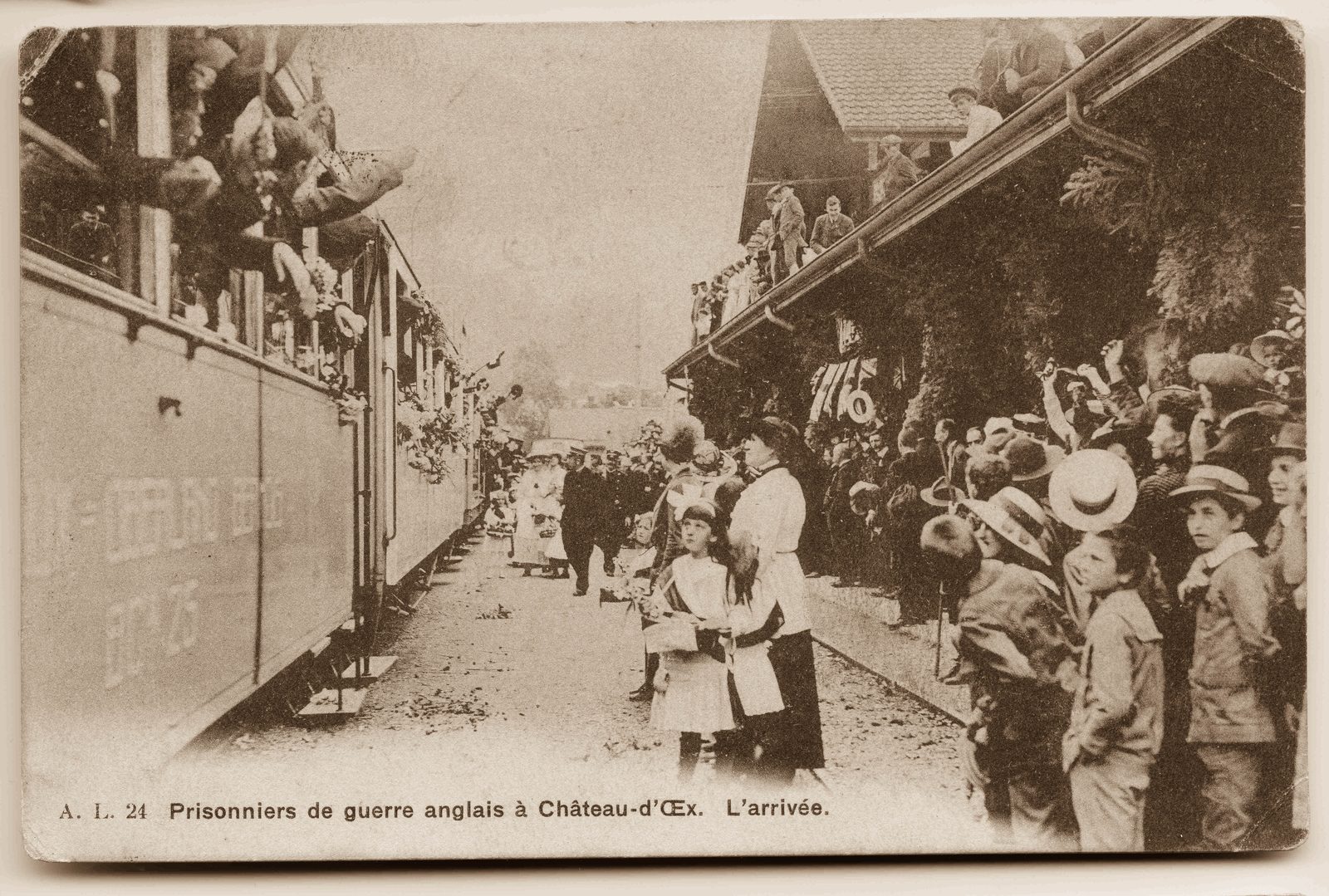
The Swiss frontier is only a few hundred yards outside and as we crossed this there was a great cheer from the train and also from the Swiss people waiting there to receive us. This was the commencement of the most wonderful reception I have ever seen. All down the line the people of the various villages were on the stations cheering, waving flags and singing, and packages of all sorts began to come in through the windows.
They reached Zürich about ten at night, Berne at two in the morning for coffee and rolls, Lausanne at five, where the platform was so crowded that people simply threw their packets into the carriages from where they stood. At Montreux they left their baggage at the station and breakfasted on the terrace of the Palace Hotel over the lake, where “bands played, speeches were made and the reception was greater than I have ever seen paid to royal personages.”
McGilvray ends by apologising that he must break off: he had been put in charge of one of the hotels, and there was a great deal to do.
The despatch
Evelyn Grant Duff, the British Minister at Berne, wrote his official account four days after the first train came in.
It is difficult to write calmly about it for the simple reason that I have never before in my life seen such a welcome accorded to any one, although for the last twenty-eight years I have been present at every kind of function in half the capitals in Europe.
He records that the day before the arrival the Prefect had issued a notice that everyone was to wear his best clothes; that every house was hung with flowers and with Swiss and British flags; that the school children were massed all down the line; and that tables were laid in the open behind the station for several hundred people.
As the train slowly drew up the scene was really extraordinary. While the band played “God Save the King,” the soldiers, covered with roses, carrying armfuls of presents, some in tears, some actually fainting with emotion, gradually left the train. First those who could walk were conducted through a lane of cheering people to the tables laid out for them. Then those who were very ill were brought in on stretchers, and, half-smothered in flowers, were quickly taken off by the Red Cross attendants to their quarters.
And then the sentence that has been quoted ever since:
Our men were simply astounded, and naturally so, after being many of them treated with every obloquy for two years or nearly so. Many of them were crying like children, a few fainted from emotion. As one private said to me, “God bless you, sir, it’s like dropping right into ’eaven from ’ell.”
A poem from a chalet
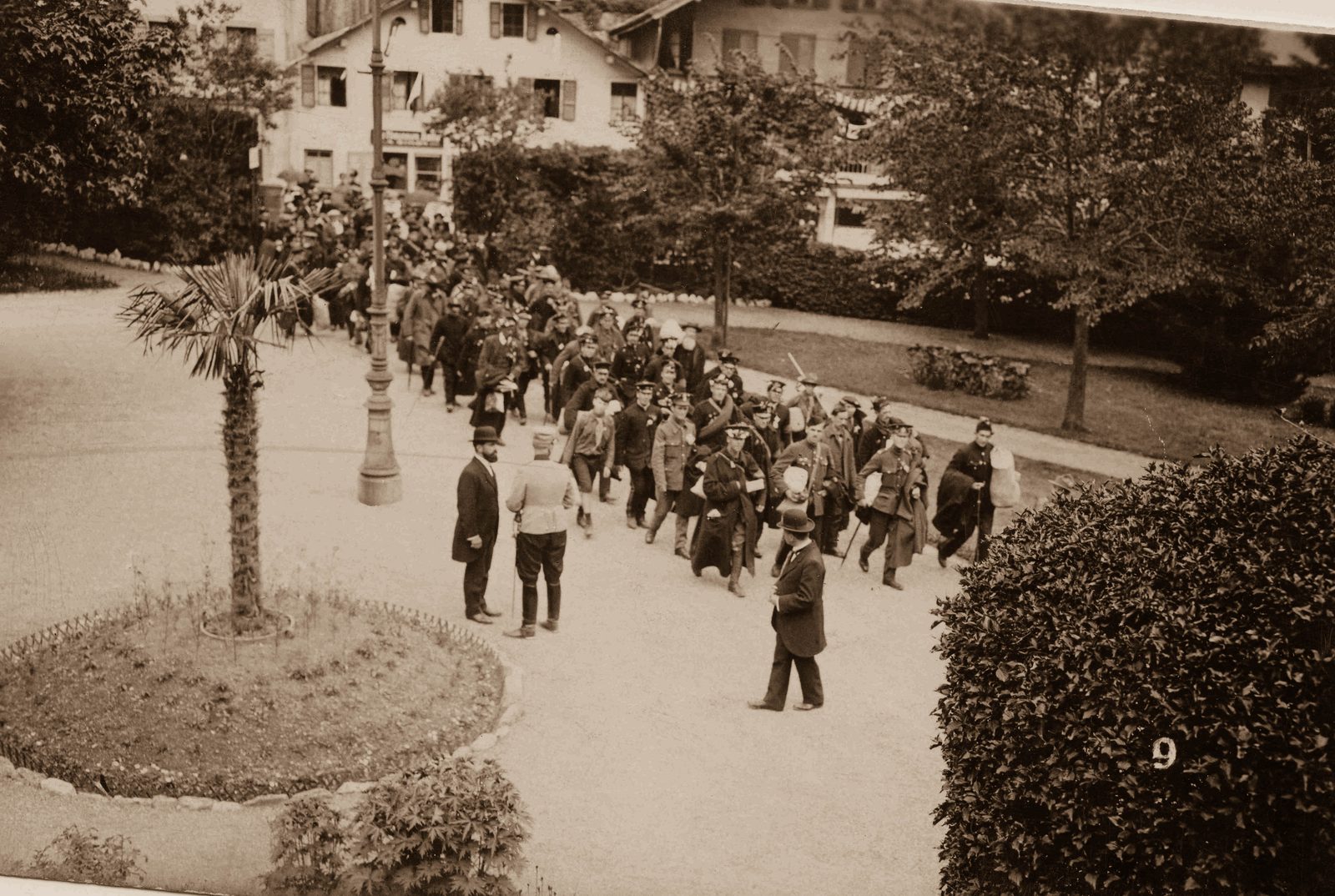
Corporal Chas. Skeels of the 2nd Cheshire Regiment wrote his account in verse, and signed it from Chalet-le-Reposir, Château-d’Œx. His train was not the first — he dates it to 12 August 1916, and describes arriving on a Sunday morning — so this is one of the later contingents making the same journey.
Lo, the German guards are leaving,
Rifles they unloaded are, —
And with steps they think so stately
They go marching by our car.The whistle sounds, — the train is moving
Banished now all fear and care,
As we hear the smiling people
Shouting: “Vive l’Angleterre!”Soon our car is strewn with roses,
Presents rain on us so fast,
That we think in pleasant places
We have cast our lines at last.Scouts are waiting with their bugles,
And salute us on our way,
Till at last, our journey, ended,
We arrive at Château d’Oex.
The village writes about itself
The most valuable accounts here are the ones nobody wrote for a British audience. Le Progrès, the local paper, had been reporting on the preparations for weeks. Its correspondent described a village turning itself out:
Dans la journée de lundi, les maisons se sont pavoisées. La rue du vieux bourg était superbe; un grand nombre de chalets étaient décorés avec goût; au haut du vieux clocher flottaient la croix blanche helvétique et le vert et blanc drapeau du canton de Vaud…
De mignonnes fillettes, telles de blanches fleurettes, couraient les rues, offrant au profit de la Crois-Rouge anglaise, des rubans et drapeaux aux couleurs des Alliés.
(On the Monday the houses put out their flags. The street of the old village was magnificent; many chalets were tastefully decorated; from the top of the old bell tower flew the white Swiss cross and the green and white flag of the canton of Vaud… Little girls, like small white flowers, ran through the streets selling ribbons and flags in the colours of the Allies in aid of the English Red Cross. — our translation.)
The paper counted the arrivals precisely: two trains, and by late morning “30 officiers et 218 soldats”. It named who came down from the surrounding villages — l’Étivaz, Rougemont, Rossinière, and further — and noted the presence of the fire brigade keeping order, the scouts, the gendarmerie, and “le sympathique et honorable correspondant du Times”. Its closing line is the one worth keeping:
Et la population du Pays-d’Enhaut… ne s’est peut-être pas bien rendu compte qu’elle venait de vivre une journée telle que l’histoire de notre pays en enregistre bien peu de pareilles.
(And the people of the Pays-d’Enhaut… perhaps did not quite realise that they had just lived through a day of a kind our country’s history records very few of. — our translation.)
And then the welcome had to be restrained
What makes Le Progrès worth reading is that it kept going after the flags came down. Within six weeks its tone had changed completely. The internees were under military discipline; the public was undermining it with kindness.
The paper carried the sanitary officer’s notice that visits required a personal card, signed and valid for one visit only, and that family or group visits were forbidden. It reported that disciplinary establishments were being prepared for internees whose conduct warranted them — “il s’agit, en première ligne, de buveurs” — and that undisciplined German internees would go to Witzwil, the French to Orbe. A longer army report published the same summer put it bluntly: people were pressing drink on the men, and
Cette course en masse de la population vers les internes n’est pas non plus compatible avec notre dignité nationale.
(This mass rush of the population towards the internees is not compatible with our national dignity either. — our translation.)
That same report gives the shape of the scheme at that point: Belgians 1,076, Germans 2,949, British 452, French 8,941, distributed across sixteen internment districts. The British were always a small minority of a much larger, mostly French, population of internees.
A fiancée’s journey
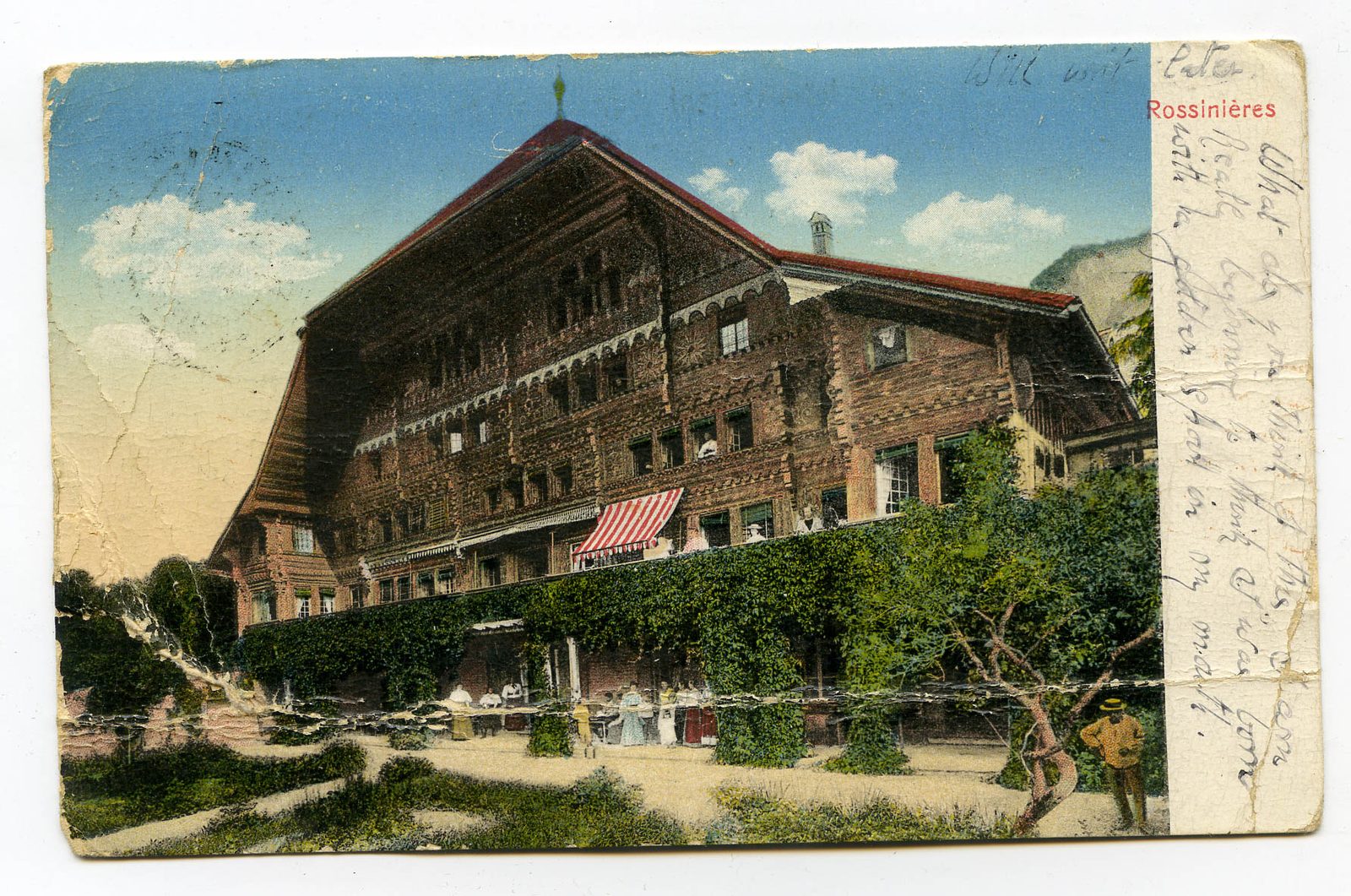
Connie Kirkup left Waterloo on 22 January 1917 with a Red Cross party of wives and fiancées, bound for Rossinière and Angus Leybourne. She and her companion missed the party at Le Havre, missed the Swiss train in Paris, and were rescued by a British Red Cross man sent to the station to collect “two ‘lost wives’”. Four days after leaving London she was still climbing.
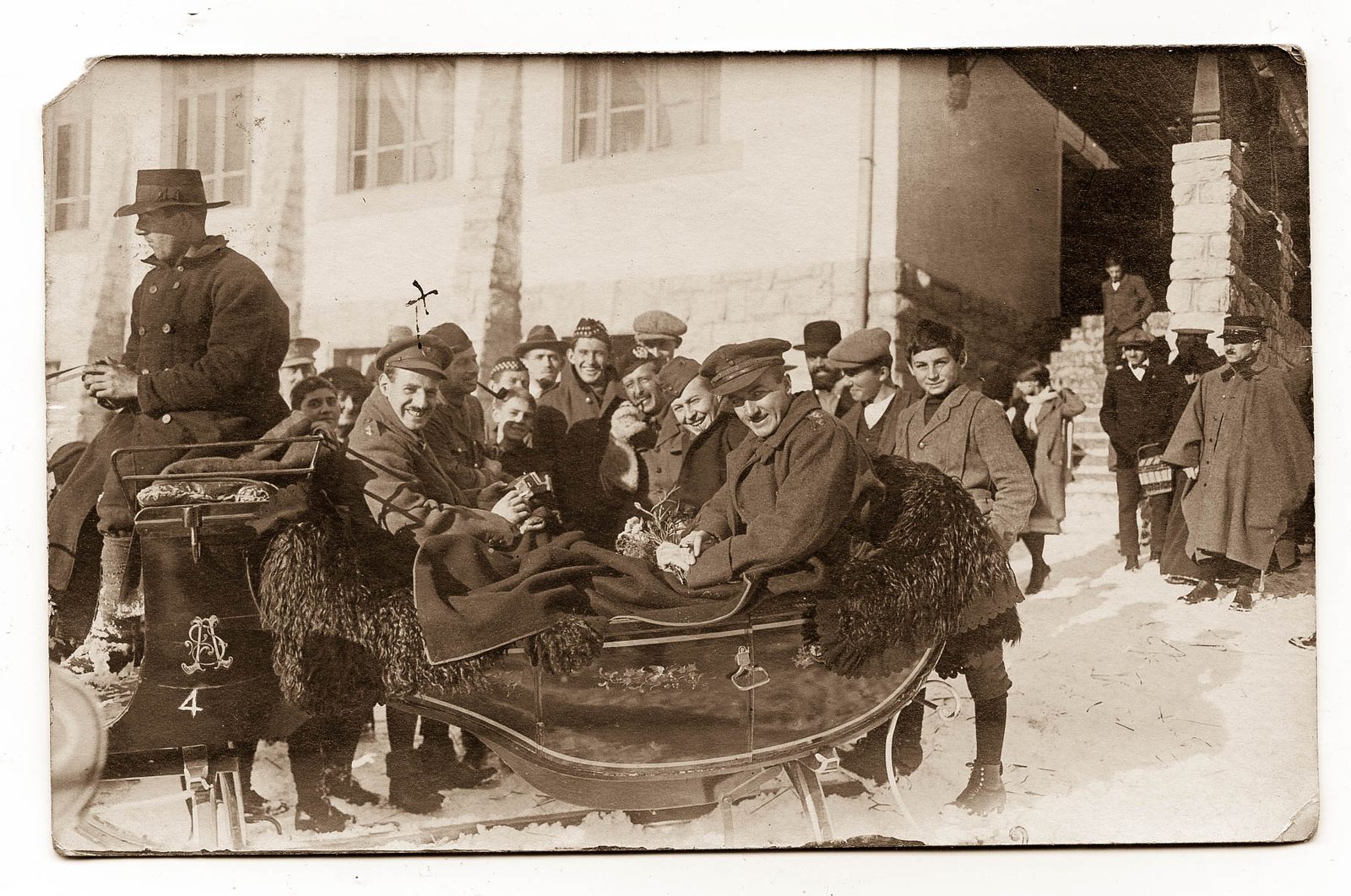
At Montreux we changed into a little electric train that zig-zagged up the mountain side, we rushed like school children from one side of the train to the other, as the view changed sides or appeared to do — in reality it was our train that turned round. As we climbed higher we saw the people tobogganing & skating and about half way up the mountain, a crowd, watching the finish of some bobsleigh races — and there — there was Angus, watching for me — he had just finished his race.
He had been meeting trains for three days. Her description of what she found at Les Avants is the sharpest thing written about the internment by anyone:
All were in holiday mood — winter sporting except for the khaki and the men who were wounded, armless or legless, or crippled, it was pre-war winter sports holiday scene.
On the last leg the other internees and their visitors moved to the far end of the compartment to leave the couple to themselves. At Rossinière they climbed a narrow path through deep snow to the chalet, where Angus’s mother and sister were waiting — and where, she learned later, there had been a scramble to change the tea cloth after a small boy upset his tea in the excitement.
Some of these visits ended in weddings.
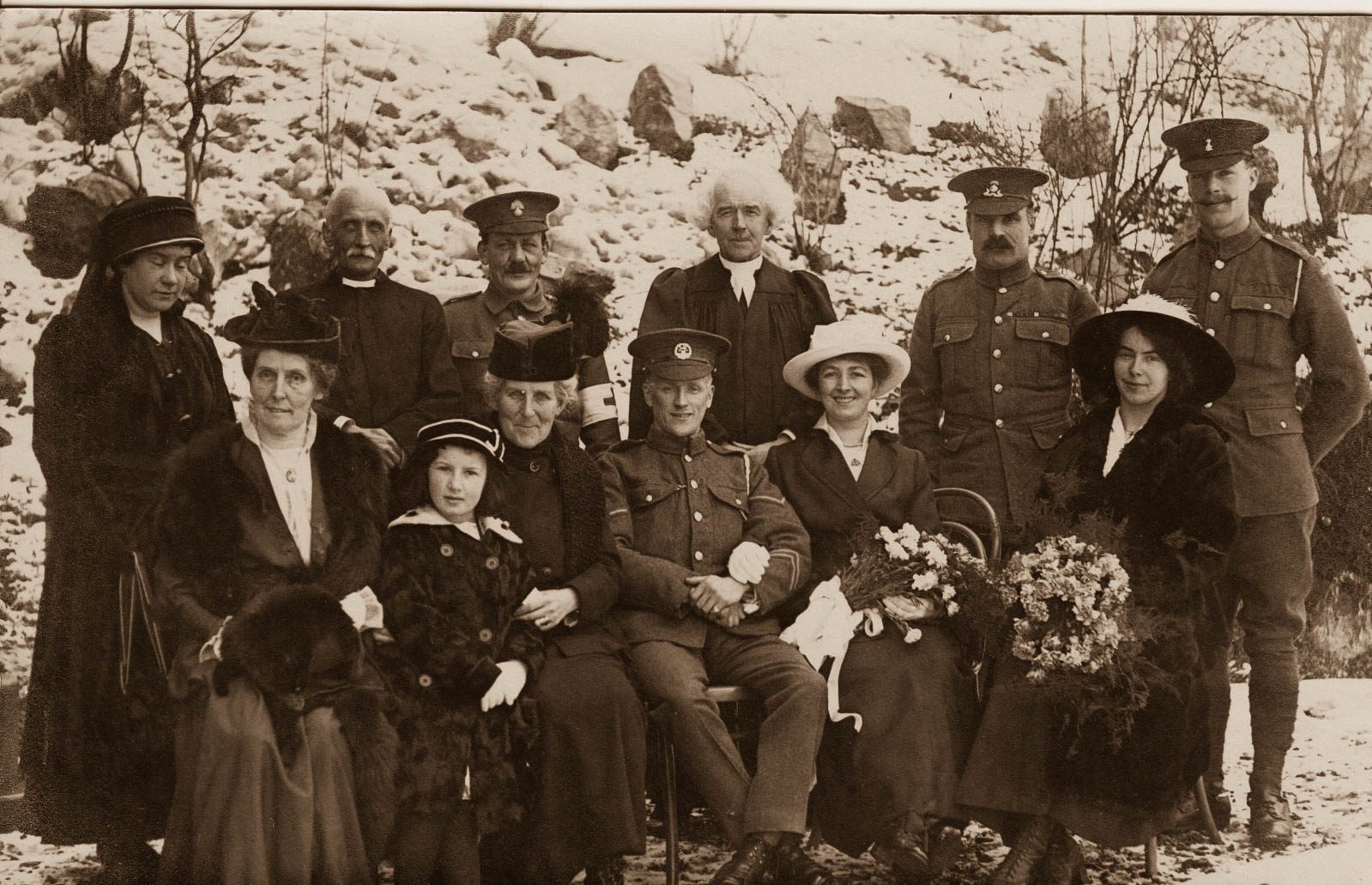
What remains
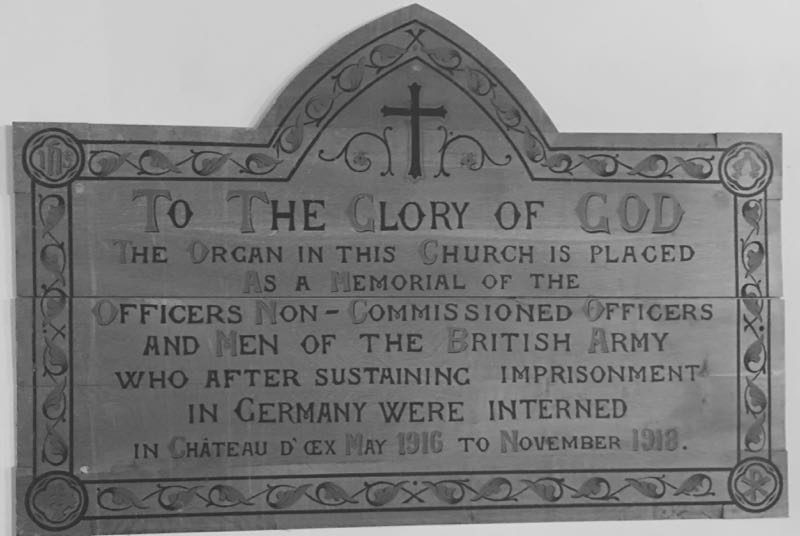
The men left in 1918. What they left behind is in the church: the organ was given as their memorial, and the plaque above it says so in as many words.
About these documents
The accounts on this page were gathered by St Peter’s own centenary research in 2016 and were published on a project website that is no longer online; the parish holds the archive. They are reproduced here as they were transcribed then, and we have not silently corrected them.
Two cautions a reader should have:
- The French reports are transcriptions, not scans. We hold the 2016 transcriptions of Le Progrès; the newspaper pages themselves are not in the parish archive, so the wording cannot at present be checked against the printed original. Small spelling irregularities in the French are as transcribed.
- Dates. Le Progrès reported the arrival in its issue of 31 May 1916, describing the previous day — Tuesday 30 May. Where the archive’s own filing gives a different date, the report’s internal evidence has been preferred.
The contemporary British press reports of the same events are published in full, with facsimiles, in the Château-d’Œx press archive — including the first train and the names of all 32 officers, and the chaplain’s appeal for the organ that this plaque commemorates.
If you are researching an ancestor who was interned here, or if you hold letters, photographs or postcards from the internment, please get in touch — several of the accounts above reached us exactly that way.
Questions answered
- What did the British soldiers interned in Switzerland in 1916 say about their arrival?
- Sergeant William McGilvray of the London Scottish wrote that the Swiss frontier lay only a few hundred yards beyond Constance, and that as the train crossed it there was a great cheer from the train and from the Swiss people waiting to receive them. He described bands, speeches and a reception at Montreux greater than he had ever seen paid to royal personages. The British Minister at Berne, Evelyn Grant Duff, reported that many of the men were crying like children and a few fainted from emotion.
- How did the village of Château-d'Œx prepare for the internees?
- The village newspaper Le Progrès recorded that the houses were decorated the day before, that the Swiss and Vaudois flags flew from the old bell tower, and that girls ran through the streets selling ribbons and flags in the Allied colours for the British Red Cross. Tables and benches were laid on the terrace behind the station, where tea and bread and butter were prepared.
- Could the wives of interned soldiers visit them in Switzerland?
- Yes. Parties of wives, mothers and fiancées travelled out under Red Cross arrangements. Connie Kirkup travelled from Waterloo to Rossinière over four days in January 1917 to visit her fiancé Angus Leybourne, missing her party at Le Havre and being collected in Paris by a British Red Cross man sent to find two lost wives.
- Is there a memorial to the interned soldiers at St Peter's Château-d'Œx?
- Yes. The organ in St Peter's was given as their memorial, and a carved plaque above it records that it stands in memory of the officers, non-commissioned officers and men of the British Army who, after sustaining imprisonment in Germany, were interned in Château-d'Œx from May 1916 to November 1918.