Cheerful Wives at Château d'Œx — The Times, 10 October 1916 (dateline "CHATEAU D'ŒX, Oct. 9")
The Times, 10 October 1916 (dateline “CHATEAU D’ŒX, Oct. 9”). One of St Peter’s First World War documents, from the years when British prisoners of war were interned at Château-d’Œx, 1916–17. Transcribed in full from a cutting made available by The Times Archive.
In this report: the second party of wives reaching Château-d’Œx without delay on the journey, making 30 couples then in the village, and the foyer des soldats where they gathered.
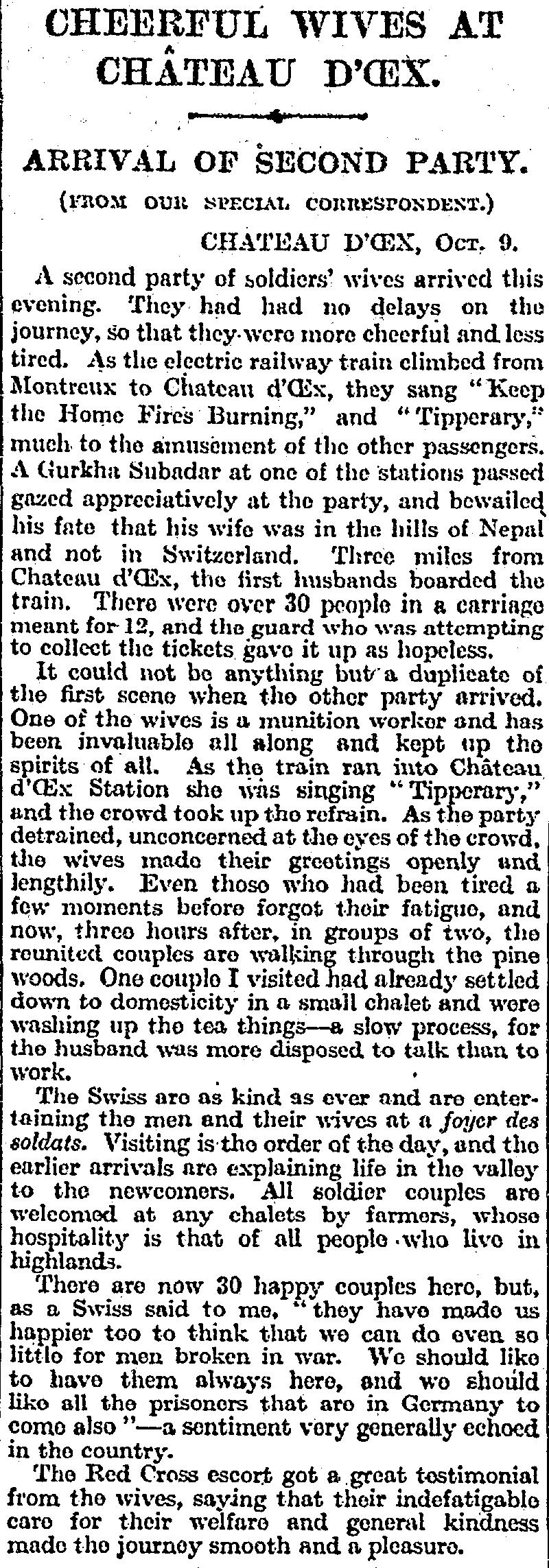
Headline as printed: CHEERFUL WIVES AT CHÂTEAU D’ŒX.
ARRIVAL OF SECOND PARTY.
Handwritten annotation
“The Times - 10/10/1916”
(FROM OUR SPECIAL CORRESPONDENT.)
CHATEAU D’ŒX, Oct. 9.
A second party of soldiers’ wives arrived this evening. They had had no delays on the journey, so that they were more cheerful and less tired. As the electric railway train climbed from Montreux to Chateau d’ŒX, they sang “Keep the Home Fires Burning,” and “Tipperary,” much to the amusement of the other passengers. A Gurkha Subadar at one of the stations passed gazed appreciatively at the party, and bewailed his fate that his wife was in the hills of Nepal and not in Switzerland. Three miles from Chateau d’ŒX, the first husbands boarded the train. There were over 30 people in a carriage meant for 12, and the guard who was attempting to collect the tickets gave it up as hopeless. It could not be anything but a duplicate of the first scene when the other party arrived. One of the wives is a munition worker and has been invaluable all along and kept up the spirits of all. As the train ran into Château d’ŒX Station she was singing “Tipperary,”
d’ŒX Station she was singing “Tipperary,” and the crowd took up the refrain. As the party detrained, unconcerned at the oyes of the crowd, the wives made their greetings openly and lengthily. Even those who had been tired a few moments before forgot their fatigue, and now, three hours after, in groups of two, the reunited couples are walking through the pine woods. One couple I visited had already settled down to domesticity in a small chalet and were washing up the tea things—a slow process, for the husband was more disposed to talk than to work.
The Swiss are as kind as ever and are entertaining the men and their wives at a foyer des soldats. Visiting is the order of the day, and the earlier arrivals are explaining life in the valley to the newcomers. All soldier couples are welcomed at any chalets by farmers, whose hospitality is that of all people who live in highlands.
There are now 30 happy couples here, but, as a Swiss said to me, “they have made us happier too to think that we can do even so little for men broken in war. We should like to have them always here, and we should like all the prisoners that are in Germany to come also”—a sentiment very generally echoed in the country.
The Red Cross escort got a great testimonial from the wives, saying that their indefatigable care for their welfare and general kindness made the journey smooth and a pleasure.
End of the transcribed document
Questions answered
- How did the second party of wives arrive at Château-d’Œx?
- The Times correspondent, writing from Château-d’Œx on 9 October 1916, reported that a second party of soldiers’ wives arrived that evening: “They had had no delays on the journey, so that they were more cheerful and less tired.” As the electric railway train climbed from Montreux they sang “Keep the Home Fires Burning” and “Tipperary”, “much to the amusement of the other passengers”.
- What happened when the train reached the village?
- Three miles from Château-d’Œx the first husbands boarded the train: “There were over 30 people in a carriage meant for 12, and the guard who was attempting to collect the tickets gave it up as hopeless.” As the train ran into the station one of the wives, a munition worker who “has been invaluable all along and kept up the spirits of all”, was singing “Tipperary”, “and the crowd took up the refrain.”
- How many couples were then in the village?
- The two parties together made 30 couples in the village. Three hours after the arrival, the correspondent wrote, “in groups of two, the reunited couples are walking through the pine woods”, and one couple he visited “had already settled down to domesticity in a small chalet”.