History of English Churches in Switzerland – Interlaken
On Sunday 5 July 1863 a party of English tourists went to church at Interlaken. They were on Thomas Cook’s first conducted tour of Switzerland, which lasted three weeks. Among them was Jemima Morrell, aged thirty-one, who kept a journal of the trip. She thought the sermon “pretty good”, though its doctrines were “slightly too much in harmony with human nature”. It was, she wrote, “rather religion presented walking in silver slippers”. The preacher spoke of the blessings of a little grace, and the party came to know him as the “Rev. Littlegrace”. Even so, she thought that no wise traveller should miss the English services.1 By then there had been English services at Interlaken in summer for more than twenty years.
A chapel in the monastery church
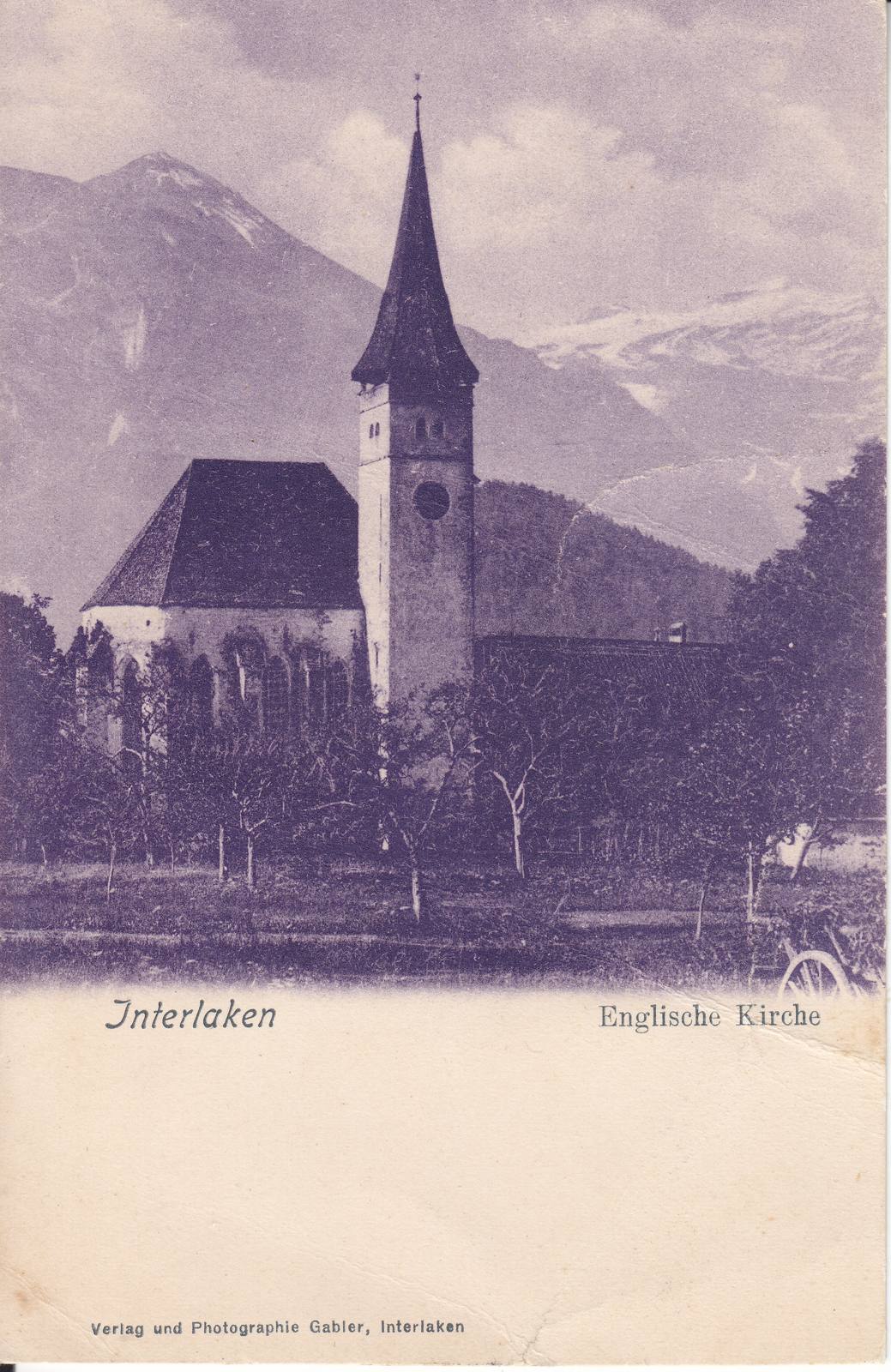
Paul Schniewind, who wrote the history of the Anglican churches in Switzerland, counts Interlaken among the places the British liked best in the early nineteenth century. He records that on 21 October 1840, in response to an application, the government of Berne granted that the choir of the “Ancient Church” be converted into an English chapel. The church had belonged to the old monastery at Interlaken, which he says was founded in 1130 and suppressed in 1528.2
In 1842 the Revd Anthony Sillery took the duty at Interlaken for the Colonial Church Society. This society of the Church of England would later be called the Colonial and Continental Church Society. Interlaken became its first holiday seasonal chaplaincy: a congregation abroad served by a visiting English clergyman for the summer season only.3 Two years later Sillery asked for help. In the season of 1844 the Revd W. H. Hill and the Revd J. T. Gwyther, vicar of Madeley, went out to share four months’ duty between them.4 Interlaken was not the first English congregation in Switzerland. There had been services at Geneva on Christmas Day 1814, and at Lausanne from November 1816.5
The Society’s historian, Brian Underwood, gives both dates. He names Sillery at Interlaken in 1842. Elsewhere he dates the Society’s work among tourists from 1844, when Interlaken was opened as a summer station. The Intercontinental Church Society, as the Society is now called, also dates its work at Interlaken from 1844.6 Schniewind adds a further claim to be first. At Thun, in July 1841, the innkeeper Knechtenhofer applied to the Berne authorities to open a chapel for English services near the Gasthof Bellevue, near Thun. He to pay the chaplain himself.7
In 1845 the Revd G. E. Biber published a survey of the English Church on the Continent. His entry for Interlaken is short: “There is a Chapel here expressly for the English Church congregation; but there is service in it only during the summer months.” He entered it as “without episcopal licence”, that is, without a licence from a bishop. The congregation had given £10 14s. in the summer of 1844 towards the funds of the Colonial Church Society. Biber listed Interlaken with Thun, Zürich and Lucerne as places with services in summer only. Lausanne, Vevey and Geneva had them throughout the year.8
The Society takes charge
Sillery had held the chapel on a ten-year grant from the canton of Berne. He had also given the Society his right to name his successor if he died. He died on 4 March 1851. That June the Revd H. Deck arrived to take the services, which ran from June to September. He found that an unknown clergyman had posted a notice on the door, offering himself as a candidate for the post. The notice said that the Bishop of London would license him if the congregation accepted him. The Bishop of London, asked about it, thought the choice lay with the congregation. Sillery’s grant was nearly at an end, so Deck applied, with local support, for it to be renewed in the Society’s name. Berne renewed it for ten years from 1 January 1851. The Society’s right to choose the chaplain was now recognised.9
From then on the Society sent clergymen out for the summer, and its published lists name some of them. The Revd J. Richardson was at Interlaken in August 1871. In June 1896 it was the Revd A. H. Tredennick, a curate at Clifton. The lists we have read name five chaplains for single months between 1871 and 1913.10
Several congregations under one roof
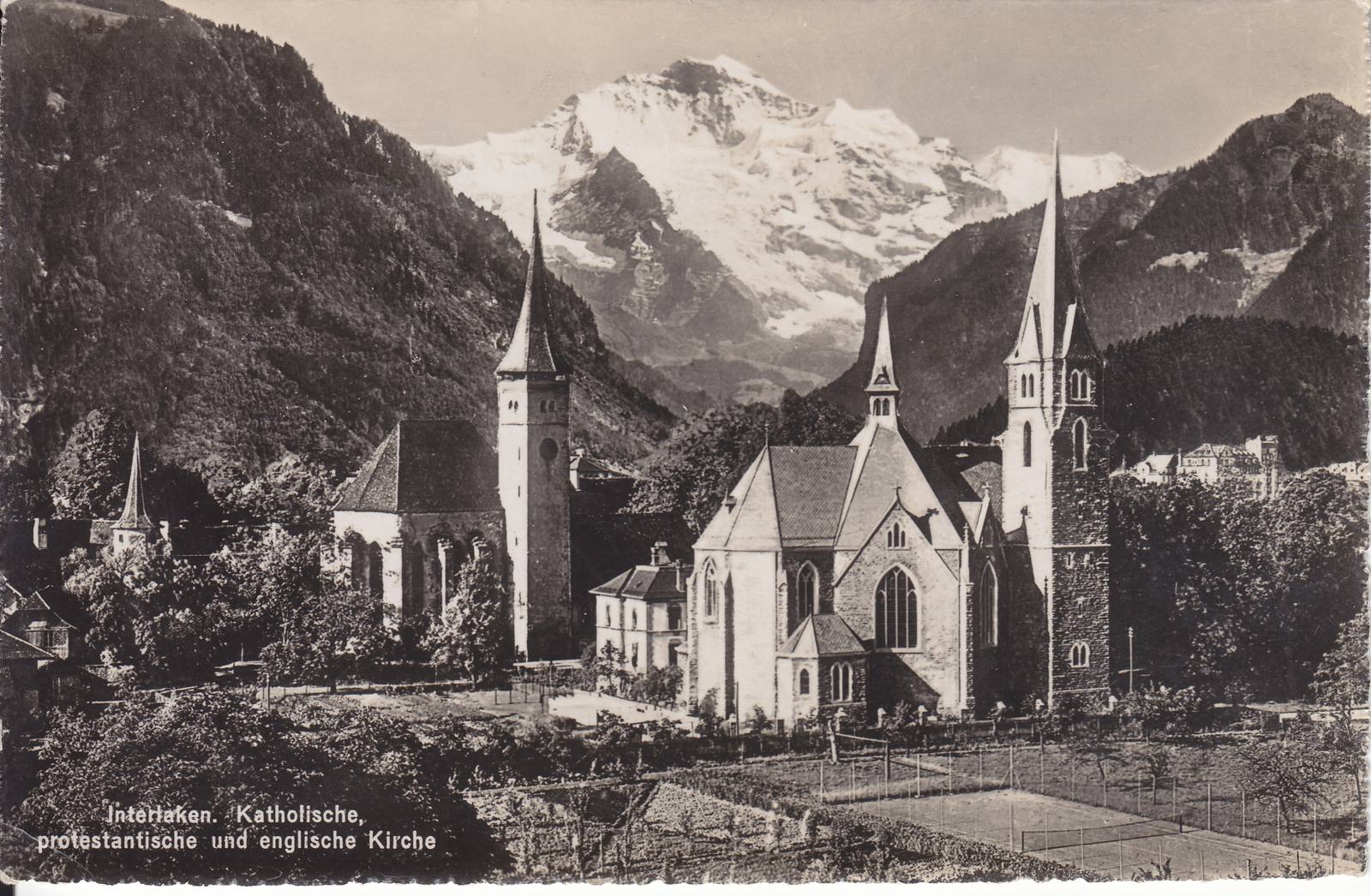
By the 1890s the English shared the old church with other congregations. Murray’s Handbook for Travellers in Switzerland placed the English church in the choir. Scottish Free Church and French Protestant services were held in the same building. A Roman Catholic chapel stood on the site of the nave.11 In 1900 The Anglican Church Magazine called the conditions of the Society’s chaplaincy at Interlaken “unique”. It reported: “The Anglican Services are held in the Choir of the old Church; the Roman Catholics in the Nave, and those of the Presbyterian and French Protestants in a side Chapel.”12 Schniewind thought Interlaken “maybe the first, in any case a very early, experience in ecumenism”, meaning the churches’ efforts to work together.13
The agreement of 1936
In 1992, Schniewind records, the church belonged to the local Protestant parish. Under a contract with the Society dated 24 June 1936, the Society was granted the use of the east part of the church, free of charge.14
Schniewind was writing in 1992, a hundred and fifty years after Sillery. By then the Society had become the Intercontinental Church Society, and Interlaken was still one of its summer chaplaincies. The bishop who wrote the foreword to the book recalled the opening of “our first holiday seasonal Chaplaincy in Interlaken in 1842”.15
We would like to know more about the chaplains of Interlaken in the nineteenth century. We would also like to see the grant of 1840, the agreement of 1936 and the 1900 article in The Anglican Church Magazine. If you can help, please write to us at info(a)stpeters.ch. For services at Interlaken today, see the Intercontinental Church Society’s page for Interlaken and Grindelwald. In the First World War, Interlaken and Mürren were both in the area where the Swiss housed interned British soldiers, as our page on the English church at Mürren tells. Thomas Cook’s tour of 1863 is part of the story told in The English experience of the Alps. The other English churches are described in our guide to the English churches in Switzerland.
-
Miss Jemima’s Swiss Journal, as quoted by Paul W. Schniewind, Anglicans in Switzerland (Berne, 1992), pp. 9–10. Schniewind heads the entry “Sunday, 6th July 1863”, but 6 July 1863 was a Monday. On p. 90 he gives the service as 5 July 1863, which was a Sunday, and we follow that. The tour ran from 26 June to 15 July 1863: Jim Ring, How the English Made the Alps (London, 2000), Kindle locations 1250–1417 of the Faber ebook. Its route took in the Gemmi Pass, Kandersteg, Interlaken and Lucerne: Julia Slater, “Following the first group tour to Switzerland”, swissinfo.ch, 7 October 2013. Schniewind, p. 9, for the three weeks. Morrell’s age is from the ViaCook cultural route guide, which gives her as “31-year-old Jemima Morrell”. Schniewind spells her name “Morell”. Her journal was published in 1963, a century after the tour (swissinfo.ch, as above). See also Diccon Bewes, Slow Train to Switzerland (London, 2013), which follows her journey. ↩
-
Schniewind, p. 89, citing the Staatsarchiv des Kantons Bern, “Rodel der englischen Kapelle Interlaken 1840-1866”, which we have not seen. For the monastery, a catalogue of the manuscripts in the Stadtbibliothek of Berne (1895) lists papers of the priory (Propstei) of Interlaken dated from 1146 to 1528; we have seen this only as a search extract. ↩
-
Brian Underwood, The history of the Commonwealth and Continental Church Society (M.A. thesis, University of Durham, 1972), p. 37, written from the Society’s own minute books; Durham e-theses 2998. Schniewind, p. 89, cites Underwood for this at p. 34. The Society was the Colonial Church Society from 1838, united with a schools society as the Colonial Church and School Society on 1 January 1851, and took the name Colonial and Continental Church Society on 1 May 1861 (Underwood, pp. 30–31, 47 and 64). Biber (note 8) calls it the Colonial Church Society in 1845. ↩
-
Underwood, p. 37, for the request, the two clergymen, Gwyther’s parish and the four months; Schniewind, p. 89. ↩
-
Schniewind, p. 6. ↩
-
Underwood, p. 37 for 1842, and pp. 164–165 for 1844 and the “summer station”; his index heads the entry “Interlaken chaplaincy (1844)”. The Intercontinental Church Society’s 1844 is from its web page “Interlaken & Grindelwald” (https://www.ics-uk.org/interlaken-grindelwald), which said that its short-term mission had been taking place at Interlaken since 1844. The Society’s 1844 probably rests on the same record as Underwood’s. ↩
-
Schniewind, p. 8, dating the application 2 July 1841 and citing “Bern, Akte Kirchenwesen 1847-1874, Thun”. On p. 118 he writes that Thun, started in 1841, “would make it the coveted number one chaplaincy”. ↩
-
G. E. Biber (ed.), The English Church on the Continent (London, 1845), p. 71, entry “Enterlachen”, OCR text with line-breaks tidied (Internet Archive 10448449bsb): “WITHOUT EPISCOPAL LICENCE. There is a Chapel here expressly for the English Church congregation; but there is service in it only during the summer months. The congregation contributed, in the summer of 1844, the sum of 10l. 14s. towards the funds of the Colonial Church Society.” Schniewind, p. 89, cites the entry at p. 70. His table on p. 7 gives Biber’s two lists: “Permanent throughout the year”, Lausanne, Vevey and Geneva; “During the summer only”, Interlaken, Thun, Zürich and Lucerne. ↩
-
Underwood, pp. 60–61, and his note A to p. 61, citing the Society’s minute of 18 March 1851 for the season from June to September. Underwood describes Deck as the last secretary of the Newfoundland School Society, one of the two bodies that joined in 1851. He names the Bishop of London as Blomfield. He adds that the renewal was recognised by the British chargé d’affaires in Berne as well as by the canton. ↩
-
Sun and Central Press, 3 August 1871, p. 2 (BNA BL/0002261/18710803), read on the page image: “Interlaken, Rev. J. Richardson, M.A.” Bristol Times and Mirror, 2 June 1896, p. 6 (BNA BL/0000984/18960602), reprinting The Times, read on the page image: “the Rev. A. H. Tredennick, curate of Christ Church, Clifton”; Crockford’s Clerical Directory for 1929 has Arthur Heywood Tredennick at Christ Church, Clifton, from 1894 to 1897. The Record, 1 July 1898, p. 10 (BNA BL/0006265/18980701), read on the page image: “Dr. G. W. Hill, V. Carleton, Pontefract, to Interlaken”. London Evening Standard, 3 July 1913, p. 11 (BNA BL/0000183/19130703), read on the page image: “Interlaken, Rev. A. F. Penney”. The Record, 1 August 1913, p. 730 (BNA BL/0006265/19130801), read on the page image: Interlaken, the Revd W. Woodall, “R. of Haughton”. We have not identified Hill, Penney or Woodall further. ↩
-
Murray’s A Handbook for Travellers in Switzerland, eighteenth edition, Interlaken entry, OCR text with line-breaks tidied (Internet Archive handbookfortrave01unse_0): “Eng. Ch. (C.C.C.S.): in the choir of the nunnery church of Interlaken. There is a Scotch Free Church and French Protestant service in the same building. A Rom. Catholic chapel stands on the site of the nave.” The copy is catalogued as 1892, but its Meiringen entry reports the English church there as “rebuilt 1893”, so this edition is of 1893 or later. ↩
-
The Anglican Church Magazine, October 1900, as quoted by Schniewind, p. 90. The fuller passage reads: “The conditions of the CCCS Chaplaincy in Interlaken are unique. Protestant Catholics, Anglicans, Presbyterians and French Protestants in English Catholic worship under the same roof - that of the chapel of the old Monastery… The Anglican Services are held in the Choir of the old Church; the Roman Catholics in the Nave, and those of the Presbyterian and French Protestants in a side Chapel.” We have not seen the magazine itself. Murray’s Handbook (note 11) describes the same arrangement. ↩
-
Schniewind, p. 90: “Interlaken was not only the first seasonal chaplaincy but maybe the first, in any case a very early, experience in ecumenism.” ↩
-
Schniewind, p. 90. His text as we read it names the parish as the “Evangelische Kirchengemeinde Gsleig-Interlaken”. A search of the Swiss press of 1935 to 1937 found no report of the contract. ↩
-
Schniewind, p. 90, who calls the Intercontinental Church Society “the successor of the former CCCS”. The bishop’s words are from the foreword to Schniewind’s book. ↩
Questions answered
- Where was the English chapel at Interlaken?
- In the choir of the church of the old monastery at Interlaken. Paul Schniewind records that on 21 October 1840, in response to an application, the government of Berne granted that the choir of the "Ancient Church" be converted into an English chapel. He dates the monastery from 1130 to 1528. In 1845 the Revd G. E. Biber reported a chapel there for the English congregation, with services only in summer. A guidebook of the 1890s still placed the English church in the choir.
- Was Interlaken the first English seasonal chaplaincy in Switzerland?
- It was the first holiday seasonal chaplaincy of the Society later known as the Colonial and Continental Church Society. In 1842 it was still called the Colonial Church Society. Its historian, Brian Underwood, records that the Revd Anthony Sillery took the duty at Interlaken in 1842. In 1844 the Revds W. H. Hill and J. T. Gwyther went out to share four months' duty. Underwood also dates the Society's work among tourists from 1844, when Interlaken was opened as a summer station, and the Intercontinental Church Society gives 1844 too. Schniewind points out that at Thun an innkeeper had applied in 1841 for leave to open a chapel for English services.
- How much did the Interlaken congregation give to the society?
- £10 14s. In his report of 1845 on the English Church on the Continent, the Revd G. E. Biber recorded that the congregation had given that sum in the summer of 1844 towards the funds of the Colonial Church Society. Biber listed Interlaken with Thun, Zürich and Lucerne as places with services in summer only. Lausanne, Vevey and Geneva had them all year.
- What was unusual about worship at Interlaken?
- Several congregations shared one old church. A guidebook of the 1890s placed the English church in the choir, with Scottish Free Church and French Protestant services in the same building, and a Catholic chapel on the site of the nave. In 1900 The Anglican Church Magazine, as quoted by Schniewind, reported: "The Anglican Services are held in the Choir of the old Church; the Roman Catholics in the Nave, and those of the Presbyterian and French Protestants in a side Chapel." Schniewind called it maybe the first, in any case a very early, experience in ecumenism.
- Did Thomas Cook's first tour of Switzerland come to Interlaken?
- Yes. Interlaken was on the route of Thomas Cook's first conducted tour of Switzerland, which ran from 26 June to 15 July 1863. One of the party, Jemima Morrell, described the English service at Interlaken on Sunday 5 July. Her journal was published a century later, in 1963, as Miss Jemima's Swiss Journal.