The Second Chance Partnership: Paul Cowley on Employing Prison Leavers
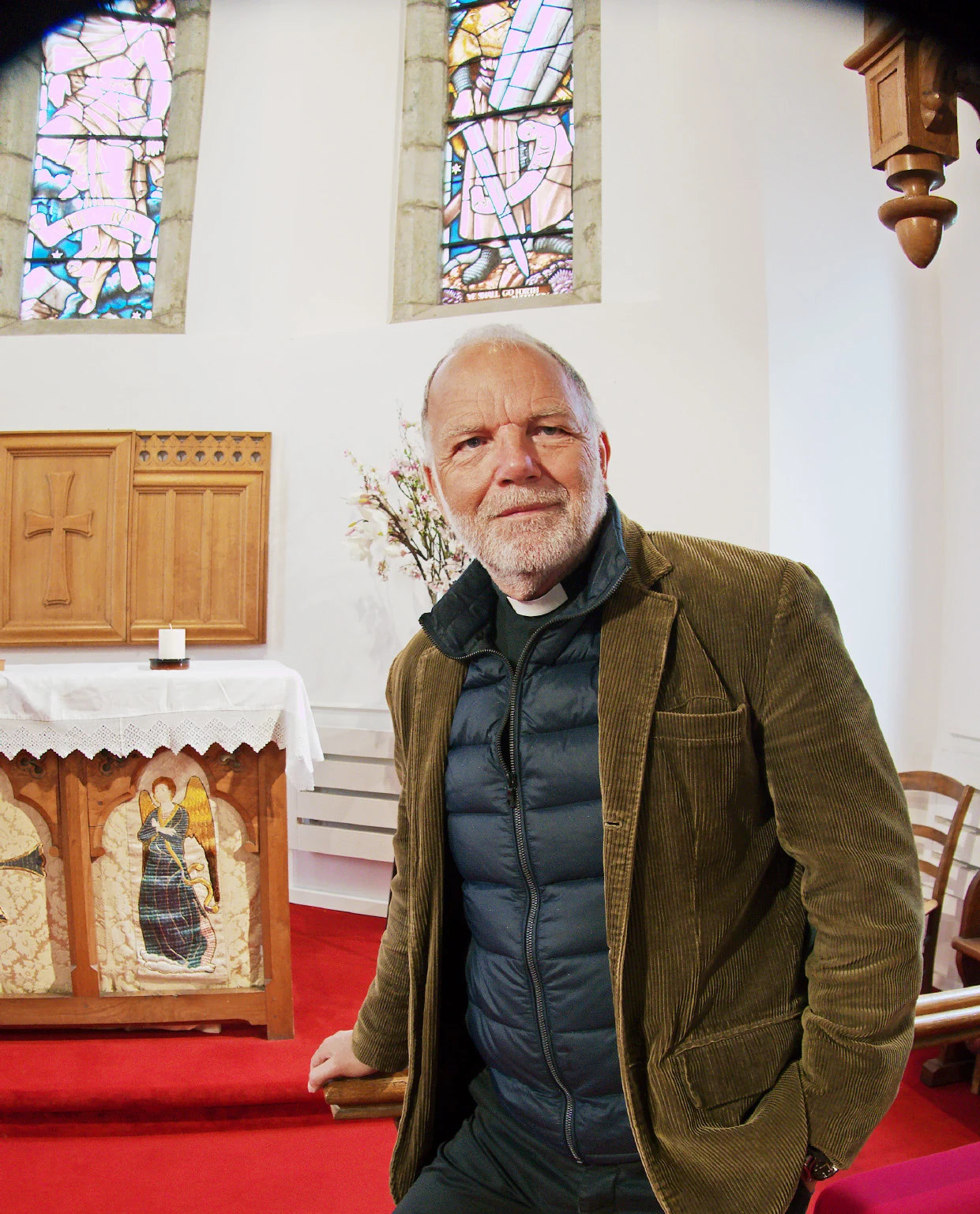
Revd Paul Cowley MBE preached at St. Peter’s on 2 and 9 August 2026, and spoke during his stay about the work he now leads. This page gathers what he has said about that work — in his own words, drawn from those two sermons and from interviews recorded at St. Peter’s in April 2026.
He is Managing Director of the Second Chance Partnership. Before that he built the Second Chance Initiative at Iceland Foods. The two names are easily confused, and the difference is the whole point of the second one: the Initiative proved the model inside a single company, and the Partnership exists to carry it beyond Iceland, to turn one retailer’s way of doing things into something any national employer can adopt.
Where the phrase second chance comes from is not incidental either. It was given to him, once, in a recruiting office in Manchester, half a century ago.
Manchester
Paul was born in Manchester in the late 1950s, to parents who were both alcoholics. Much of his childhood was spent in bars while they argued. “My father was a fighter and my childhood was very disruptive,” he says. “It wasn’t a good childhood.”
At fifteen, nearly sixteen, he argued with his father and was thrown out of the house. He went willingly enough, thinking it would be easier outside than in, and it was not. He slept on the streets of Manchester, then began stealing, shoplifting and taking cars, until the courts ran out of patience with him. He went into the hearing expecting a fine and a telling-off.
“The magistrate on the bench said, you are not doing what we want you to do, Cowley. You, my son, are going to prison.”
He went to borstal, and then to prison. He describes the experience in two words — really awful — and it left him frightened rather than reformed. “I was scared to get involved with people,” he says. “I thought I might go back to prison again.” For a few years afterwards he lived alone and took whatever work he could get, keeping everybody at arm’s length. His parents had divorced and separated after he left, so there was no family to go back to either.
The second chance he was given first
In January 1976 Paul was driving a removals van, cash in hand, when he saw a billboard for the British Army — do you want a life of adventure? He parked the van and walked into the recruiting office in Manchester, where he told them the truth: that he had been in prison as a young man, that he had made mistakes, and that he wanted to change. They turned him down, because a criminal record was a bar. But on his way out, the sergeant major said something Paul did not know what to do with: “Don’t give up, son. You never know, if you keep trying.”
So he kept trying. For six or eight weeks he went back, had the same conversation and got the same answer, until eventually he asked them to simply tell him no and stop giving him false hope. Instead they took him through to the back offices and sat him down in front of a senior officer.
“We’ve been watching you for the last eight weeks and you seem pretty determined… I’m going to take a chance on you, son. Do not let me down. I’m going to give you a second chance.”
The officer stamped his form, and seventeen years in the army followed: two tours of Northern Ireland, the Falklands, four different regiments, discharge as a staff sergeant. He was good at it, and he is careful not to make it sound redemptive. “The soldiering was very good. It saved my life,” he says. “But personally, my life was just a mess.” There were two marriages and two divorces in those years, and he describes himself in that period without much mercy: “I became like my father. I was a womaniser. I was a drinker. I was a fighter. I was not a good man.”
His mother’s Bible
Near the end of his army career, Paul’s mother made contact through the military and asked to see him. He had not seen either parent since the day he left home. He said yes — why not — and she came to stay with him and Amanda, his girlfriend and later his wife. Then the army sent him away for three months to teach young soldiers to ski, and while he was gone she fell ill. He was brought home on compassionate leave and had ten days with her.
“She died of cancer. She died in my arms, actually. I got into bed with her in the hospital, and I held her, and she died.”
He was left with her clothes and no idea what to do with them, so he bagged them up for the charity shops. Going through them he found a Bible, which surprised him, because his mother had no faith that he knew of. Inside were photographs of him as a child, passages marked in highlighter, and a telephone number written in the back.
He rang it.
“I just said, who are you? How do you know my mother? And why is your number in the back of this Bible? And the lady answered on the phone and said, you must be Paul… I said, yes I am, but how do you know her? Your mother became a Christian, and that Bible that you’ve got is the one that was given to her when she was baptised. And we all know about you in the church, because we’ve been praying for you.”
He told her his mother was dead, and hung up. But the question the call had opened would not close again. “That was the catalyst for me to start thinking, how did my mother become a Christian? She was a crazy woman.”
Throwing in the towel
Paul had been, by his own account, an atheist for nearly thirty-eight years. He started going to church to answer the question his mother had left him, and ended up on an Alpha course at a large London church with Amanda — though he nearly didn’t get there, since “lots of things came up that were stopping us”. The moment, when it came, was on the weekend away. The talk was Nicky Gumbel on the Holy Spirit, and the sentence that landed was that God loves people unconditionally.
“And I was thinking about my past and all the things I’d done, and things I’d told people I’d done, and things I wouldn’t tell anyone that I’d done. And I thought, goodness me, God knows all those things that I’ve done that I’ve not told anybody, and he could still love me unconditionally.”
He slipped to his knees at the back of a full room, hoping nobody would see, and prayed that if there was anyone up there and any of this was true, he needed some help — “because I’m just tired of being on my own, and everything felt like a fight, like a battle.”
The picture that came to him was from boxing. He had learned to box in the army, having been bullied at school and decided it would not happen again, and he knew what happens when one fighter is plainly too strong: the corner throws in the towel. “And I felt God say to me, why don’t you just throw the towel in, and we’ll do this stuff together from now on?”
Two men he knew came and put their hands on his shoulders and prayed. That was 1994.
Dartmoor
The first prison visit after his conversion was not his idea. Paul was then general manager of a large London health club, in at seven and rarely out before eleven at night, and a persistent colleague at the church kept asking him to come along until he said yes to make her stop.
It was HMP Dartmoor, remote on the moors and since closed. He finished at the club at half past eleven at night and drove straight down, arriving at four or five in the morning for an eight o’clock start, slept in the car, and was woken by his colleague banging on the window. Then, in the chapel, in front of forty or fifty men, she announced without warning that Paul would now stand up and give his testimony. “Didn’t ask me,” he says. “And I was so nervous. I was so nervous about speaking. And I got through it anyway.”
It was the first time he had ever spoken publicly about his past. Driving home alone afterwards, something settled.
“I felt he said to me, you did okay there. That was all right, well done. I’ve got a job for you, if you’ll be brave and courageous. If you’ll trust me… I’ve got a job that I think we can do well together.”
He asked for another visit, then another. “I fell in love with it, if that’s the right thing to say,” he says — which made no sense from where he was standing. “I was in the health club industry, I was doing very well, I had a nice job, money, all the toys to go with it. But I wasn’t satisfied. I wanted to be back in a prison, which was very weird.”
When the church offered him a job as a prison pastor, the salary turned out to be less than his expense account had been. “I said to her, is that the whole salary? She said yes, that’s what we pay. And I said, let me think about it.”
He took it.
The man at the gate
Ordained in 2002, Paul founded Caring for Ex-Offenders in 2005. The idea was simple: meet people at the prison gate on the day of release, and connect them to a church that would take responsibility for them. Before there were staff, it was him standing at the gate. He points out, with some relish, that this is roughly where probation came from in the first place: a church volunteer who went with people to court, and a collection to pay for it. He once found himself telling that story over dinner to the head of the London Probation Service.
The man he still talks about is one he first met in Dartmoor: a violent character who became a Christian on an Alpha course inside, was moved around the prison system, and was eventually released from Brixton, where Paul met him at the gate with his bin bag and took him for breakfast. The charity had only a handful of employers willing to take people on, and what they offered was unglamorous. The council in London could provide street sweeping, and almost nobody would take it.
“Nobody would take the job, because they all thought it was below them… And the thing with [him], what I remember is, he said yes straight away. I’ll take it. And he took the job, and he became one of the best street sweepers.”
Street sweepers push a cart with their brushes in it, and his had a covered compartment where he kept a Bible — “and what he loved about the job is he could read his Bible all day.” He went on to start a landscaping business, and employed ex-offenders himself.
Paul is careful not to make too much of it. “That kind of heart to change gave me encouragement that people can change,” he says. “But some people don’t want to change.” Around two thousand people came through the charity in all.
A bar in Botswana
The route to Iceland Foods was, by any reasonable standard, absurd. Paul had been doing prison work in Botswana, hard work and just finished, when colleagues invited him along on a short safari. The others went upstairs to change for dinner while he went to the bar, unshaven and in shorts, where a stranger struck up conversation and asked what he was doing there. “I said, you’re a bit cheeky, aren’t you?” They had a beer, and he explained the prison work, then his own background, then his testimony. The stranger was fascinated, and sceptical.
“And he said, so what — you’re, like, a priest? I said, yes I am. He said, what, dressed like that? I said, yeah — I’m just finished work.”
It was only then that the stranger said who he was.
“I don’t know if you know who I am. I said, no, I don’t. He said, my name’s Malcolm Walker. I founded Iceland Foods.”
Sir Malcolm Walker asked him to come to Chester. Paul went, and offered to find him somebody suitable to run a rehabilitation scheme. “He went, no, I want you. I said, I’ve got a job, I’m working at a church. He said, stop that stuff and come and work for me.” He signed a contract before he had resigned from Holy Trinity Brompton, where he had been on staff for more than twenty years, then went home and told Amanda he thought he had just taken a job.
The one condition he set was that the method would be his.
“If we’re doing it — I’ve done this for twenty-odd years, really, and a lot of it doesn’t work. The way it will work is this way. You have to do A, B, C and D. And they’re quite radical. And he went, okay.”
Because Iceland was a privately owned family business whose founder was personally committed to it, that instruction went down the chain without negotiation: “If Paul sends you somebody, you’re taking them. That’s the end of it.” And when it came to naming the thing, he reached back nearly fifty years to the recruiting office — “because I was given a second chance, I wanted to call it that.”
What makes the model different
Most employment schemes for prison leavers end in an interview. This one ends in a job.
“We offer a guaranteed job. If there’s no job available in the store, we pay for the job till there is available. We offer the job inside prison before they’re released, one hundred per cent. So they have a job, with a letter… Those two things are very radical, and still nobody’s doing that.”
The letter matters to Paul more than almost anything else about the scheme, because it is the difference between a promise and a job. “When I say, you’ve passed — you get a letter from me. It says well done, you passed the interview, your job will be at [the company]… So when you come out and you go to the site, whatever it is, you’re not going there for a second interview. You’re going there to start work.”
The obligation binds the employer as firmly as the candidate, and partners either sign up to it or stay out.
“If I send you Fred, he has a job with you. There’s no ifs or buts. If he fails your training week, or if he fails a drug test on Thursday, then fine, dismiss him. But otherwise he has a job — because that’s what I’m promising at the interview.”
He is unbending about it: “I don’t care how big a company are. If you can’t sign up to that, then I don’t want you on board.”
Against the guarantee sit fixed exclusions, and he is candid that every one of them was written by a failure. Nobody on the sex offenders register, partly a legal bar given that the partner businesses are public-facing. Nobody convicted of arson, which insurers will not wear. Nobody convicted of an act of terrorism. Nobody on a prescribed medication programme for drug addiction, because he tried it and found that stabilising on methadone and holding down a new job at the same time asks too much of a person. Nobody released homeless, with no fixed address, because he tried that too. “So everything that’s failed,” he says, “I’ve tried.”
Not everyone gets through. By April 2026 he put it at roughly fifteen or sixteen hundred face-to-face interviews conducted in prisons, from which around seven or eight hundred jobs had been offered, with about five hundred people working and another fifty waiting to be placed. Some of the gap is honesty: “A lot of them tell lies. Sometimes the prison system doesn’t really know what they’ve done… and if they tell lies and they don’t tell the truth, I don’t offer them a job, because that’s not a good start.”
Initiative, then Partnership
The Second Chance Initiative was built for one company, and it worked. By 2024 Iceland Foods had become, on its own account, the UK’s biggest retail new hirer of people leaving prison. Sir Malcolm Walker’s response was to ask for the thing to be given away.
“It was his idea, actually… ‘Let’s open this opportunity of what you’ve created with the Second Chance Initiative, and let’s get some partners on board, and have a standalone.’“
So a second, separate charity was founded in 2025: the Second Chance Partnership, a non-profit, with Iceland providing seed funding and Paul Cowley as Managing Director. Businesses join as partners and pay for the expertise; his team goes into prisons and interviews on their behalf. Asked directly what separates the two, he puts it simply.
“That’s the difference between the Second Chance Initiative, which was solely for a partner that was retail. It’s now opened up into different things.”
The practical gain is range. A retail-only scheme can only offer retail work, whereas a partnership can match a skill to a sector: forklift and HGV licences, warehouse operatives, poultry and farm work, hospitality, night shifts, apprenticeships. He describes interviewing a man with a class one HGV licence suspended for another six months: “There’s no HGV drivers at Iceland Foods, but there is at GXO.” A single employer would have had nothing for him.
Iceland Foods remains the founding partner, and other national employers have joined since — among them the logistics company GXO and 2 Sisters Food Group. The partnership is still recruiting employers, so the current list is the one published on its own site, scpartnership.org.uk; it is a registered charity, number 1213510, and now works in more than ninety UK prisons. Preaching at St. Peter’s on 2 August 2026, Paul Cowley put the running total at “over 800 jobs” offered to men and women leaving prison.
The objection, and his answer
The hardest part of the job, Paul says, is not the prisoners. It is the employers.
“I think most businesses want to do this work. They see the benefit, and they see that it’s a good business opportunity… But they’re scared. They’re scared of newspapers, they’re scared of mistakes. They’re scared of being on the front of the Daily Mail.”
He was once put the objection live on Times Radio. The interviewer asked how she should feel, as a single mother, opening her front door to a home-delivery driver just out of prison. He asked her instead about the building they were sitting in, where some two thousand people worked. Had every one of them been background-checked? Did she know what the person queuing in front of her in the canteen had done?
“She goes, no, not really. I said, so what we do is decrease the element of risk all the time. But you’re always going to have an element of risk… When Fred turns up with the shopping bags delivered to your house, I can guarantee you I know every single thing about him, and I’ve checked him responsibly. Safeguarding background checks, crime checks, everything.”
What he is offering, on that reading, is risk somebody has actually checked. The commercial case follows from there. There are no recruitment agency fees, and candidates arrive on full contracts rather than through an agency that treats them as a number. Retention and attendance among his placements, he says, run better than the general workforce — “if it works, they’re really keen to change their lives… and then you get a reliable workforce. You get a dedicated workforce.” Several have been promoted to supervisor, and one is training to manage a store.
He likes one story in particular, which GXO’s head of HR rang up to tell him, laughing.
“She went, no — he turned up in a suit and we all thought he was from head office. We weren’t quite sure what he was, but he was suited and booted, and he turned up for work… we just had a laugh, but thank you for choosing someone like that who really made an effort.”
On his own website the argument is put more bluntly: “Employing prison leavers isn’t charity — it’s good business.”
Inside the prisons
The work has grown past what one man can do. By April 2026 the team was five, several of them poached from the prison system itself: Prison Employment Leads, the staff who run employment hubs inside prisons, and Paul is unrepentant about where they came from: “I think I stole the best two.” Between them they were covering eight or nine prisons a week, interviewing five to seven men or women at each, with the country split east and west and a further appointment made to cover London’s seventeen prisons alone.
They had also begun building something new: the Second Chance Retail Training Academy, a working shop inside a prison, where prisoners buy their food, and where the people stocking the shelves and serving are prisoners being trained for retail work outside. Five were under way by April 2026, two of them trading.
Why he keeps at it
The reason is not commercial, and Paul does not pretend otherwise. Preaching here on 2 August, he described interviewing a young man for a job and opening with the simplest question there is — tell me a little about yourself.
“He was stunned, he was silent. I said, no, just talk, just chat while we have a coffee together. And then he looked up at me, and he said, no one has ever asked me that for years. I started to sob… These are these big macho men that you think are in prison — not when you break them down on their own and they realise what they’ve done. And he began to sob.”
The men themselves put it more bleakly. One told him that after a while “nobody even knows you’re alive”. Another gave him the line he now repeats most often, and it is why he asks employers for a job rather than sympathy.
“The punishment isn’t prison. The punishment is believing nobody will ever trust you again.”
Preaching a week later on Peter stepping out of the boat, he reached for the same people.
“I’ve met so many men and women leaving prison who were terrified of taking that first step back into society. Almost frozen. I’ve seen people at the gate — when the gates open, they’ve got their bag, and they’re on their way out, and they stop, frozen, solid, terrified to take that step into freedom.”
The argument he makes to businesses is the same one he makes from a pulpit. Almost everyone in prison comes out again. There are, he reckons, only about twenty-five people in the United Kingdom who never will.
“So the rest of them are coming out to your village, to your town, to your area, to your street. So let’s help them when they come out, not go back in again.”
Hear Paul Cowley preach at St. Peter’s
- Five Loaves, Two Fish, One Surrendered Life — 2 August 2026
- Wind, Waves, and a Hand That Never Lets Go — 9 August 2026
More about his life and ministry: Paul Cowley MBE · All sermons by Paul Cowley
His autobiography, Thief, Prisoner, Soldier, Priest, was written by his wife Amanda and published by Hodder Faith in 2020.
Elsewhere on the web: the Second Chance Partnership’s own site is scpartnership.org.uk — the place to go to become a partner, or to see who the current partners are. Paul Cowley’s personal site, with his speaking, press coverage and long-form interviews, is paulcowleymbe.com.
Questions answered
- What is the Second Chance Partnership?
- The Second Chance Partnership is a non-profit charity founded in 2025 to help UK employers recruit people leaving prison. Businesses join as partners and pay for the charity's expertise; its team interviews candidates inside prison and places them into guaranteed jobs on release. Its founding partner is Iceland Foods, and other national employers have joined since. Its Managing Director is Revd Paul Cowley MBE.
- What is the difference between the Second Chance Initiative and the Second Chance Partnership?
- The Second Chance Initiative is the programme Paul Cowley built inside Iceland Foods from 2022, placing people leaving prison into retail and delivery roles at that one company. The Second Chance Partnership, founded in 2025, is a separate charity that opens the same model to other employers. As Paul Cowley puts it: 'That's the difference between the Second Chance Initiative, which was solely for a partner that was retail. It's now opened up into different things.'
- Which companies are part of the Second Chance Partnership?
- Iceland Foods is the founding partner, and other national employers have joined since — among them the logistics company GXO and 2 Sisters Food Group. The partnership is still recruiting employers, so the current list of partners is the one published on its own site at scpartnership.org.uk.
- How does the Second Chance model work?
- Two features make it unusual. The job is offered inside prison, before release, confirmed in a letter the candidate carries out with them — so they leave with employment already secured rather than the promise of an interview. And if no vacancy exists at that moment, the employer pays for the post until one does. In Paul Cowley's words: 'Those two things are very radical, and still nobody's doing that.'
- Who is not eligible for the scheme?
- The charity applies fixed exclusions: nobody on the sex offenders register, nobody convicted of arson, nobody convicted of an act of terrorism, nobody on a prescribed medication programme for drug addiction, and nobody released without a fixed address. Paul Cowley describes these protocols as learned the hard way: 'Everything that's failed, I've tried.'
- Why are employers reluctant to hire people leaving prison?
- Paul Cowley's answer is that the barrier is fear rather than principle: 'I think most businesses want to do this work. They see the benefit… But they're scared. They're scared of newspapers, they're scared of mistakes.'
- Does employing prison leavers make business sense?
- Paul Cowley argues it does, on two grounds: no recruitment agency fees, and a workforce whose background is known in full detail, unlike an ordinary hire. He also points to retention and attendance among his placements being better than the general workforce. As he puts it on his own website: 'Employing prison leavers isn't charity — it's good business.'
- What is a Second Chance Retail Training Academy?
- A shop inside a prison, run as a working store where prisoners buy food, staffed and stocked by prisoners who are being trained for retail work on release. Five had been established by April 2026, two of them trading.