History of English Churches in Switzerland – Lausanne
In September 1822 an advertisement in English appeared among the notices of the Feuille d’avis de Lausanne. It offered for sale “An english travelling Chariot built in London by Bolton”, which had “never made but two journies, viz, from London to Lausanne and from Lausanne to Geneva”. It came with a table and bed, tea and sugar chests, and room outside for two servants. The owner was parting with it only “by reason of its not being roomy enough for a large family”. Enquiries were to go to “the Rev. J. Cheesbrough, campagne de la Borde, Lausanne”. That was almost certainly Isaac Kendal Cheesbrough, who had just come to Lausanne as its first permanent English chaplain. He stayed for thirty-five years.1 The congregation he served would not have a church of its own, Christ Church, until July 1878.11
The early congregation
The English had been worshipping in Lausanne for six years by then. The end of the wars with France brought British travellers back to the Continent, and in 1816 the literary review Bibliothèque universelle remarked that it was “raining English”. The first English service in Lausanne was held on Sunday 10 November 1816 in the Chapelle de la Mercerie, with a chaplain named Thruston. The chapel stood on the site of the medieval church of Saint-Étienne. It had been built in 1811–12 for the town’s German-speaking Protestants, who shared it with the Roman Catholics and then with the English. The building still stands and has long been used by the Gymnase de la Cité. On 15 July 1818 members of the congregation drew up the “Constitution of the English Church in Lausanne”. It provided for a subscription and collections to pay for the chaplaincy, and a service every Sunday at half past eleven. At times the English also borrowed the cathedral and the church of Saint-Laurent.2
What drew them to Lausanne was not so much the lake as the French language. From the 1820s, Paul Schniewind writes, more and more young British people came to Lausanne to study, often lodging with families who were glad of the income. The settled colony was small. Answering a questionnaire in 1845, Cheesbrough counted about eighty English residents, “chiefly of the upper and middle classes”. There was a summer influx of visitors, and a congregation of between eighty and two hundred. Further along the lake, the Montreux shore would become a winter home for English invalids, a story told on our page Wintering on the Swiss Riviera. Lausanne’s English came for its schools.3
Cheesbrough came from Chester, and he settled into Vaud life more thoroughly than most English chaplains. He married Catherine Constance Tissot, the daughter of a Vaudois pastor. His work took him well beyond Lausanne, to Nyon, Morges, Vevey, Yverdon and, often, Berne. There he held services for the British minister, and in 1839 he buried two of the minister’s daughters. The register he began in 1822 was kept up by his successor until 1867.4
It was Cheesbrough who answered the same 1845 questionnaire. In nearly a quarter of a century, he wrote, he had “never had the pleasure of seeing one of our spiritual fathers”. No bishop had come, and he had to admit young people to Holy Communion on the promise that they would be confirmed when they could. That complaint opens our page on the English churches in Switzerland, which tells how the Church of England eventually answered it. In Lausanne confirmations stayed rare. The only one on record in Cheesbrough’s time was held by the Bishop of London on 2 September 1850. Nineteen candidates came forward, five of them from the de Cerjat family, who had helped to found the congregation.5
In the autumn of 1840 the congregation left the Mercerie for the new Swiss church at Ouchy, down by the lake. It had been built with a large gift from the English philanthropist William Haldimand. The English held their services there, between those of the national church, until 1878. That story, and Haldimand’s, is told on the page for the Temple de la Croix d’Ouchy.6
Cheesbrough died on 31 July 1857. The town’s register of deaths, printed in the Feuille d’avis, lists him simply as “Isaac-Kendal Cheesbrough, ministre anglais, âgé de 64 ans”.7
A church of their own
Under his successors the congregation grew. John Lawson Sisson welcomed Archibald Tait, Bishop of London and later Archbishop of Canterbury, as a preacher in 1861, and the Archbishop of York in 1867. By then the arrangement at Ouchy was proving too small and too awkward. The English complained of noise, of the size of the church and of the hours, especially when the Swiss held their Sunday election meetings there. Rosemary Raedler-Hacking, in her history of the church, credits the de Cerjat family in particular with the decision of 1864. That was the decision to look into building a church of their own.8
The building committee had the good fortune to obtain plans from George Edmund Street. He was one of the leading church architects in England, and later the architect of the Royal Courts of Justice in London. His plans are dated 1875, and that October the committee issued a notice launching a building fund. The work was carried out by two Lausanne architects, Edouard van Muyden and Maurice Wirz, under an agreement signed on 9 November 1876 by Robert Baird for the committee. Van Muyden modified Street’s design a little, most visibly at the entrance. The land was bought in May and June 1877.9
A week later a short notice appeared in L’Estafette, signed “Le Comité”. The foundation stone of the new English church would be laid on Tuesday 19 June at eleven o’clock. It would follow a service at ten “précises” in the church at Ouchy, taken by the chaplain, the Revd Robert Eden. Into the stone went copies of that day’s Estafette and two numbers of the Gazette de Lausanne. With them went a handwritten history of the congregation since 1818, the visiting cards of five of the contractors, and a paintbrush.10
The building went up quickly. On 1 February 1878 L’Estafette reported that the roof was finished, and that people admired “l’élégance et le bon goût du petit clocher qui la surmonte”. On 2 July the Feuille d’avis was asked to announce that the new English church, “(Christ-Church), au boulevard de Grancy”, would be inaugurated on Thursday 4 July at noon. The following Sunday the paper’s list of services carried a new heading, “Eglise anglaise (Christ Church)”, with Eden preaching at eleven in the morning and four in the afternoon.11
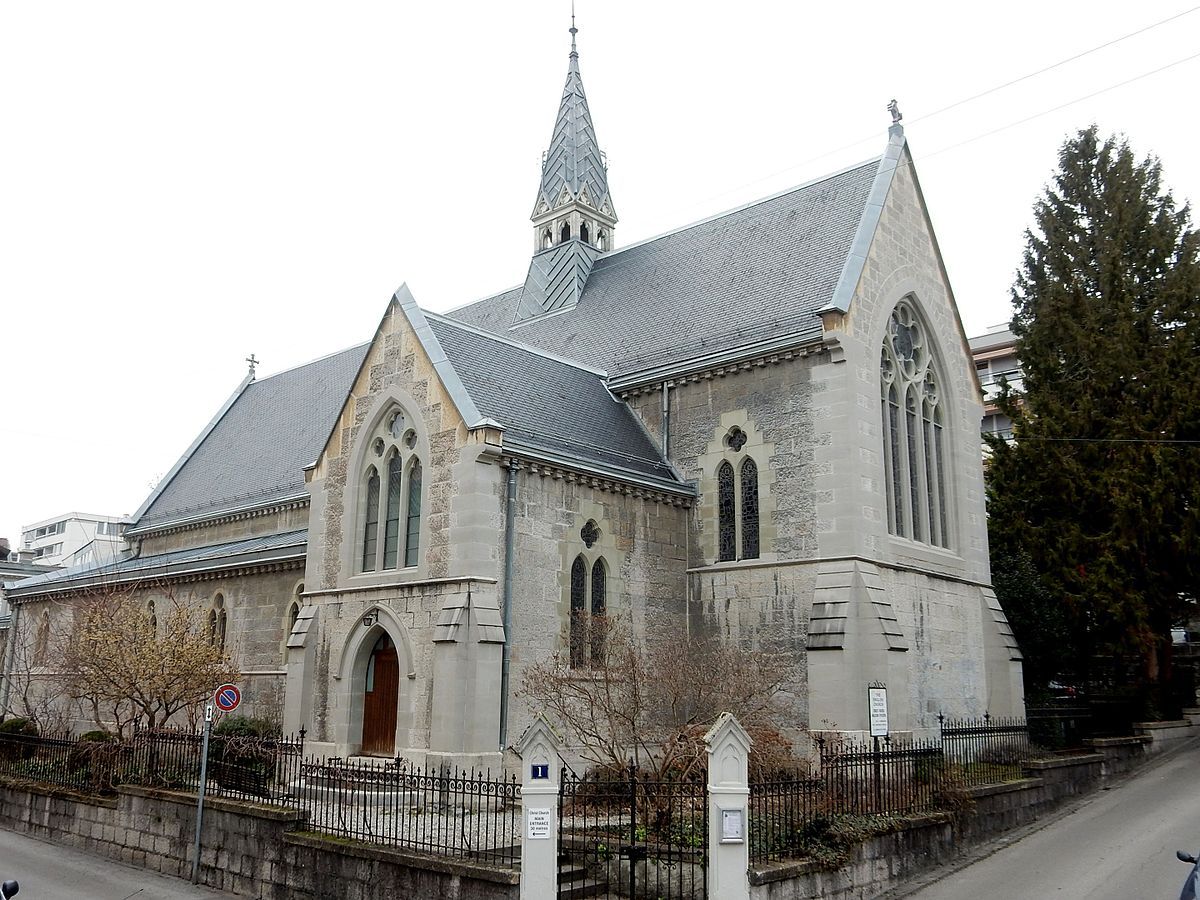
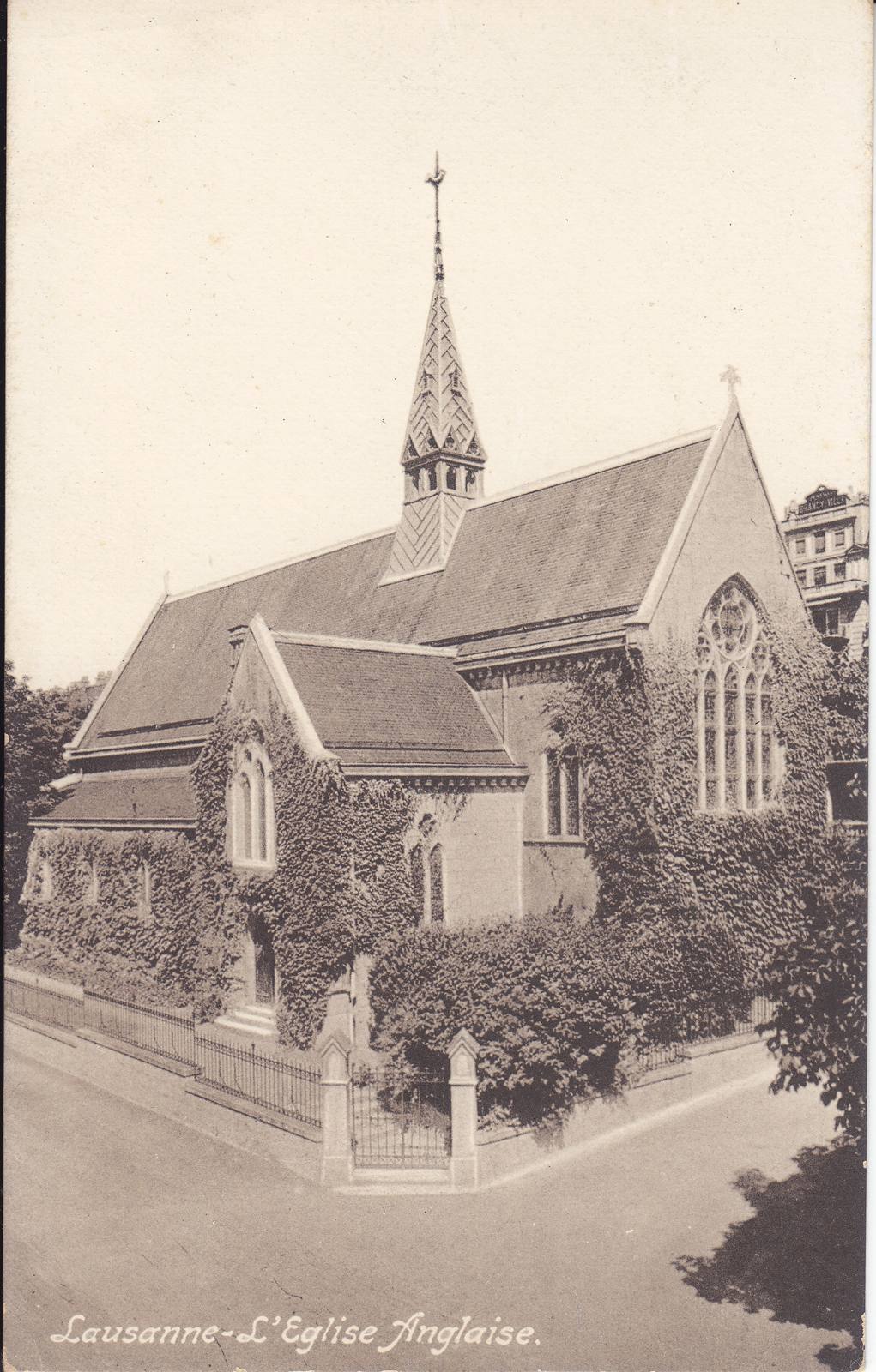
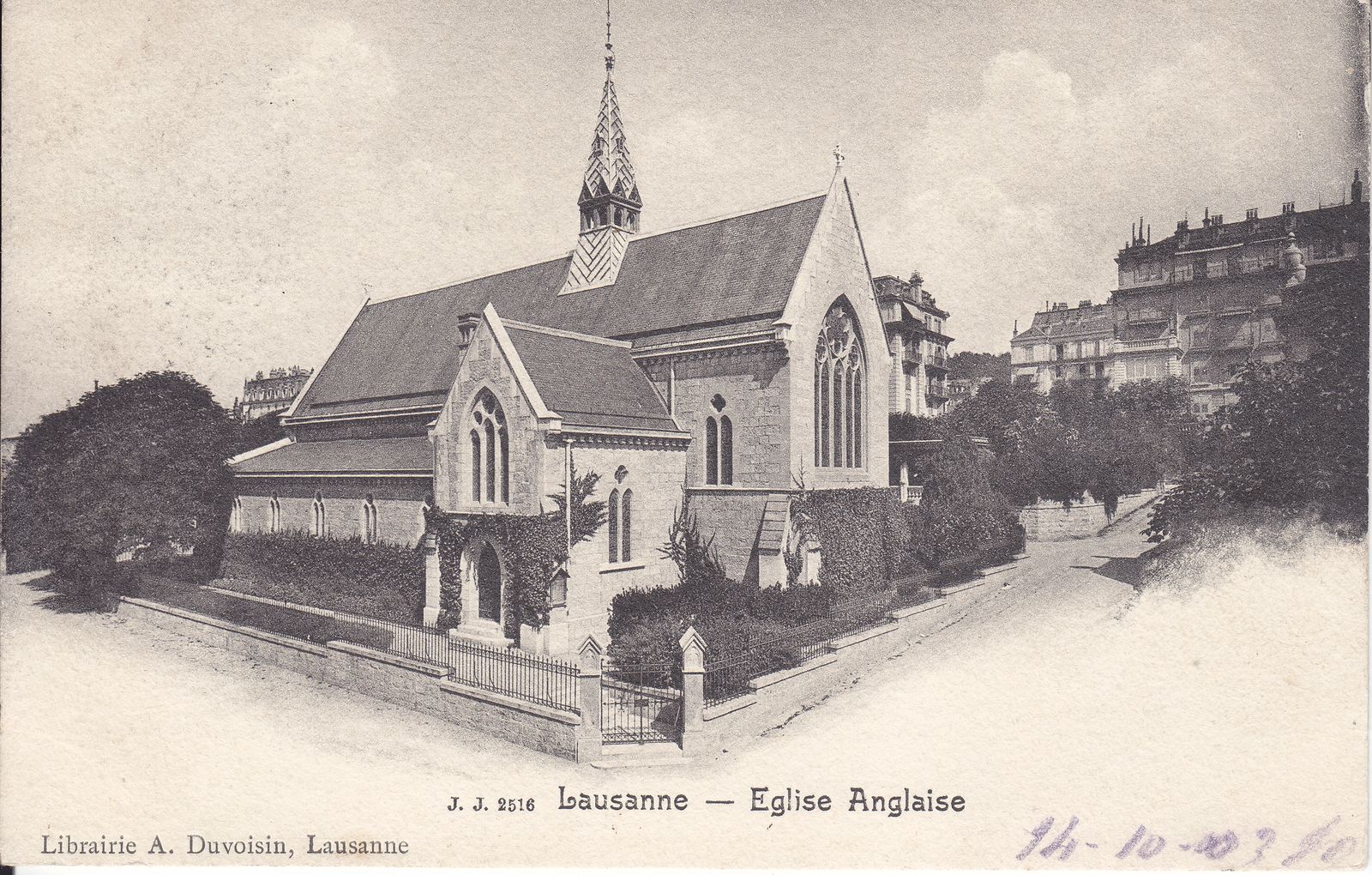
Street’s church mixes the two countries. The steep roof and the little bell turret perched on it are local in feeling. The porch, the stonework and almost everything inside, from the timber vault to the paired windows, are English. The windows are by Clayton and Bell of London, who often worked with Street. It was the only church in the town apart from those of the national church allowed a bell, which at first was a large cowbell.12
In October 1882 two young Englishmen came to Lausanne to learn French. They were the elder sons of the Prince of Wales, Prince Albert Victor and Prince George, the future King George V. The Feuille d’avis reported in January that they had gone home to their parents for Christmas and would return about the 16th. They were staying, with a governor, at the Hôtel Beau-Rivage at Ouchy. They left on Ascension Day, Thursday 3 May 1883, by the 4.22 train. The paper noted an original touch to their departure. A young naval officer in their party, Mr Anderson, made his entrance into the carriage “d’un saut, la tête la première, par dessus la portière déjà fermée”. The church’s own history says that the princes attended services at Christ Church and became close to Eden. The local papers we have read do not mention their churchgoing.13
The new church had been opened with a debt, and it could not be consecrated until the debt was paid. The last payment was made by an anonymous friend at Christmas 1886. By then the church was full. Several months before the consecration the chaplain, Paul Singer, reported: “Our church is crowded; so that many have to leave for want of standing room.”14
The bishop who came to consecrate it was Thomas Wilkinson, bishop for the English congregations of Northern and Central Europe. He had first confirmed in Lausanne in June 1886, and wrote in his journal of “the beautiful church built by Mr Street”. On Monday 6 June 1887 he returned. The Nouvelliste vaudois reported that at half past ten “l’évêque Wilkinson, du Zoulouland” had consecrated the English church “devant une nombreuse assistance”. With him were the chaplains of Lausanne, Territet, Geneva, Aigle and Vevey, and several English clergy passing through. The church was beautifully decorated with flowers and greenery, and at half past three the bishop confirmed thirty-five candidates.15
A town of schools
Wilkinson was struck by one thing above all. After visiting the Sunday school in 1887 he wrote that he knew of hardly any other chaplaincy on the Continent that had one. “Here I am told that the children number 200.” Lausanne was a town of young people, and the church was full of them. During the long chaplaincy of Daniel George Davies, from 1891 to 1912, the town almost doubled in size, and the church had to be enlarged. Plans were drawn in March 1897. In 1898 a south aisle and south transept were added, with a heating chamber beneath, and the walls, railings and gates followed in 1899. The church now seated more than five hundred, and it remains the largest church in the English Gothic Revival style in Switzerland. Among those who knew it were the young officers who came to Lausanne to learn French for their army examinations. Many of them went on to serve in the South African War.16
The First World War scattered the colony. Families went home, young men joined the forces, and eighteen names are recorded on the church’s memorial board. Services continued throughout the war.17
Gustavus Bieneman, who became chaplain in September 1920 after years as chaplain and university teacher at Neuchâtel, brought the church back to life. He invited Swiss pastors to preach at monthly student services, and worked closely with the Scots Kirk. On Remembrance Day, Wednesday 11 November 1925, the English and Scots ministers held a joint service at Christ Church, by then described as on the avenue d’Ouchy. Some 700 people came to a church built to seat about 500. The Tribune de Lausanne noted that the organist, Mr Sainsbury, “a fait une fois de plus valoir toute la puissance et la beauté des nouvelles orgues de l’Eglise anglaise”. The same day more than 500 people went to the tea party of the Anglo-American colony, where a collection raised 1,300 francs.18
The next year Bieneman organised, with the minister of the Scots Kirk and the World Student Christian Federation, an Advent service in the cathedral that drew 1,800 people. Someone had called pre-war Lausanne “the town of the forty Colonels”, the report remarked. It might now be called “the town of ‘four times forty schools’”. In August 1927 the World Conference on Faith and Order met in Lausanne. At its opening service in the cathedral, on the morning of Wednesday 3 August, the organ was played by Mr Sainsbury, “organiste de l’Eglise anglaise”. The American Bishop Charles Brent preached in English. During the conference Christ Church held daily communion services and was lent to the Swedish Lutherans and the Old Catholics.19
The schools shaped the church for another generation. When Bieneman retired in 1935, the president of the association of Lausanne girls’ schools wrote to the church committee. “The greater number of the congregation is composed of young people,” she said, and she asked for a chaplain with experience of teaching. His successor, Frank Middleton, began talks on religion in all the larger schools. Early in 1937 the committee lost its chairman, Baron Axel de Reuterskiöld, who had been elected in August 1884 and had served for fifty-three years.20
War and after
Christ Church stayed open through the Second World War, but only with the help of a bank loan of 60,000 francs, secured on the building. After the war the committee repaid it, but had to sell the land to the east of the church to the town. Chaplains came and went until Llewellyn Powell began ten years’ service in 1949.21
The church celebrated its centenary with a communion service on 9 June 1978, the bishop celebrating. Michel Jéquier published a history of the congregation. An exhibition on the English in nineteenth-century Lausanne was held at the Ancien-Évêché, and the church’s papers went to the Archives cantonales vaudoises the following year. After an appeal and the church’s listing as a historic monument, the architect Alberto Sartoris restored the building.22
A new round of restoration began in the 1990s. The west wall and its windows were restored in 1996–97, the east window in 2003, and a new floor with underfloor heating was laid in 2012. In August 2003 the builders opened the foundation stone laid on 19 June 1877. Inside they found what the committee had put there: the newspapers of that week, the history of the congregation, the contractors’ cards and the paintbrush. They were given to the Archives cantonales vaudoises in 2005, to join the rest of the church’s papers, which begin with the constitution of 1818.23
Christ Church stands at avenue de l’Église-Anglaise 1, just off the avenue d’Ouchy, in the street named after it.24
Rosemary Raedler-Hacking’s Anglican Worship in Lausanne is the congregation’s own account of this story, and several of the details above are drawn from it.
We would like to know more about the English in Lausanne, particularly the chaplains and families of the years before 1878, and about the church in the Second World War. If you have papers, photographs or memories of Christ Church, please write to us at info(a)stpeters.ch. The other English churches of Vaud are described on our guide to the English churches in Switzerland.
-
Feuille d’avis de Lausanne, 24 September 1822, p. 2, “To be sold” (Scriptorium item 40046), read on the page image. The advertisement gives the initial “J.”; the identification with Isaac Kendal Cheesbrough, whom Paul W. Schniewind, Anglicans in Switzerland (Berne, 1992), pp. 46 and 52, has arriving in 1822, is ours. La Borde was a country property “à cinq minutes de Lausanne” (Feuille d’avis de Lausanne, 20 October 1840, p. 3, item 40989). ↩
-
Schniewind, pp. 6 and 46, for the review’s remark (Bibliothèque universelle, 1816), the first service, the chaplain’s name and the constitution; he spells the chaplain “Thuston” in his text and “Thruston” in his list, and the Archives cantonales vaudoises (ACV) give “NN. Thruston, 1816–1817”. The constitution’s provisions are from Rosemary Raedler-Hacking, Anglican Worship in Lausanne. For the building: “Ancienne église et cure de la Mercerie”, notreHistoire.ch, 1 December 2013 (the German Protestants from 1812, Catholics 1814–1835, Anglicans 1818–1840), and Ville de Lausanne, Les lieux de culte lausannois: notices historiques (2011, after Catherine Schmutz Nicod, 2009), entry for the Église de Villamont (built by Henri Perregaux in 1811, later the gymnasium of the Gymnase de la Cité). The borrowed cathedral and Saint-Laurent are from the ACV inventory, fonds P Eglise anglaise (2012), “Histoire du producteur”. The 1816 service falls before the Lausanne papers held by Scriptorium begin, so it has not been checked in the press. ↩
-
Schniewind, pp. 6–7 and 47, quoting Cheesbrough’s reply to the Biber questionnaire (Biber Report, 1845). ↩
-
Schniewind, pp. 46–47 and 61–62. The ACV inventory gives Cheesbrough’s dates as 1790–1857; the death register of 1857 (note 7) makes him 64. ↩
-
Schniewind, pp. 7 and 47. The Biber report does not name the minister at Lausanne; the identification is Schniewind’s, and our guide page follows it. ↩
-
Schniewind, p. 47; Courrier Suisse, 17 November 1840, p. 3 (Scriptorium item 733775), for the English service on the day the church was dedicated, Sunday 15 November 1840. Schniewind also says the congregation worshipped “until 1849 at the Mercerie”, which contradicts his own “autumn 1840” and every other source; we take 1849 to be a misprint. ↩
-
Feuille d’avis de Lausanne, 11 August 1857, p. 4, “Morts à Lausanne, Juillet 1857” (item 42200), read on the page image. The ACV hold an account of a “Cheesbrough Testimonial Committee” dated January 1857. ↩
-
Schniewind, pp. 47 and 52; ACV inventory, “Histoire du producteur”, for the complaints (“bruit, taille trop petite des localités, problèmes d’horaires — surtout en relation avec des réunions électorales qui se tenaient souvent le dimanche”); Raedler-Hacking, for 1864 and the de Cerjats. Schniewind’s text calls Sisson “Joseph Lawson Sisson” and his list “John Lawson Sisson”; the ACV list agrees with “John”, and the Almanach de Lausanne for 1861 has “Rév. Sisson”. ↩
-
Schniewind, p. 47; Les lieux de culte lausannois, entry 2, “Eglise anglaise”, for the plans dated 1875 and the architects van Muyden and Wirz; ACV inventory, P Eglise anglaise 6/1 (agreement of 9 November 1876), 5 (purchase of the land, 25 May – 29 June 1877) and 8/1 (the “Rising Fund”, notice of October 1875); Raedler-Hacking, for van Muyden’s changes and the entrance. ↩
-
L’Estafette, 18 June 1877, p. 1 (item 96338), read on the page image; the same notice appears in the Feuille d’avis de Lausanne, 15 June 1877, p. 4 (item 45688). The contents of the stone are from the ACV inventory, P Eglise anglaise 8/2, which lists the Gazette de Lausanne of 16 and 18 June 1877 and L’Estafette of 18 June 1877. No report of the ceremony itself has been found in the Scriptorium papers; the Gazette de Lausanne is not held there. ↩
-
L’Estafette, 1 February 1878, p. 3 (item 96531); Feuille d’avis de Lausanne, 2 July 1878, p. 4 (item 45993), and 5 July 1878, p. 4 (item 45927), all read on the page image. No report of the opening service has been found. ↩↩
-
Raedler-Hacking, for the architectural description and the bell; Les lieux de culte lausannois, entry 2, for the bell turret, the timber vault and Clayton and Bell. ↩
-
Feuille d’avis de Lausanne, 11 October 1882, p. 5 (item 87564); 10 January 1883, p. 4 (item 87643); 5 May 1883, p. 8 (item 87742), all read on the page image. The last gives their ages as 19 and 18. Ascension Day 1883 fell on 3 May. Raedler-Hacking, for their churchgoing and Eden. ↩
-
Schniewind, pp. 47–48, quoting the chaplain’s report. ↩
-
Nouvelliste vaudois, 7 June 1887, p. 3, “Lausanne” (item 115429), read on the page image; the report names the chaplains as “P.-A. Singer, pasteur à Lausanne; Sankey, pasteur à Territet; Last, pasteur à Genève; Caison, pasteur à Aigle, et Dice, pasteur à Vevey”. The same report is in the Feuille d’avis de Lausanne, 7 June 1887, p. 4 (item 89021). Schniewind, pp. 47–48, for Wilkinson’s journal of June 1886 and the consecration “in the presence of a large gathering of Anglican clergy from the Lake region”. ↩
-
Schniewind, p. 48, quoting the Record Book, 1887; ACV inventory, P Eglise anglaise 6/3 (plans of the enlargement, 22 March 1897) and 8/2 (invoices for the enlargement, 1898–99); Raedler-Hacking, for the aisle, transept, heating, walls and railings; Les lieux de culte lausannois, entry 2: “la plus grande église de style « Gothic revival » anglais de Suisse”. Davies’s dates are from the ACV list of chaplains. ↩
-
Schniewind, p. 48; Raedler-Hacking, for the memorial board and the services during the war. ↩
-
Schniewind, pp. 20 and 49, for the attendance of about 700 in a church seating about 500; Tribune de Lausanne, 14 November 1925, p. 2, “Remembrance-Day” (item 61277), read on the page image, for the tea that followed and the 1,300 francs raised (it gives no figure for the service itself). At the tea the British consul, M. Alfred Galland, welcomed the new American vice-consul, Mr F. W. Baldwin, and a Lieutenant-Colonel Marjoribanks spoke about the disabled ex-servicemen and the Earl Haig’s Fund. Raedler-Hacking dates the enlargement of the organ by Adolphe and Gustave Tschanun to 1924. ↩
-
Schniewind, p. 49; La Revue, 4 August 1927, p. 1, “Le Congrès de Lausanne. A la Cathédrale” (item 133817), read on the page image. ↩
-
Schniewind, pp. 49–50, quoting Miss D. M. Ruey’s letter of 27 July 1936 and a report of Whitsun 1936. ↩
-
Schniewind, p. 50; ACV inventory, P Eglise anglaise 9/2 (mortgage bonds of 1878, 1940 and 1945 in favour of the Crédit foncier vaudois). ↩
-
Schniewind, p. 51; ACV inventory, for the exhibition, the deposit of 14 March 1979 and Michel Jéquier, “L’Église anglaise de Lausanne”, Revue historique vaudoise, 1978, pp. 57–105, which the inventory calls the standard account. We have not yet read Jéquier. Les lieux de culte lausannois dates a restoration to 1974 and records the church as a listed historic monument. ↩
-
Raedler-Hacking, for 1996, 2003 and 2012 (a floor costing CHF 360,000); Les lieux de culte lausannois, for the restoration of the windows in 1997 by Werner Weyhe; ACV inventory, P Eglise anglaise 8/2 and “Modalités d’entrée” (the finds of August 2003, reported in 24 heures on 22 August 2003, handed over on 12 May 2005 by Adèle Kelham, priest-in-charge). ↩
-
Les lieux de culte lausannois, entry 2, for the address. The present service times and clergy have not been checked. ↩
Questions answered
- When did Anglican worship begin in Lausanne?
- The first English service in Lausanne was held on Sunday 10 November 1816, in the Chapelle de la Mercerie, with a chaplain named Thruston. On 15 July 1818 members of the congregation drew up the Constitution of the English Church in Lausanne. The first permanent chaplain, Isaac Kendal Cheesbrough, came to Lausanne in 1822 and stayed for thirty-five years.
- Who designed Christ Church, Lausanne?
- Christ Church, Lausanne, was designed by George Edmund Street, one of the leading church architects in England and later the architect of the Royal Courts of Justice in London. His plans are dated 1875. The work was carried out by two Lausanne architects, Edouard van Muyden and Maurice Wirz, under an agreement signed on 9 November 1876. Van Muyden modified Street's design a little, most visibly at the entrance.
- When was Christ Church, Lausanne consecrated?
- The foundation stone of Christ Church, Lausanne, was laid on Tuesday 19 June 1877, and the church was opened at noon on Thursday 4 July 1878. It could not be consecrated until its debt was paid, and the last payment was made by an anonymous friend at Christmas 1886. Bishop Thomas Wilkinson consecrated it on Monday 6 June 1887.
- Did any members of the British royal family worship at Christ Church, Lausanne?
- The two elder sons of the Prince of Wales, Prince Albert Victor and Prince George, the future King George V, came to Lausanne in October 1882 to learn French. They stayed at the Hôtel Beau-Rivage at Ouchy and left on 3 May 1883. The church's own history says that they attended services at Christ Church, Lausanne, and became close to the chaplain, Robert Eden. The local papers we have read do not mention their churchgoing.
- Why did the English come to Lausanne?
- The English came to Lausanne not so much for the lake as for the French language. From the 1820s more and more young British people came to Lausanne to study, often lodging with families who were glad of the income. A report of 1926 said the town might now be called "the town of 'four times forty schools'". The settled English colony was small. In 1845 the chaplain counted about eighty English residents, with a summer influx of visitors.
- Where did the English worship in Lausanne before Christ Church was built?
- The English in Lausanne worshipped at first in borrowed churches, above all the Chapelle de la Mercerie, built in 1811–12 for the town's German-speaking Protestants. At times they also used the cathedral and the church of Saint-Laurent. From the autumn of 1840 until 1878 they held their services in the new Swiss church at Ouchy, the Temple de la Croix d'Ouchy, between those of the national church.
- What happened at Christ Church on Remembrance Day 1925?
- On Wednesday 11 November 1925 the English and Scots ministers held a joint Remembrance Day service at Christ Church, Lausanne. Some 700 people came to a church built to seat about 500, and the organist, Mr Sainsbury, played the church's new organ. The same day more than 500 people went to the tea party of the Anglo-American colony, where a collection raised 1,300 francs.
- Where is Christ Church, Lausanne?
- Christ Church, Lausanne, stands at avenue de l'Église-Anglaise 1, just off the avenue d'Ouchy, in the street named after it.