History of English Churches in Switzerland – Lausanne-Ouchy
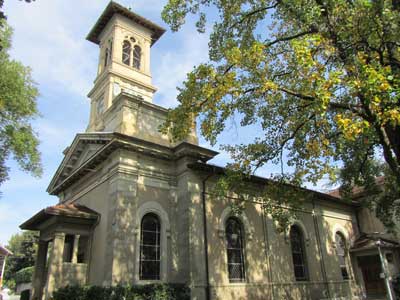
On Sunday 15 November 1840 a new church was dedicated at Ouchy, the lakeside village below Lausanne. The weather was bad, but a large congregation came. The parish minister, M. Espérandieu, preached. M. Bridel had been pastor to the people of Ouchy for several years, and he rose to give his old flock some words of affection and advice. At two in the afternoon M. Scholl climbed into the pulpit in his turn, to greet his former parish and wish it well. In between, the Courrier Suisse noted, “le service anglais a eu lieu à midi”. The English congregation of Lausanne had moved in on the first day, and it would stay for thirty-eight years.1 The church is the Temple de la Croix d’Ouchy, still the Reformed church of the quarter.8
A church for Ouchy
Ouchy had had no church of its own since the Reformation, when its medieval chapel of Saint-Théodule was abandoned. A church there was talked about in the eighteenth century, and seriously from about 1829. In 1838 two architects, Louis Wenger and Henri Fraisse, each submitted a design. Fraisse’s was built in 1839–40, on land belonging to the town. It was a plain neo-classical hall of three bays, with its bell tower rising above the entrance front. It was the first church of any size to be built outside the old town of Lausanne, and the quarter grew up around it.2
The town could build it because of William Haldimand. Paul Schniewind calls him “a very wealthy and benevolent English gentleman of Swiss origin”, and puts his gift at 75,000 francs. A public subscription paid for the rest. Haldimand lived at Denantou, his property near Ouchy. He had been Member of Parliament for Ipswich, and a director of the Bank of England. He helped to bring steamers to the lake and the railways to the town, and to transform Ouchy itself. For working people he built the wash-house and baths at the Riponne. The Asile des aveugles, the hospital for the blind, was to be his monument. He died at Denantou on 20 September 1862, in his seventy-ninth year. The Nouvelliste vaudois called him “le philantrope lausannois par excellence”, and said that Lausanne had been in his eyes his native town. His funeral, the paper predicted, would be a day of public mourning. British papers carried his death a week later and remembered him as the member for Ipswich. The English church counted him among the laymen who had done most for it.3
Two congregations, one church
The English had worshipped since 1816 in the Chapelle de la Mercerie in the old town. At Ouchy they fitted their Sundays around the Swiss parish. In October 1840 the town announced the hours for the new church. There would be a sermon every Sunday at nine in summer and ten in winter, a prayer at two in the afternoon, and a catechism class on Thursdays. The English took the hours between, with a service in the late morning and another at half past three. A list of Lausanne’s Sunday services printed in October 1864 shows the pattern. At Ouchy the Swiss minister M. Curtat took the nine o’clock. Under “Eglise anglaise” came “A 11 ½ heures du matin et 3 ½ heures du soir, Mr. Sisson”.4
People in Lausanne came to call the building the “église anglicane”. The cantonal year-book listed the English chaplaincy, the post of a clergyman serving a congregation abroad, simply as Ouchy. Its edition for 1861 has one line under “Culte anglican”: “Ouchy — Rév. Sisson”. There were English congregations elsewhere in Vaud by then, at Vevey and Montreux among them, but the year-book did not list them.5
The arrangement had its trials. Rosemary Raedler-Hacking’s history of the congregation says that noise from the local inn often disturbed the afternoon service. In 1864 the church council asked the authorities for more seats and for kneelers. It dropped the idea when it learnt that the English would have to pay. The cantonal archives’ account of the congregation lists noise, lack of room and clashes over the hours. It singles out the Sundays when the Swiss held their election meetings in the church. The same October 1864 list shows a second Anglican service in the town, at eleven in the chapel of the Terreaux, taken by a Mr Thompson. Who he was, and why there were two, we do not yet know.6
By the 1870s the English had decided to build a church of their own, Christ Church, on what is now the avenue de l’Église-Anglaise. One of their last occasions at Ouchy was on Tuesday 19 June 1877. The chaplain, Robert Eden, took a service in the church at ten o’clock, and the foundation stone of the new church was laid at eleven. They held their services at Ouchy for another year, and moved to Christ Church when it opened on 4 July 1878.7
The church today
The Temple de la Croix d’Ouchy is still the Swiss Reformed church of the quarter, now the Paroisse Saint-Jean. It stands where the avenues d’Ouchy, de Cour and de l’Elysée meet. It has changed since the English knew it. In 1901–03 a fourth bay and a larger gallery doubled its capacity, and the bell tower and front were remodelled in a medieval spirit. A parish hall was added at the east end in 1912. Beside the entrance, a monument put up in 1906 recalls the Banquet des Jordils, held on 14 July 1791 to mark the fall of the Bastille. In 1935 the church was given four new bells, named Espérance, Prière, Foi and the Christmas bell. The town’s own guide to its churches counts them among the finest peals in Lausanne.8
The story of the English congregation before and after its years at Ouchy is told on the Lausanne page. The other English churches of Vaud are on our guide to the English churches in Switzerland. If you know more about the English at Ouchy, or about Mr Thompson’s chapel, please get in touch at info(a)stpeters.ch.
-
Courrier Suisse, 17 November 1840, p. 3, “Lausanne” (Scriptorium item 733775), read on the page image: “C’est avant-hier, dimanche, qu’a eu lieu la dédicace du temple nouvellement construit pour la suffragance pastorale d’Ouchy.” The addresses of Espérandieu, Bridel and Scholl were printed and sold by the Lausanne bookseller Ducloux: Feuille d’avis de Lausanne, 19 January 1841, p. 1 (item 41002). Paul W. Schniewind, Anglicans in Switzerland (Berne, 1992), p. 47, gives the move as “autumn 1840” and the stay as 39 years. ↩
-
Ville de Lausanne, Les lieux de culte lausannois: notices historiques (2011, after Catherine Schmutz Nicod, 2009), entry 12, “Temple de la Croix d’Ouchy – Paroisse Saint-Jean – EERV”. Schniewind (p. 47) says it seated 400 to 500. ↩
-
Schniewind, p. 47; Les lieux de culte lausannois, entry 12 (“Ville de Lausanne avec don important du philanthrope d’origine anglaise William Haldimand (1784-1862), propriétaire de la campagne du Denantou, et souscription publique”); Nouvelliste vaudois, 20 September 1862, p. 4 (item 107810), read on the page image; Archives cantonales vaudoises (ACV), inventory of fonds P Eglise anglaise (2012), “Histoire du producteur”. The obituary says he died “cette nuit”, that is, the night of 19–20 September 1862. For the English side of his life, eight British papers of 26 September to 4 October 1862 carry the same deaths notice, among them the Morning Herald (London), 27 September 1862, p. 8, the London Evening Standard, 26 September 1862, p. 7, and the Dundee Courier, 29 September 1862, p. 4: “at his residence, near Lausanne, in the 79th year of his age, William Haldimand, Esq., formerly M.P. for Ipswich, and a director of the Bank of England” (read in the British Newspaper Archive’s OCR text, not on the page image; two copies misread the age as 70). Schniewind’s 75,000 francs is not sourced in his text; the Swiss franc was introduced only in 1850, so the currency of the figure is uncertain. ↩
-
Feuille d’avis de Lausanne, 20 October 1840, p. 3, notice of the Greffe municipal dated 16 October 1840 (item 40989), and 22 October 1864, p. 4 (item 43039), both read on the page image; Schniewind, p. 47, for “Sundays at 11am and 3.30 pm”. ↩
-
Schniewind, p. 47; Almanach de Lausanne, 1861, p. 44 (item 199063), read on the page image. The previous version of this page follows the entry in later editions, from 1866 to 1901; only 1861 has been rechecked here. For Vevey (from 1823) and Montreux (from 1853), Schniewind, pp. 52 and 56. ↩
-
Rosemary Raedler-Hacking, Anglican Worship in Lausanne, for the inn and 1864; ACV inventory, “Histoire du producteur”; Feuille d’avis de Lausanne, 22 October 1864, p. 4 (item 43039), and L’Estafette, 15 October 1864, p. 4 (item 92449), both read on the page image. ↩
-
L’Estafette, 18 June 1877, p. 1 (item 96338), read on the page image; L’Estafette, 22 June 1877, p. 4 (item 96342), still lists “Eglise anglaise (Ouchy)” with Eden. ↩
-
Les lieux de culte lausannois, entry 12, which also records the renovation of 1954, the transept windows of 1955 by François Ribas and the organ of 1962, and calls the bells “l’une des plus belles et majestueuses sonneries lausannoises”. ↩↩
Questions answered
- What is the Temple de la Croix d’Ouchy?
- The Temple de la Croix d’Ouchy is the Swiss Reformed church at Ouchy, the lakeside village below Lausanne, today the church of the Paroisse Saint-Jean. It was built in 1839–40 to plans by Henri Fraisse, on land belonging to the town, with a large gift from William Haldimand and a public subscription. It was dedicated on Sunday 15 November 1840. From then until 1878 the English congregation of Lausanne held its services there too, in the hours between those of the Swiss parish.
- Where did Lausanne’s Anglicans worship before Christ Church was built?
- From 1816 Lausanne’s Anglicans worshipped in the Chapelle de la Mercerie in the old town. From November 1840 they shared the new Temple de la Croix d’Ouchy with the Swiss parish, and on 4 July 1878 they moved to their own church, Christ Church.
- Who was William Haldimand?
- William Haldimand, whose gift made the church at Ouchy possible, was a very wealthy Englishman of Swiss origin who lived at Denantou, his property near Ouchy. He had been Member of Parliament for Ipswich and a director of the Bank of England. He helped to bring steamers to the lake and the railways to Lausanne, and built the wash-house and baths at the Riponne for working people. The Asile des aveugles, the hospital for the blind, was to be his monument. He died at Denantou on 20 September 1862, in his seventy-ninth year. The Nouvelliste vaudois called him “le philantrope lausannois par excellence” and predicted that his funeral would be a day of public mourning.