History of English Churches in Switzerland – Meiringen
In the summer of 1891 the Revd John William Horsley came to Switzerland for the first time. He spent a month as chaplain “in the little English church in the grounds of the Hotel Sauvage at Meiringen”, which he called “the charming village in the narrow Haslital”.1 One evening a party of young Londoners, clerks and shopmen mainly, walked into the hotel garden, tired from the long walk over from the Furka Pass. They came from the Regent Street Polytechnic, and a fortnight in Switzerland had cost each of them under eight pounds. Horsley began to wonder whether “Woolwich on the Alps” was really impossible. Letters and inquiries told him that it could be done, and the next summer he came back with a party of his own.2
Dr May’s church
By then there had been English services at Meiringen for more than forty years. Paul Schniewind, in his history of the Anglican chaplaincies in Switzerland, records that the Revd Dr May of Nottingham started the first services in 1850. From 1864, he writes, the authorities let Dr May use the little Swiss church, built in 1486. In 1868 Dr May decided to build a new church in Swiss style. Eduard Baud, the proprietor of the Hôtel Sauvage, gave the site in the hotel garden, and the church opened in June that year.3 Ruth Freiburghaus, writing in St Ursula’s Church Magazine in 2016, dates the new church to 1864. In Schniewind’s account, though, that was the year the services moved into the Swiss church.4
That August Queen Victoria came to Switzerland for a four-week holiday, staying on the Gütsch above Lucerne. Schniewind writes that she gave £50 towards the new church at Meiringen, though he does not say that she went there. Freiburghaus reckons the gift at £4,000 or more in today’s money.5 Schniewind also records that the Society for the Propagation of the Gospel had the right to nominate Meiringen’s chaplains from 1876. In 1906 the Society accepted the patronage, and so became the church’s patron.6
The fire of 1891
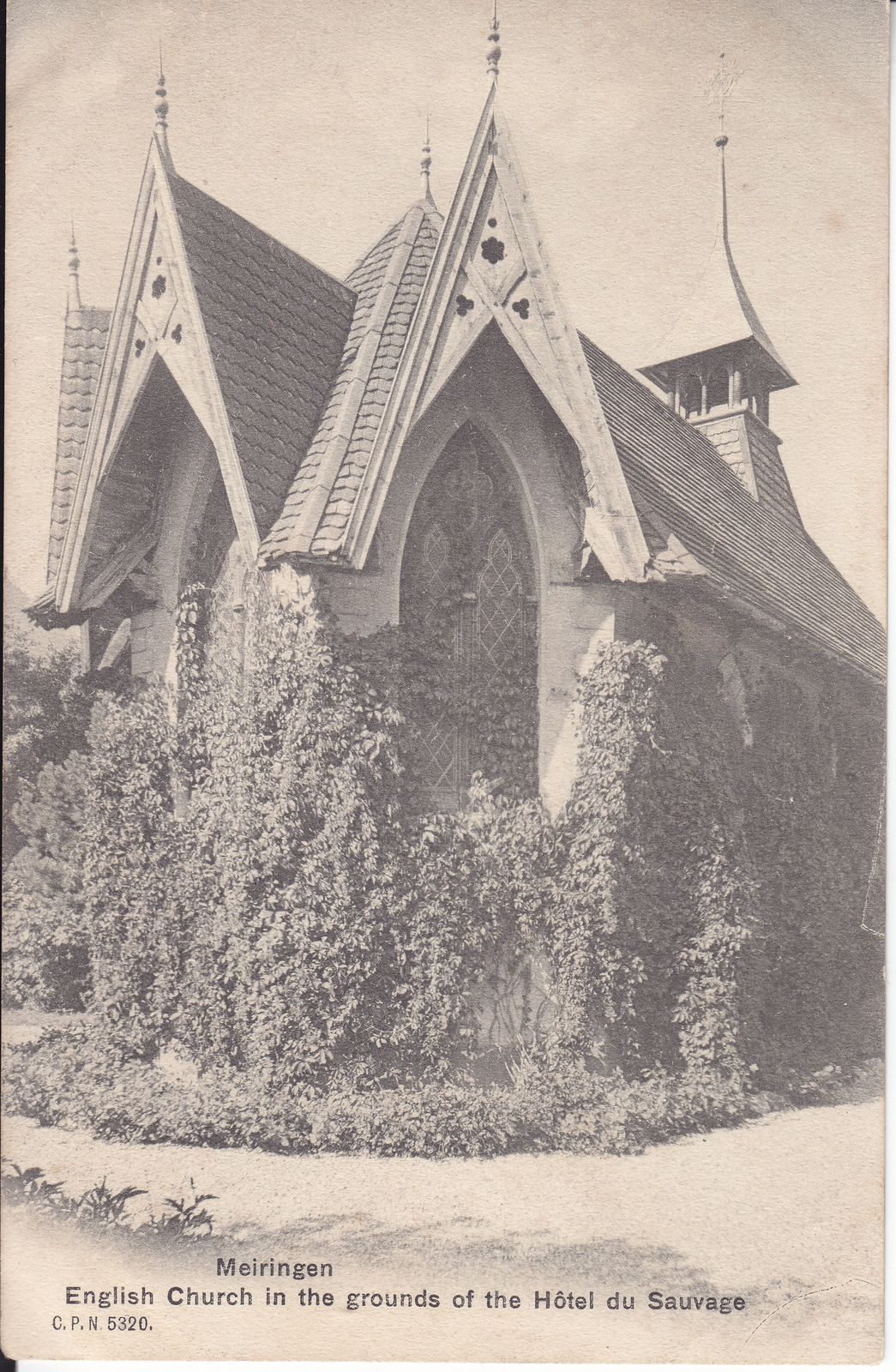
On Sunday 25 October 1891 fire swept through Meiringen. Writing to Der Bund the next day, a correspondent reported: “Meiringen, as the whole world knew it, has disappeared.” The Gothic-built English church, he added, had burned out completely.7 Schniewind records that the church’s records were lost with it. The Hôtel Sauvage came through. Murray’s Handbook for Travellers in Switzerland later listed it and noted that “All the other inns perished in the great fire”. A new church was built on the same site, and Murray gives the year as 1893.8 Horsley, who liked to help the tradesmen and hotel-keepers of Meiringen with the English of their notices, later listed the slips he wanted to spare them. One was a kindly box put up “for the incendiaries” after the English church had burned down.9
Canon Horsley’s parties
Horsley’s first party came in the summer of 1892. There were fifty-one of them, “mainly from Woolwich and Plumstead, of all ages and of both sexes”. The party grew each year until he had to limit it to 140, “which was the accommodation of the dining-room at the hotel”. When he published his memoirs in 1911 he was Rector of St Peter’s, Walworth, and an honorary canon of Southwark. He was about to set out on his twentieth annual visit. By then a special train took the party from Ostend to Basel, and another from Lucerne to Meiringen. For a fortnight or three weeks they walked and climbed from the village, in what Horsley called “a continuous family picnic”. His visit was always at the beginning of June, “as my chaplaincy is then”.10
Schniewind calls him “Canon H Horsley” and says that the tradition began in 1891. Horsley’s own account shows that 1891 was his first month as chaplain, and that the parties began the following year. Schniewind adds that Horsley brought them nearly every year until 1921, the year of his death.11
During the First World War, Schniewind records, about 200 British soldiers were interned at Meiringen, and they had the use of the English church. They were among the sick and wounded prisoners of war whom Switzerland took in, and workshops were opened for them in the village. Freiburghaus names Meiringen as one of a string of camps that also included Château-d’Œx, Mürren, Vevey, Les Diablerets, Lucerne, Davos and Leysin.12
The later years
In the late 1920s and early 1930s, Schniewind writes, Meiringen lost some of its popularity with English tourists. Each year, though, chaplains still came out with the sizeable English parties that kept coming.13 In 1937, faced with overwhelming repairs, the SPG surrendered the church to the owners of the Hôtel Sauvage, who sold it to the Christian Science group. Schniewind adds that Anglican services have since been held in the local Swiss church when the need arose.14
André Meyer described the building in 1972, in a Swiss journal of art history, when the Christian Scientists had it. He found a small hall of three bays ending in a many-sided chancel. He ranked it with Holy Trinity at Pontresina among the most important English churches in Switzerland. Its particular charm, he thought, lay in the way its architect had drawn on local ways of building. He pointed to the small roof turret with its pointed spire, the shingles, and the deep saddle roof typical of the Bernese Oberland.15
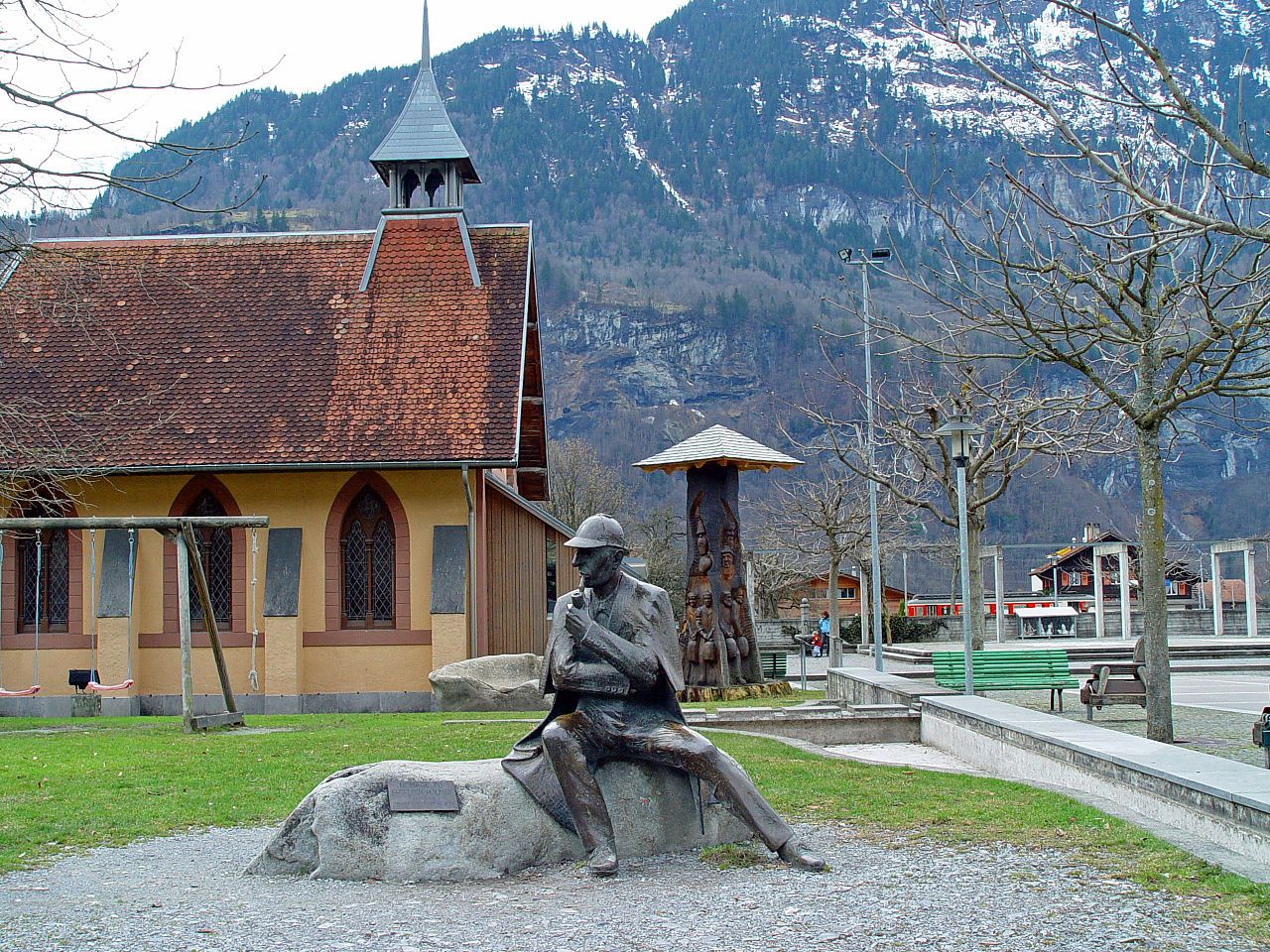
Arthur Conan Doyle had discovered Meiringen on a tour of Switzerland with his wife in 1893. In “The Final Problem” he sent Sherlock Holmes to the nearby Reichenbach Falls. In 1991 a museum dedicated to Holmes opened in the former English church. When Freiburghaus wrote about the church in 2016, a figure of Holmes sat outside it, smoking his pipe.16
We would like to know more about Dr May and the first church of 1868, about the rebuilding of 1893, and about the parties that came after Canon Horsley. If you can help, please write to us at info(a)stpeters.ch. The English church at Mürren also served British internees in the First World War, and Interlaken had one of the first summer chaplaincies in Switzerland. How the English came to the Alps, and to hotels like those at Meiringen, is told in The English experience of the Alps. The other English churches are described in our guide to the English churches in Switzerland.
-
John William Horsley, “I remember”: memories of a “sky pilot” in the prison and the slum (London: Wells Gardner, Darton & Co., 1911), chapter VII, “Holidays”, p. 148 (Internet Archive item iremembermemorie00horsuoft), OCR text: “It was in the summer of 1891 that I found myself in Switzerland for the first time, officiating as chaplain for a month in the little English church in the grounds of the Hotel Sauvage at Meiringen, the charming village in the narrow Haslital, the front garden of the Wetterhorn massif.” ↩
-
Horsley, p. 149: “One evening there trudged into the hotel garden a party of unmistakably London lads, clerks and shopmen mainly, weary somewhat with the long walk from the Furka Pass”. They were from the Regent Street Polytechnic, and a fortnight in Switzerland “had cost each under eight pounds”. He began “to consider whether ‘Woolwich on the Alps’ was an impossibilty”, and “By correspondence and inquiry I found that this could be.” ↩
-
Paul W. Schniewind, Anglicans in Switzerland (Berne, 1992), pp. 118–119, citing the SPG’s file on Meiringen and the Dixon Report. Schniewind, p. 10, dates the opening to June 1868. He adds, p. 118, that the SPG’s evidence put the start of regular summer services at Meiringen in 1850, while the Colonial and Continental Church Society’s evidence put Interlaken first, in 1842, and that Thun had services from 1841. We have found no other record of Dr May, or of the building and opening of the church in 1868. ↩
-
Ruth Freiburghaus, “The English Church at Meiringen”, St Ursula’s Church Magazine, August–September 2016, pp. 18–19, OCR text. She writes that from 1864 the services were held in a new church in the garden of the hotel. Her account follows Schniewind on most points, and it appears to run his two events of 1864 and 1868 together. Schniewind, p. 118: “From 1864 the authorities gave the little Swiss Church built in 1486 to Dr May for services.” ↩
-
Schniewind, p. 10, for the holiday, which began “at the beginning of August 1868”, at the Pension Wallis on the Gütsch, and for the gift; he cites a letter from the Stadtarchiv Luzern of 12 August 1991. Schniewind, p. 119, repeats the gift, and p. 10 adds: “There is no record about attendance at a religious service during the Swiss visit.” Jim Ring, How the English Made the Alps (London, 2000), also dates the Queen’s first Alpine journey to the summer of 1868. We have found no record of the gift outside Schniewind and the accounts that follow him. Freiburghaus, p. 18: “(This would be £4,000 or more in today’s money, depending on how you measure the value.)” ↩
-
Schniewind, p. 119: “Since 1876 SPG has had the right to nominate the chaplains and in 1906 the Society accepted the patronage.” ↩
-
“Brand in Meiringen”, Täglicher Anzeiger für Thun und das Berner Oberland, 28 October 1891 (e-newspaperarchives.ch TAA18911028-01.2.11), OCR text, passing on a letter to Der Bund written on 26 October: “Meiringen, wie man dasselbe in der ganzen Welt kannte, ist verschwunden. … Die goth[isch] gebaute englische Kirche ist vollständig ausgebra[nnt].” The letters in brackets are lost in the OCR, and the translations are ours. The report calls the burnt church Gothic, where Schniewind, p. 119, says that Dr May built it “in Swiss style”. Der Bund, 27 October 1891 (DBB18911027-01.2.14), reported the number of families affected; we have seen it only as a search extract. ↩
-
Schniewind, p. 119: “In 1891 a fire destroyed most of Meiringen, including the English church and all records. A new church was built on the same site.” John Murray, A Handbook for Travellers in Switzerland, eighteenth edition, index and directory, “Meiringen” (Internet Archive item handbookfortrave01unse_0), OCR text: “Hotels: Sauvage, large and very good. All the other inns perished in the great fire of Oct. 25, 1891 … Eng. Ch. burnt Oct. 25, 1891, rebuilt 1893.” The archive catalogues this copy as 1892, but its text is later. A search of the Swiss press for 1891–1893 found no report of the rebuilding. The postcard shown here has an undivided back on the copy we hold. Freiburghaus, p. 18, captions her copy “Postcard ca. 1900 by Comptoir de Phototypie, Neuchâtel”, and writes that the new church is the one “shown in the postcard”. ↩
-
Horsley, pp. 156–157: “For my friends the tradesmen and hotel-keepers of Meiringen, I am always ready to revise the English of their advertisements, so that they shall not say they sell ice-pickles when they mean ice-axes, nor when the English church has been burned down put up a kindly box ‘for the incendiaries,’ …” ↩
-
Horsley, pp. 149–150: “Next summer, therefore, found me personally conducting a party of fifty-one, mainly from Woolwich and Plumstead, of all ages and of both sexes; and this had developed each year until I had to limit my party to one hundred and forty, which was the accommodation of the dining-room at the hotel.” On p. 150 he describes the special trains, “a continuous family picnic in and from Meiringen”, and adds: “My visit is always at the beginning of June, as my chaplaincy is then”. His posts are given on the title page of the book. ↩
-
Schniewind, p. 119: “a tradition begun in 1891 by Canon H Horsley who, up to 1921, used to bring 140 people nearly every year in June, acting as chaplain.” Horsley’s dates, 1845–1921, are from the National Union Catalog, Pre-1956 Imprints, vol. 255, which we have seen only as a search extract. We have not found when his parties ended. ↩
-
Schniewind, p. 119, for the soldiers and the church, and p. 17 for the internment of sick and wounded prisoners of war and the workshops: “Workshops for the British were opened at the Châlets de Seeburg near Lucerne … and at Meiringen.” Freiburghaus, pp. 18–19, gives the figure of 200, following Schniewind, and lists the camps: “Apart from Meiringen there were camps in Chateau-d’Oex, Murren, Vevey, Diablerets, Lucerne, Davos and Leysin.” ↩
-
Schniewind, p. 119: “In the late 1920s and early 1930s Meiringen lost some of its popularity with English tourists.” Freiburghaus, p. 18, writes that “up until 1931 English chaplains used to bring groups as large as 140 people to Meiringen every year”. She gives no source for the year. ↩
-
Schniewind, p. 119: “In 1937, in view of the overwhelming repairs required, SPG surrendered the church to the owners of Hotel Sauvage who sold it to the Christian Science group. Anglican services have since been held, if the need arose, in the local Swiss church.” Freiburghaus, p. 19: “The building had been deconsecrated and sold in 1937, when repairs had become unaffordable. It had changed hands several times and was used for some years by the Christian Science group.” ↩
-
André Meyer, “Englische Kirchen in der Schweiz”, Zeitschrift für schweizerische Archäologie und Kunstgeschichte 29 (1972), p. 79 (doi 10.5169/seals-165810), from the PDF’s text layer: “Die heute von der Christian Science übernommene ehemalige englische Kapelle, ein kleiner Saalbau von drei Achsen mit polygonalem Chorabschluß”. On Pontresina: “Gehört die Holy Trinity Church in Pontresina zweifellos zu den bedeutendsten Werken des englischen Kirchenbaus in der Schweiz, so gilt dies nicht weniger von der englischen Kapelle in Meiringen”. On its charm, he writes that it lies “in der Art, wie der Künstler die Eigenart der lokalen Baugewohnheiten in die künstlerische Komposition miteinbezieht”, and names “der kleine Dachreiter mit weit überstehendem Spitzhelm, die Schindelbedachung, dann das tief herabgezogene Satteldach, wie es für das Berner Oberland typisch ist”. His photographs of the outside and inside are on p. 78, and his list of plates, p. 70, has “Meiringen, English Church (heute Christian Science)”. The translations are ours. ↩
-
Freiburghaus, pp. 18–19: “He had discovered Meiringen on a tour of Switzerland with his wife in 1893”; “a museum dedicated to him was opened in the former English church in 1991”; and visitors can “observe him smoking his pipe sitting outside the 19th century church”. The museum has a page about the building on its own website (sherlockholmes.ch, “The English church”, www.sherlockholmes.ch/en/Angebot/The_english_church), which we have not checked. For the story of the detective’s visit there is also “How Sherlock Holmes and Dr. Watson came to Meiringen” (www.221b.ch/Meiringen_e.html). ↩
Questions answered
- When was the English church at Meiringen built?
- Paul Schniewind's history records that the Revd Dr May of Nottingham, who started the first English services at Meiringen in 1850, decided in 1868 to build a church in Swiss style. Eduard Baud, the proprietor of the Hôtel Sauvage, gave the site in the hotel garden, and the church opened in June 1868. Ruth Freiburghaus, writing in St Ursula's Church Magazine in 2016, dates the new church to 1864, but in Schniewind's account that was the year the services moved into the village's Swiss church. The first English church burned in the fire of 25 October 1891, and a new one was built on the same site. Murray's Handbook gives the year as 1893.
- Did Queen Victoria give money to the English church at Meiringen?
- Paul Schniewind records that Queen Victoria, on holiday in Switzerland in August 1868, gave £50 towards the new church at Meiringen. He does not say that she went there. Ruth Freiburghaus, writing in St Ursula's Church Magazine in 2016, reckons the gift at £4,000 or more in today's money.
- What is the English church at Meiringen used for now?
- In 1991 a museum dedicated to Sherlock Holmes opened in the former English church. Arthur Conan Doyle had discovered Meiringen on a tour of Switzerland with his wife in 1893, and in "The Final Problem" he sent Holmes to the nearby Reichenbach Falls. Paul Schniewind records that in 1937, faced with overwhelming repairs, the SPG surrendered the church to the owners of the Hôtel Sauvage, who sold it to the Christian Science group.
- Were British soldiers interned at Meiringen during the First World War?
- Yes. Paul Schniewind records that about 200 British soldiers were interned at Meiringen during the First World War, and that they had the use of the English church. Workshops were opened for them in the village. Ruth Freiburghaus names Meiringen as one of a string of camps that also included Château-d'Œx, Mürren, Vevey, Les Diablerets, Lucerne, Davos and Leysin.