Interned British Soldiers at Chateau d'Oex. the Third Contingent and How They Spent Christmas — The Greater Britain Messenger — date not established
The Greater Britain Messenger — date not established. One of St Peter’s First World War documents, from the years when British prisoners of war were interned at Château-d’Œx, 1916–17. Transcribed in full from the bound volumes of the Greater Britain Messenger.
In this report: how the third contingent of interned soldiers spent Christmas at Château-d’Œx — roast beef and plum pudding, a Christmas tree, and a concert.
Headline as printed: INTERNED BRITISH SOLDIERS AT CHATEAU D’OEX. THE THIRD CONTINGENT AND HOW THEY SPENT CHRISTMAS.
By the Rev. E. Dudley Lampen, M.A., British Chaplain at Chateau d’Oex, Switzerland.
THE arrival of a new contingent of wounded prisoners of war to be interned in Switzerland has always a scene of pathos mingled with joy and happiness at their release from Germany. This time, even more than when the soldiers first arrived at the end of May 1916, we were called upon to witness all the scenes we were beyond all description touching in their appeal to our feelings of pity. Yet one felt the appeal of being able to minister, even if in so small a degree, to the comfort of the men and to their restoration to peace of mind by showing them that they were welcome and among friends and fellow countrymen.
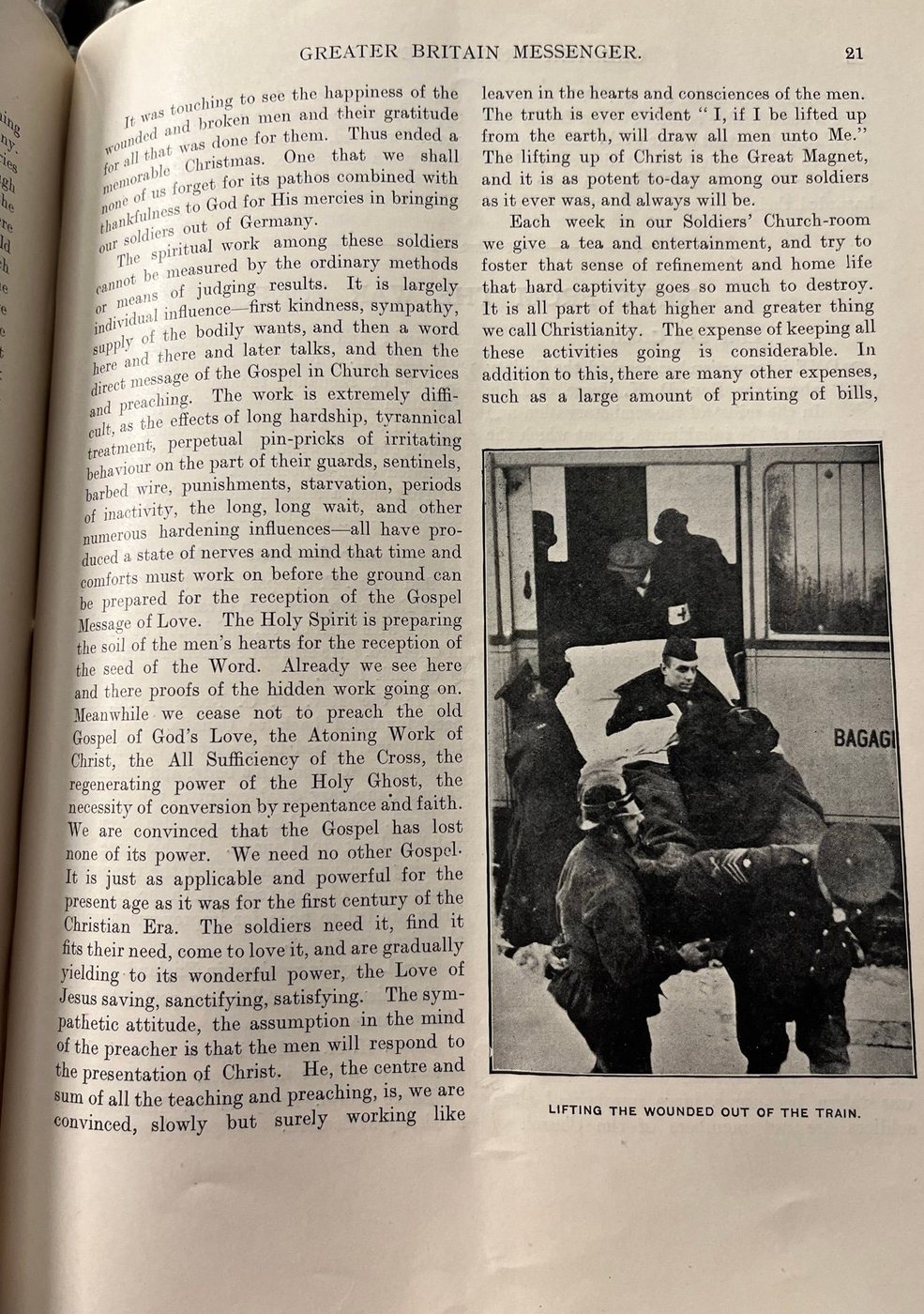
The train was signed as having passed the last station, and the word was passed along the line by the station-master that in five minutes they would be here. At length we saw the first carriage coming in sight, and then, as the train came in a standstill, cheers rang out from the assembled crowd, flags waved, and a hearty welcome was given to the tired men. What pale faces appeared at the carriage windows! But brave as ever the wounded men answered in the cheers by singing one of their own light-hearted music-hall songs. Emaciation was evident, and the pinch of hunger marked every countenance. But joy and relief shone in each face with a light that no past suffering could dim and no cruelty their enemies had inflicted could henceforth affect. Captivity was past, and liberty was before them, plenty of food, comfortable quarters and kind friends; all was enough to produce a glad smile and a buoyancy of heart that compensated for all through which they had passed. The first carriages were soon emptied of men able to walk, and willing hands assisted the lame and weak towards the Grande Salle near by, where tables had been set out, covered with white linen decorated with flowers, and a feast of tea and cakes awaited the men. The ladies soon had steaming cups of tea before them, for the morning was a bitterly cold with 20° of frost which the sun had not yet risen over the valley to mitigate.
Into the hall the men came, carrying each a bundle and a box containing the few treasures and necessities they had managed to bring away with them. How weak and dishevelled they seemed—some in uniforms worn to rags, others with no uniform at all, only the civilian garments they had with difficulty secured. In a few days with new khaki we should hardly recognise them, but at present their very worn out clothing was a sign of their ill-treatment apart from any other visible marks of their captivity. These were by no means missing.
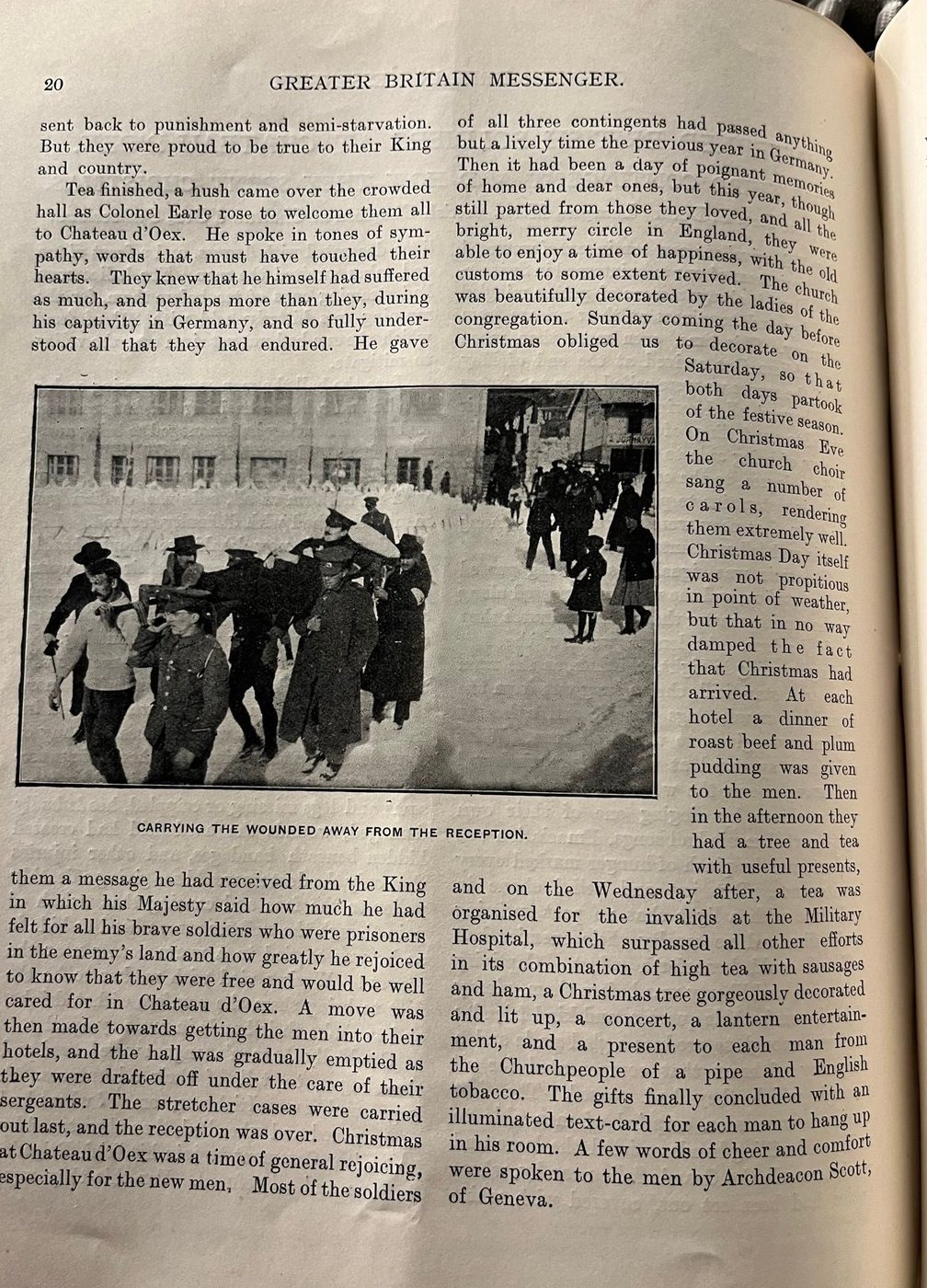
Soon the doors again opened to receive this time the stretcher cases. Man after man, broken by war’s cruel fingers, was carried in. The tears streamed down the faces of many of the onlookers as they witnessed the moving spectacle of young men lamed and maimed for life—arms and legs missing or crippled, heads badly damaged, wounds the battlefield had created hidden beneath bandages, and other injuries that only the doctors would see giving a deathly pallor to the face and causing that twitch of pain though the sufferer strove hard to hide it as he was carried to a warm corner next to the stoves! Worked and worker to be the stoves! Workers tried them to the comfort of hot drinks, and to shake their hands in mute sympathy.
Gradually the men’s tongues were loosened and they began to tell of their adventures. A large number were Irishmen, some of whom had been coaxed and wheedled, then threatened by the traitor Casement to join his Irish Brigade. But one and all refused. For this they were
sent back to punishment and semi-starvation. But they were proud of to be true to their King and country.
Tea finished, a hush came over the crowded hall as Colonel Eagle rose to welcome them all to Chateau d’Oex. He spoke in tones of sympathy, words that must have touched their hearts. They knew that he himself had suffered so much, and perhaps more than they, during his captivity in Germany, and so fully understood all that they had endured. He gave them a message he had received from the King in which his Majesty said how much he had felt for all his brave soldiers who were prisoners in the enemy’s land and how greatly he rejoiced to know that they were free and would be well cared for in Chateau d’Oex. A move was then made towards getting the men into their hotels, and the hall was gradually emptied as they were drafted off under the care of their sergeants. The stretcher cases were carried out last, and the reception was over. Christmas at Chateau d’Oex was a time of general rejoicing, especially for the new men. Most of the soldiers of all three contingents had passed anything but a lively time the previous year in Germany. Then it had been a day of poignant memories of home and dear ones, but this year, though still parted from those they loved, and all the bright, merry circle in England, they were able to enjoy a time of happiness, with the customs to some extent renewed. The church was beautifully decorated with the ladies of the congregation. Sunday coming the day before Christmas obliged us to decorate on the Saturday, so that both days partook of the festive season.
On Christmas Eve the church choir sang a number of carols, rendering them extremely well. Christmas Day itself was not propitious in point of weather, but that in no way damped the fact that Christmas had arrived. At each hotel a dinner of roast beef and plum pudding was given to the men. Then in the afternoon they had a tree and tea with useful presents, and on the Wednesday after, a tea was organised for the invalids at the Military Hospital, which surpassed all other efforts in its combination of high tea with sausages and ham, a Christmas tree gorgeously decorated and lit up, a concert, a lantern entertainment, and a present to each man from the Churchpeople of a pipe and English tobacco. The gifts finally concluded with an illuminated text-card for each man to hang up in his room. A few words of cheer and comfort were spoken to the men by Archdeacon Scott of Geneva.
It was touching to see the happiness of the broken men and their gratitude expressed was not ended a memorable Christmas. One that we shall never forget for its pathos combined with hopefulness to God for his mercies in bringing our soldiers out of Germany.
The spiritual work among these soldiers cannot be measured by the ordinary methods of judging results. It is largely or means of individual influence—first kindness, sympathy, supply of the bodily wants, and then a word here and there and after tables, and then the direct message of the Gospel in Church services and preaching. The work is extremely difficult, as the effects of long hardship, tyrannical treatment, perpetual pin-pricks of irritating behaviour on the part of their guards, sentinels, barbed wire, punishments, starvation, periods of inactivity, the long, long wait, and other numerous hardening influences—all have produced a state of nerves and mind that time and comforts must work on before the ground can be prepared for the reception of the Gospel Message of Love. The Holy Spirit is preparing the soul of the men’s hearts for the reception of the seed of the Word. Already we see here and there proofs of the hidden work going on. Meanwhile we cease not to preach the old Gospel of God’s Love, the Atoning Work of Christ, the All Sufficiency of the Cross, the regenerating power of the Holy Ghost, the necessity of conversion by repentance and faith. We are convinced that the Gospel has lost none of its power. We need no other Gospel—It is just as applicable and powerful for the present age as it was for the first century of the Christian Era. The soldiers need it, find it fits their need, come to love it, and are gradually yielding to its wonderful power, the Love of Jesus saving, sanctifying, satisfying. The sympathetic attitude, the assumption in the mind of the preacher is that the men will respond to the presentation of Christ. He, the centre and sum of all the teaching and preaching, is, we are convinced, slowly but surely working like
the fight for us. We, therefore, confidently appeal to the general public to give all the money we need, so that we may be on that score. The Secretary of the Society will gratefully receive any contributions which may be sent for this purpose.
NEWS FROM THE WAR ZONE.
Lille and Croix.
SOME information has reached the Society about the Rev. D. K. Moore, of Lille. In the midst of the semi-starvation and oppression of the inhabitants, about which the newspapers have given substantial accurate accounts, Mr. Moore is always bright and hopeful, biding whatever fears or anxieties he may feel and cheering the hearts of his people. He is able to hold service in a room attached to the church, and some fifteen or twenty still attend.
From the same source we have confirmation of the news published last month, namely that H. Fishe, of Croix, is very ill, and unable to be moved.
Brussels.
The Rev. H. S. T. Galan, so we learn on excellent authority, has congregations of sixty at church, continues to hold a Sunday School and some other Church organisations, and is able to visit his people within a radius of some miles. His ministry is much valued for its spirituality and faith. His young wife aids him in all his work.
Chateau d’Oex.
With the consent of the Bishop, the Rev. E. D. Lampen has arranged for Commissioner Oliphant, the head of the Salvation Army in Switzerland, to hold a Mission in the church for the interned British soldiers. This step was taken because a large number of these soldiers are not members of the Church of England; and it was rendered easier by the fact that Mr. Oliphant is in full orders in the Church of England, though he joined the Salvation Army many years ago. About two hundred soldiers were brought under the influence of the Mission, in addition to those who attended open-air services.
That such a Mission should take place is a remarkable sign of the times.
Our Students in Arms.
2nd Lieut. F. S. Spackman, 5th Worcestershire Regiment, has been invalided back from France with shell shock, and is now at [?] in Cheshire. He still suffers from his heart and is on sick leave.
Pte. F. G. Frost, D.C.M., has been invalided back to Canada. He writes that he was sniped by a shot in the shoulder which travelled about his body, and which has caused temporary disablement of the left arm.
Sergt. Burd, D.C.M., has also been invalided back to Canada. In his case the severing of a nerve has caused the temporary disablement of one foot. Both he and Mr. Frost are led to hope for improvement under electrical treatment.
Corpl. Bays is retained in England.
2nd Lieut. J. B. Allen is reported to be in Mesopotamia.
Sergt. H. A. Godby is now a Physical Instructor at a base in France.
Lance-Corpl. Baggs is an Instructor in Musketry at Seaford.
End of the transcribed document
Questions answered
- How did the interned soldiers spend Christmas at Château-d’Œx?
- The Rev. E. Dudley Lampen’s account in The Greater Britain Messenger describes the third contingent’s Christmas in the village — roast beef and plum pudding, a Christmas tree, and a concert. The article carries no annotation and no printed date anywhere, so the archive publishes it as undated rather than assigning one.
- What was the arrival of a new contingent like?
- Lampen wrote that the arrival of a new contingent of wounded prisoners “has always a scene of pathos mingled with joy and happiness at their release from Germany”. When the train came to a standstill, “cheers rang out from the assembled crowd, flags waved, and a hearty welcome was given to the tired men”, and the wounded men “answered in the cheers by singing one of their own light-hearted music-hall songs.”
- What condition were the men in when they arrived?
- “What pale faces appeared at the carriage windows!” Lampen wrote. “Emaciation was evident, and the pinch of hunger marked every countenance. But joy and relief shone in each face with a light that no past suffering could dim and no cruelty their enemies had inflicted could henceforth affect. Captivity was past, and liberty was before them.”