With the British Wounded in Switzerland — The Greater Britain Messenger — date not established (late 1916)
The Greater Britain Messenger — date not established (late 1916). One of St Peter’s First World War documents, from the years when British prisoners of war were interned at Château-d’Œx, 1916–17. Transcribed in full from the bound volumes of the Greater Britain Messenger.
In this report: the assistant chaplain’s account of the valley — over 500 prisoners in the area, in a village of some 3,000 people at 3,500 feet — and the state the men arrived in.
Headline as printed: WITH THE BRITISH WOUNDED IN SWITZERLAND. By the Rev. Isaac Hutchinson, Assistant-Chaplain at Chateau d’Oex.
Handwritten annotation
None visible
Must England be to you and me? Just England still to you and me? We, who have walked among the dead, And watched the smile of agony, And seen the price of Liberty, Which we have not known correctly From other lands. Nay, shall we dread, From other lands. ‘Tis not return, Dread lest we hold blood-guilty The things that men have died to free. For all the blood that has been shed, By men whose guardian are we, If we return !”
(Lieut. F.W. HARVEY, in “A Gloucester Lad.”)
My work commenced before I reached Switzerland. Exactly twenty-four hours after leaving London I started from Paris on my second night’s journey. About no o’clock on the following morning, when “tired nature’s sweet restorer, balmy sleep,” would have been a welcome fellow-traveller, a most conspicuously absent, I heard a plaintive English voice in the corridor asking, “Do we change here for Chateau d’Oex ?” On going out I found an Englishman of the respectable working-class type and his wife, evidently quite lost. They did not know a word of French, and had never been abroad before. I told them I was going to Chateau d’Oex, and
they said they were going there to see their son, whom they had not seen for two years, and who had just recently arrived with the last batch of wounded prisoners from Germany. From that night onwards they kept close to me. On arrival at Chateau d’Oex I saw them and their son all standing together silently and in tears—but it was an eloquent silence, and doubtless they were tears of joy.
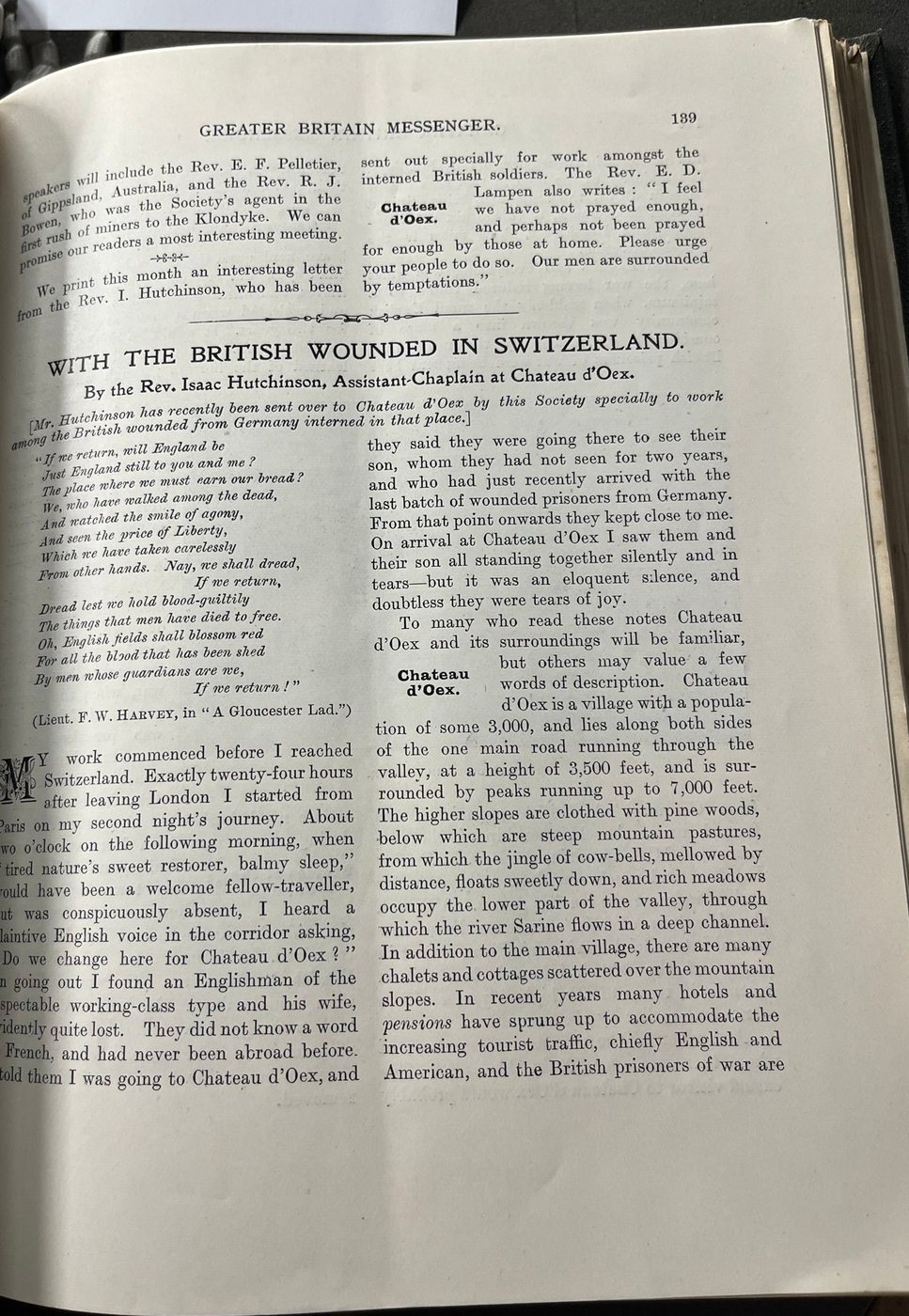
To many who read these notes Chateau d’Oex and its surroundings will be familiar, but others may value a few words of description. Chateau d’Oex is a mountain with a population of some 3,000, and lies along both sides of the one main road running through the valley, at a height of 3,500 feet, and is surrounded by peaks running up to 7,000 feet. The higher slopes are clothed with pine woods, below which are steep mountain pastures, from which the jingle of cow-bells, mellowed by distance, floats sweetly down, and rich meadows occupy the lower part of the valley, through which the river Sarine flows in a deep channel. In addition to the main village, there are many chalets and cottages scattered over the mountain slopes. In recent years many hotels and pensions have sprung up to accommodate the increasing tourist traffic, chiefly English and American, and the British prisoners of war are
now quartered in a dozen or so of these buildings. The majority of the men in this area are at Chateau d’Oex, the remainder being divided between Rougemont, a village six miles up stream, and Rossinières, three miles in the opposite direction.
Three months ago everything was quiet here, the war having reduced traffic to a minimum, and the small English community was thrown into a state of considerable excitement by the news that British prisoners of war were being sent here
Chateau d’Oex.
A British committee was formed, under the chairmanship of the permanent C.C.C.S. Chaplain, the Rev. E. Dudley Lampen, and much was done to prepare for and welcome the coming guests. Although the functions of this committee have now passed into official hands, Col. Picot, officer in charge of the British internment, has written recently in terms of the highest praise of the work done earlier by the committee.
And what of the prisoners themselves, of whom there are over 500 in this area ? The casual visitor to Chateau d’Oex would probably
take away a completely wrong impression of their real condition. Kindly old ladies have been known to ask me why they are here, because they look so well. Behind all the brave smiles and the smart bearing the blind eyes, and maimed limbs, and shattered nerves, and unextracted wounds that have suffered for two years or more. It would be neither possible nor right to state on paper all the learned of the horrors through which the men have passed and of the sufferings they have endured. For one could not reproduce the voices vibrant with emotion nor the nervous working of the features as the men lived through their experiences over again in the telling.
The Prisoners.
A few brief specimens may not be out of place. Many of the men were captured in the early days of the war, when the German policy of frightfulness was practised in its most brutal forms; but some of those captured later have also had to
endure much barbarity. A young Welshman during the retreat from Mons was wounded by a bullet, and while making his way towards the dressing station was again wounded in the side by a shell, and lay helpless and conscious. A German came up and asked in English, “Where are you wounded ?” and then brought down the butt-end of his rifle with a thud on the wounded place. The man still survived, however, and was taken to a German hospital, where five of his ribs were removed.
Another man was lying with a broken leg, and an enemy soldier kicked him on the other leg, with the result that he suffered more from the fracture. One soldier, well known to me now engaged in business before the battlefield, had his leg broken in five places, and lost all food or drink for eight days and nights before being picked up.
At night another comrade, who was wounded and captured at Laos, saw an English officer shot with a rifle held at the hip, and shot again as he lay on the ground. The sergeant tried to obtain the officer’s identity disk, but was driven away. He and other prisoners, as they were, were then driven on at the point of the lance by mounted Uhlans. When they arrived at the quarters of a German General they fell or lay down exhausted, but the General made them stand up, when they were again prodded on to Lille.
Stories like these might be told in much larger numbers, but enough has been said to indicate the condition of the men. Knowing all this and much more, one is anxious to do all that one can for the help and comfort of those who have endured so much for us. The Colonial and Continental Church Society has undertaken considerable extra expense in order to provide adequate spiritual and other ministrations for those wounded prisoners, and all who value such work ought to support it on grounds not only generously, but to the point of sacrifice.
With it all, the men are very human. At first the sight of a clerical collar causes reserve, but that soon melts away with a little tactful treatment. A joke is much appreciated, and there is also an obvious absence of “starch.” Once friendly contact is obtained, it is not difficult to get to the heart of things. To a soldier from Edinburgh I remarked that one of the most touching stories I had ever heard concerned a little dying boy in the Royal
The Clerical Collar.
Infirmary at Edinburgh, and I repeated the story to him. He replied that the most touching thing he had ever heard was the oft-repeated cry on the battlefield from men who had almost lapsed into unconsciousness: “Stretcher-bearers, please! Stretcher-bearers, please !” This led to an earnest talk on the things that matter most.
When visiting sick men, humour bubbles up in the most spontaneous fashion. In one
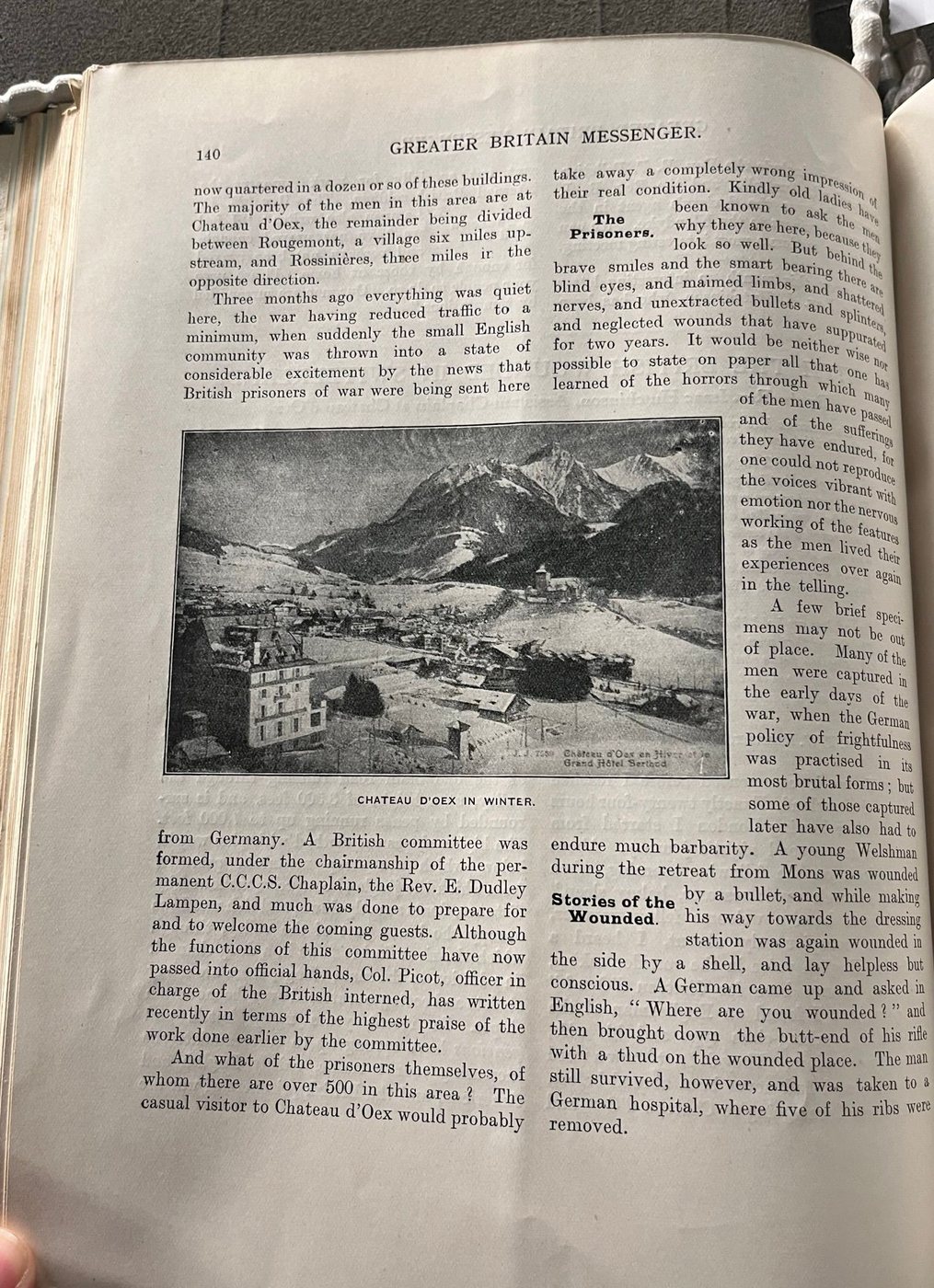
[photograph of church]
CHATEAU D’OEX: THE ENGLISH CHURCH.
room were two men. One was sitting on his bed with a wire cage over his wounded leg. He belonged to the West Kents, and pointed proudly to a picture showing one of the doughty deeds of that regiment.
“Ugh !” said the other, who was a Yorkshireman. I turned and asked why he had not a picture of his Yorkshire Regiment.
“Because,” he replied with an expansive smile, “the wall would not be big enough to hold it !”
When talking with a group of men about occupations and studies, I asked one man what he would prefer to do if he could have his choice. He promptly replied, “Go home to England !”
Sitting down to a harmonium one day I played some hymns which the men standing behind me sang. Finally, in a silence that could be felt, I played “Home, Sweet Home,” and did not dare to look round lest we should all break down.
“Home,Sweet Home”
These are some glimpses at the personal work. Finally, I need only add a brief paragraph with regard to work on a more organised kind. There are three services on Sunday in the English Church at Chateau d’Oex, and a good many soldiers attend the Morning Service, and some are members of the choir. It is proposed shortly to have Evangelical services on Sunday nights, with occasional services, I take services on alternate Sundays at Rougemont and Rossinières, the officers kindly conducting services at those places on the second Sunday in my absence. On Wednesday evenings I have a Bible Class for soldiers at Chateau d’Oex, and am happy to report that the attendance has doubled in the past fortnight. At the request of the senior officer I am organising a brass band, a male-voice choir, and other gatherings, so as to keep the men pleasantly occupied during the winter evenings.
A great door and effectual is opened.
Brethren, pray for us!”
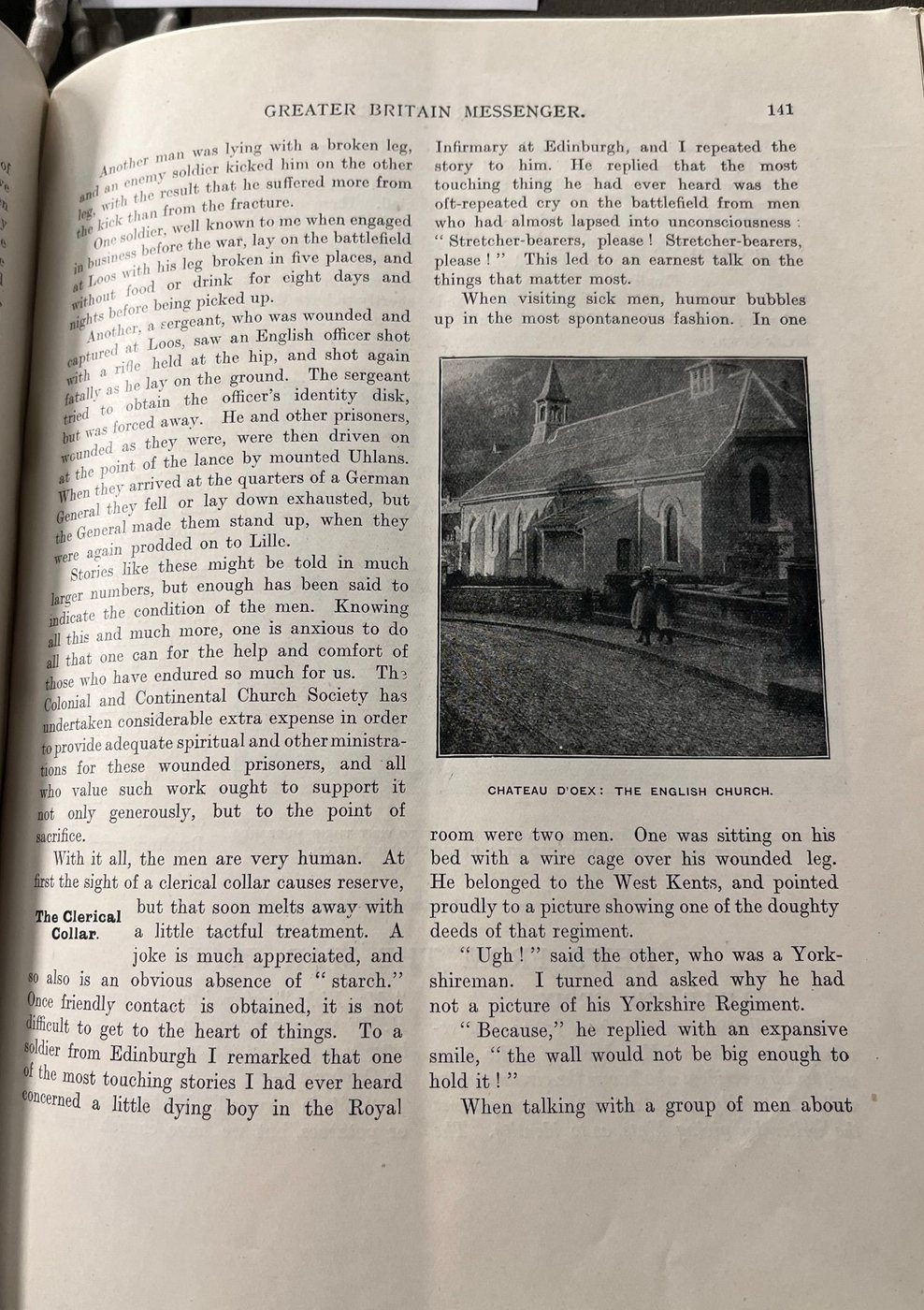
End of the transcribed document
Questions answered
- How many British prisoners were in the Château-d’Œx area?
- The assistant chaplain’s account in The Greater Britain Messenger describes over 500 prisoners in the area, in a village of some 3,000 people lying at 3,500 feet. The item itself is undated; the archive places it in late 1916 on the dating evidence set out with the transcript, and does not assign it a printed date it does not have.
- What did the writer see on the journey out?
- He wrote that his work “commenced before I reached Switzerland”. On the second night’s journey from Paris he heard “a plaintive English voice in the corridor asking, ‘Do we change here for Chateau d’Oex?’” — an Englishman “of the respectable working-class type” and his wife, who knew no French and had never been abroad, travelling to see a son they had not seen for two years, who had just arrived with the last batch of wounded prisoners from Germany.
- What happened when that family was reunited?
- “On arrival at Chateau d’Oex I saw them and their son all standing together silently and in tears — but it was an eloquent silence, and doubtless they were tears of joy.”