The Claim of the Prisoners — The Times, 6 September 1916
The Times, 6 September 1916. One of St Peter’s First World War documents, from the years when British prisoners of war were interned at Château-d’Œx, 1916–17. Transcribed in full from a cutting made available by The Times Archive.
In this report: who paid for the wives’ journeys — Mr. Fenwick Harrison and Sir Robert Younger each offering to send out fifty wives and mothers at their own expense — and the unfinished argument over whether any British prisoner in Germany was still ‘friendless’.
Headline as printed: The Claim of the Prisoners.
Handwritten annotation
The Times 6/9/1916
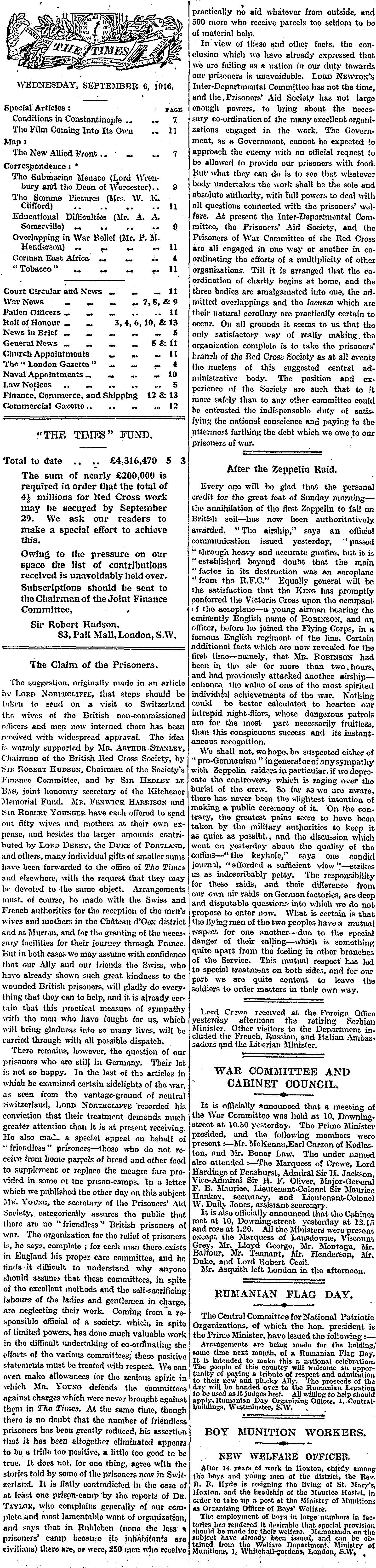
The suggestion, originally made in an article by Lord Northcliffe, that steps should be taken to send on a visit to Switzerland the wives of the British non-commissioned officers and men now interned there has been received with widespread approval. The idea is warmly supported by Mr. Arthur Stanley, Chairman of the British Red Cross Society, by Sir Robert Hudson, Chairman of the Society’s Finance Committee, and by Sir Hedley le Bas, joint honorary secretary of the Kitchener Memorial Fund. Mr. Fenwick Harrison and Sir Robert Younger have each offered to send out fifty wives and mothers at their own expense, and besides the larger amounts contributed by Lord Derby, the Duke of Portland, and others, many individual gifts of smaller sums have been forwarded to the office of The Times and elsewhere, with the request that they may be devoted to the same object. Arrangements must, of course, be made with the Swiss and French authorities for the reception of the men’s wives and mothers in the Château d’Oex district and at Murren, and for the granting of the necessary facilities for their journey through France. But in both cases we may assume with confidence that our Ally and our friends the Swiss, who have already shown such great kindness to the wounded British prisoners, will gladly do everything that they can to help, and it is already certain that this practical measure of sympathy with the men who have fought for us, which will bring gladness into so many lives, will be carried through with all possible dispatch.
There remains, however, the question of our prisoners who are still in Germany. Their lot is not so happy. In the last of the articles in which he examined certain sidelights of the war, as seen from the vantage-ground of neutral Switzerland, Lord Northcliffe recorded his conviction that their treatment demands much greater attention than it is at present receiving. He also made a special appeal on behalf of “friendless” prisoners—those who do not receive from home parcels of bread and other food to supplement or replace the meagre fare provided in some of the prison-camps. In a letter which we published the other day on this subject Mr. Young, the secretary of the Prisoners’ Aid Society, categorically assures the public that there are no “friendless” British prisoners of war. The organization for the relief of prisoners is, he says, complete; for each man there exists in England his proper care committee, and he finds it difficult to understand why anyone should assume that these committees, in spite of the excellent methods and the self-sacrificing labours of the ladies and gentlemen in charge, are neglecting their work. Coming from a responsible official of a society, which, in spite of limited powers, has done much valuable work in the difficult undertaking of co-ordinating the efforts of the various committees; these positive statements must be treated with respect. We can even make allowances for the zealous spirit in which Mr. Young defends the committees against charges which were never brought against them in The Times. At the same time, though there is no doubt that the number of friendless prisoners has been greatly reduced, his assertion that it has been altogether eliminated appears to be a trifle too positive, a little too good to be true. It does not, for one thing, agree with the stories told by some of the prisoners now in Switzerland. It is flatly contradicted in the case of at least one prison-camp by the reports of Dr. Taylor, who complains generally of our complete and most lamentable want of organization, and says that in Ruhleben (none the less a prisoners’ camp because its inhabitants are civilians) there are, or were, 250 men who receive practically no aid whatever from outside, and 500 more who receive parcels too seldom to be of material help.
In view of these and other facts, the conclusion which we have already expressed that we are failing as a nation in our duty towards our prisoners is unavoidable. Lord Newton’s Inter-Departmental Committee has not the time, and the Prisoners’ Aid Society has not large enough powers, to bring about the necessary co-ordination of the many excellent organizations engaged in the work. The Government, as a Government, cannot be expected to approach the enemy with an official request to be allowed to provide our prisoners with food. But what they can do is to see that whatever body undertakes the work shall be the sole and absolute authority, with full powers to deal with all questions connected with the prisoners’ welfare. At present the Inter-Departmental Committee, the Prisoners’ Aid Society, and the Prisoners of War Committee of the Red Cross are all engaged in one way or another in co-ordinating the efforts of a multiplicity of other organizations. Till it is arranged that the co-ordination of charity begins at home, and the three bodies are amalgamated into one, the admitted overlappings and the lacunæ which are their natural corollary are practically certain to occur. On all grounds it seems to us that the only satisfactory way of really making the organization complete is to take the prisoners’ branch of the Red Cross Society as at all events the nucleus of this suggested central administrative body. The position and experience of the Society are such that to it more safely than to any other committee could be entrusted the indispensable duty of satisfying the national conscience and paying to the uttermost farthing the debt which we owe to our prisoners of war.
End of the transcribed document
Questions answered
- Who paid for the prisoners’ wives to travel to Switzerland?
- The Times reported that Mr. Fenwick Harrison and Sir Robert Younger “have each offered to send out fifty wives and mothers at their own expense”, besides larger amounts contributed by Lord Derby, the Duke of Portland and others, and many individual gifts of smaller sums forwarded to the office of The Times.
- Who supported Lord Northcliffe’s proposal?
- The idea was “warmly supported by Mr. Arthur Stanley, Chairman of the British Red Cross Society, by Sir Robert Hudson, Chairman of the Society’s Finance Committee, and by Sir Hedley le Bas, joint honorary secretary of the Kitchener Memorial Fund”. Arrangements still had to be made with the Swiss and French authorities for the reception of the women in the Château-d’Œx district and at Mürren.
- What did the article say about prisoners still held in Germany?
- It turned from the interned men in Switzerland to “the question of our prisoners who are still in Germany”, whose “lot is not so happy”, recording Lord Northcliffe’s conviction that their treatment demanded much greater attention than it was then receiving. The argument over whether any British prisoner in Germany was still “friendless” is left unfinished on this cutting.