Our Soldiers in Switzerland — The Times, 23 August 1916
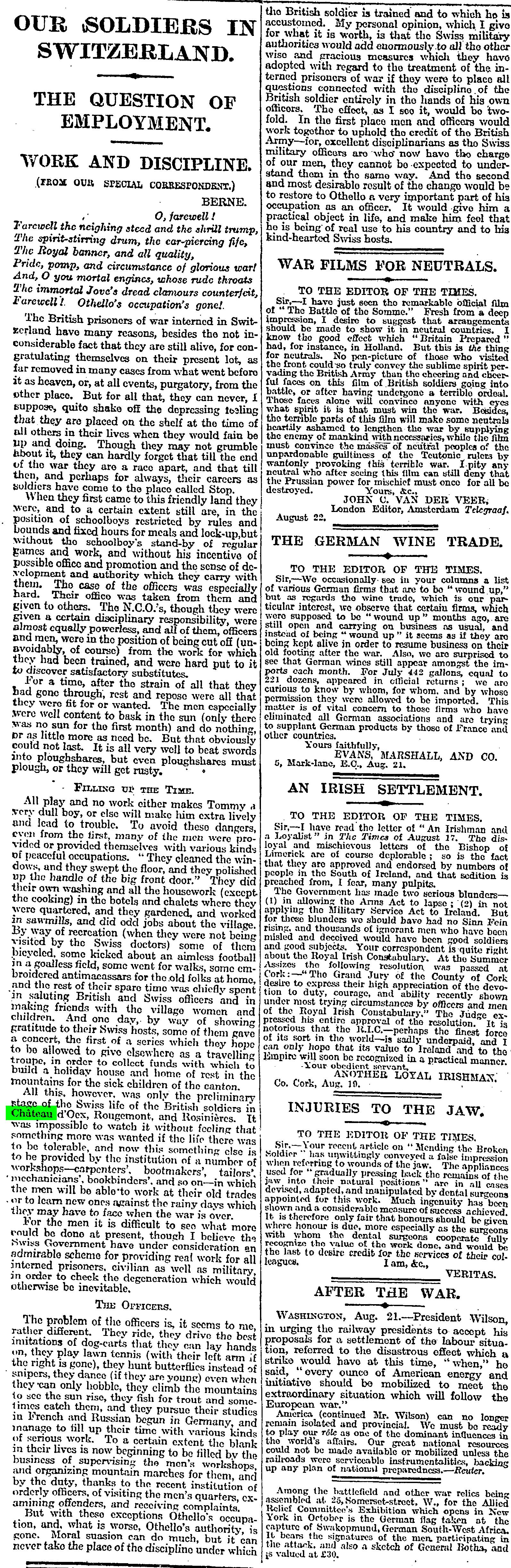
The Times, 23 August 1916. One of St Peter’s First World War documents, from the years when British prisoners of war were interned at Château-d’Œx, 1916–17. Transcribed in full from a cutting made available by The Times Archive.
In this report: the correspondent’s report on what the interned men were given to do — the workshops set up for them, and his argument that discipline should be handed back to their own officers.
Headline as printed: OUR SOLDIERS IN SWITZERLAND.
Handwritten annotation
The Times - 23 August 1916
THE QUESTION OF EMPLOYMENT.
WORK AND DISCIPLINE.
(FROM OUR SPECIAL CORRESPONDENT.)
BERNE.
O, farewell !
Farewell the neighing steed and the shrill trump,
The spirit-stirring drum, the ear-piercing fife,
The Royal banner, and all quality,
Pride, pomp, and circumstance of glorious war!
And, O you mortal engines, whose rude throats
The immortal Jove’s dread clamours counterfeit,
Farewell ! Othello’s occupation’s gone!
The British prisoners of war interned in Switzerland have many reasons, besides the not inconsiderable fact that they are still alive, for congratulating themselves on their present lot, as far removed in many cases from what went before it as heaven, or, at all events, purgatory, from the other place. But for all that, they can never, I suppose, quite shake off the depressing feeling that they are placed on the shelf at the time of all others in their lives when they would fain be up and doing. Though they may not grumble about it, they can hardly forget that till the end of the war they are a race apart, and that till then, and perhaps for always, their careers as soldiers have come to the place called Stop.
When they first came to this friendly land they were, and to a certain extent still are, in the position of schoolboys restricted by rules and bounds and fixed hours for meals and lock-up, but without the schoolboy’s stand-by of regular games and work, and without his incentive of possible office and promotion and the sense of development and authority which they carry with them. The case of the officers was especially hard. Their office was taken from them and given to others. The N.C.O.’s, though they were given a certain disciplinary responsibility, were almost equally powerless, and all of them, officers and men, were in the position of being cut off (unavoidably, of course) from the work for which they had been trained, and were hard put to it to discover satisfactory substitutes.
For a time, after the strain of all that they had gone through, rest and repose were all that they were fit for or wanted. The men especially were well content to bask in the sun (only there was no sun for the first month) and do nothing, or as little more as need be. But that obviously could not last. It is all very well to beat swords into ploughshares, but even ploughshares must plough, or they will get rusty.
FILLING UP THE TIME.
All play and no work either makes Tommy a very dull boy, or else will make him extra lively and lead to trouble. To avoid these dangers, even from the first, many of the men were provided or provided themselves with various kinds of peaceful occupations. “They cleaned the windows, and they swept the floor, and they polished up the handle of the big front door.” They did their own washing and all the housework (except the cooking) in the hotels and chalets where they were quartered, and they gardened, and worked in sawmills, and did odd jobs about the village. By way of recreation (when they were not being visited by the Swiss doctors) some of them bicycled, some kicked about an aimless football in a goalless field, some went for walks, some embroidered antimacassars for the old folks at home, and the rest of their spare time was chiefly spent in saluting British and Swiss officers and in making friends with the village women and children. And one day, by way of showing gratitude to their Swiss hosts, some of them gave a concert, the first of a series which they hope to be allowed to give elsewhere as a travelling troupe, in order to collect funds with which to build a holiday house and home of rest in the mountains for the sick children of the canton.
All this, however, was only the preliminary stage of the Swiss life of the British soldiers in Château d’Oex, Rougemont, and Rosinières. It was impossible to watch it without feeling that something more was wanted if the life there was to be tolerable, and now this something else is to be provided by the institution of a number of workshops—carpenters’, bootmakers’, tailors’, mechanicians’, bookbinders’, and so on—in which the men will be able to work at their old trades or to learn new ones against the rainy days which they may have to face when the war is over.
For the men it is difficult to see what more could be done at present, though I believe the Swiss Government have under consideration an admirable scheme for providing real work for all interned prisoners, civilian as well as military, in order to check the degeneration which would otherwise be inevitable.
THE OFFICERS.
The problem of the officers is, it seems to me, rather different. They ride, they drive the best imitations of dog-carts that they can lay hands on, they play lawn tennis (with their left arm if the right is gone), they hunt butterflies instead of snipers, they dance (if they are young) even when they can only hobble, they climb the mountains to see the sun rise, they fish for trout and sometimes catch them, and they pursue their studies in French and Russian begun in Germany, and manage to fill up their time with various kinds of serious work. To a certain extent the blank in their lives is now beginning to be filled by the business of supervising the men’s workshops, and organizing mountain marches for them, and by the duty, thanks to the recent institution of orderly officers, of visiting the men’s quarters, examining offenders, and receiving complaints.
But with these exceptions Othello’s occupation, and, what is worse, Othello’s authority, is gone. Moral suasion can do much, but it can never take the place of the discipline under which the British soldier is trained and to which he is accustomed. My personal opinion, which I give for what it is worth, is that the Swiss military authorities would add enormously to all the other wise and gracious measures which they have adopted with regard to the treatment of the interned prisoners of war if they were to place all questions connected with the discipline of the British soldier entirely in the hands of his own officers. The effect, as I see it, would be twofold. In the first place men and officers would work together to uphold the credit of the British Army—for, excellent disciplinarians as the Swiss military officers are who now have the charge of our men, they cannot be expected to understand them in the same way. And the second and most desirable result of the change would be to restore to Othello a very important part of his occupation as an officer. It would give him a practical object in life, and make him feel that he is being of real use to his country and to his kind-hearted Swiss hosts.
End of the transcribed document
Questions answered
- How did the interned soldiers occupy their time in Switzerland?
- The Times correspondent reported that, for a time after the strain of all they had gone through, “rest and repose were all that they were fit” for. He described the men as at first “in the position of schoolboys restricted by rules and bounds and fixed hours for meals and lock-up”, but without the schoolboy’s stand-by of regular games and work, and wrote about the workshops that were set up to give them occupation.
- Why was internment difficult for the men despite their release?
- The correspondent wrote that although the interned men had many reasons for congratulating themselves on their present lot, “they can never, I suppose, quite shake off the depressing feeling that they are placed on the shelf at the time of all others in their lives when they would fain be up and doing” — that until the end of the war they were “a race apart”, and their careers as soldiers had “come to the place called Stop.”
- What did the correspondent think should change?
- He argued that discipline should be handed back to the men’s own officers. He wrote that the case of the officers was “especially hard” — “their office was taken from them and given to others” — and that the N.C.O.s, though given a certain disciplinary responsibility, were “almost equally powerless”, all of them cut off from the work for which they had been trained.