British Sick and Wounded in Switzerland — The Greater Britain Messenger, No. CCI, July 1916
The Greater Britain Messenger, No. CCI, July 1916. One of St Peter’s First World War documents, from the years when British prisoners of war were interned at Château-d’Œx, 1916–17. Transcribed in full from the bound volumes of the Greater Britain Messenger.
In this report: the chaplain’s own account of the first months — 357 men and thirty officers arriving on 30 and 31 May — and the French and Belgian soldiers already interned at Leysin.
🔴 The archive filename says 1917-07-01. The masthead says JULY, 1916 — a year out. The issue is numbered “No. CCI.” and dated “JULY, 1916.” in print, and the text describes the prisoners arriving “last Tuesday and Wednesday (May 30 and 31)”, which were indeed a Tuesday and Wednesday in 1916. There is no handwritten annotation on this item; the printed masthead is the authority. This is not the DD/MM filename bug — it is a straight year error, so the “both components ≤ 12” rule would not have caught it.
⚠️ This is the Greater Britain Messenger, not The Times — it is therefore outside the
Times Archives permission recorded in the archive’s PROVENANCE.md.
Headline as printed: BRITISH SICK AND WOUNDED IN SWITZERLAND.
Handwritten annotation
None visible
I. AT CHATEAU D’OEX.
By the Rev. E. Dudley Lampen, C.C.C.S. Chaplain.
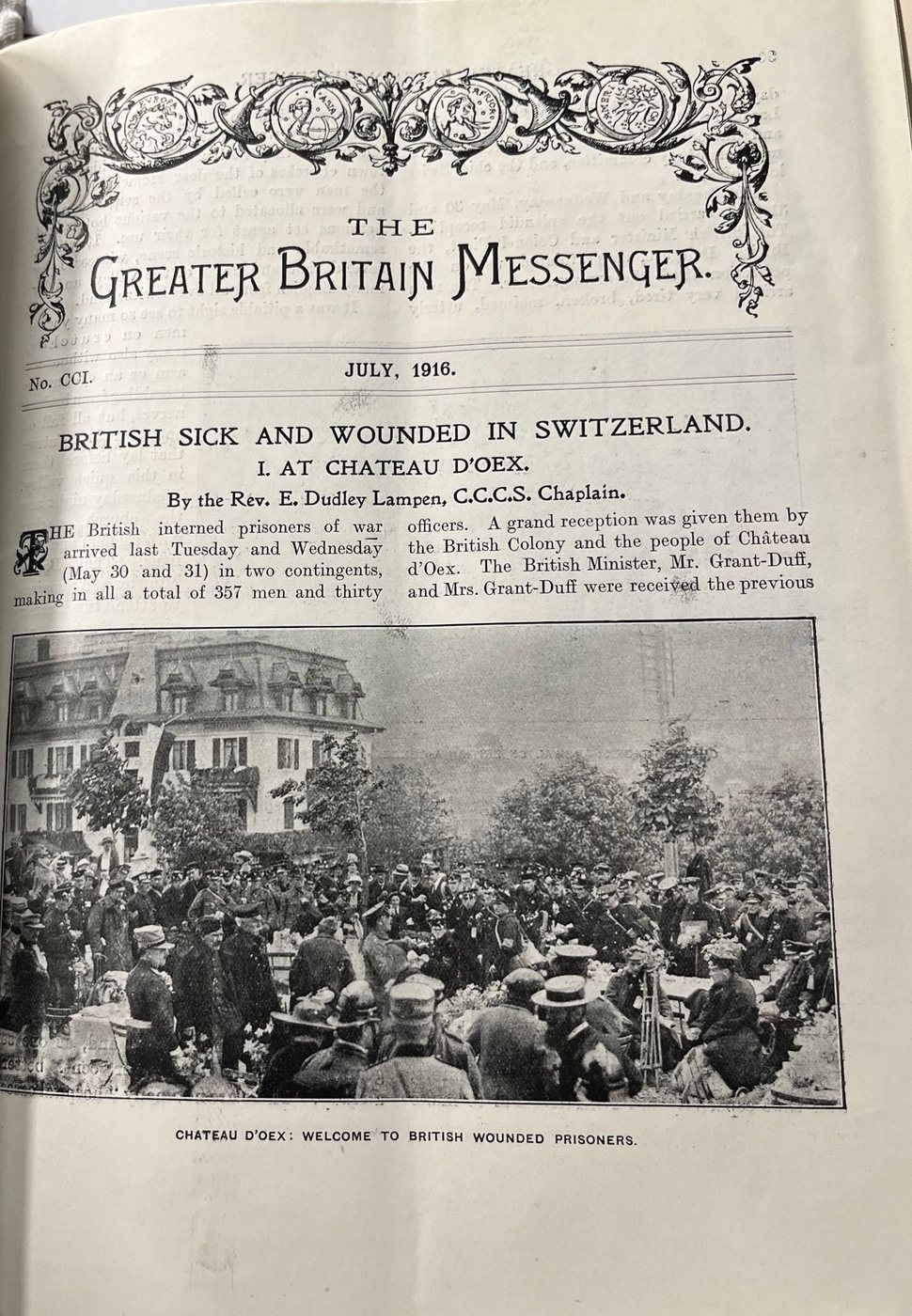
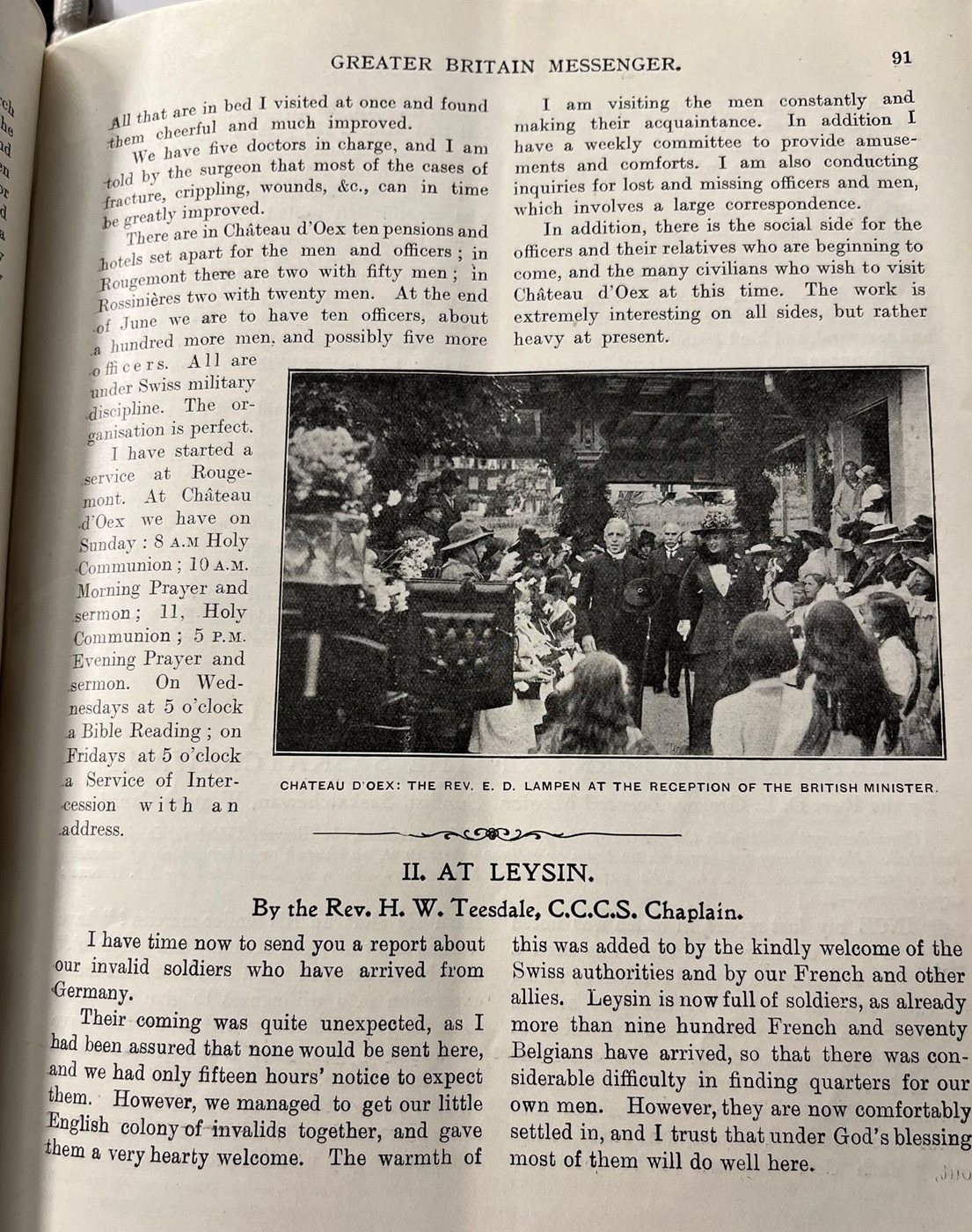
THE British interned prisoners of war arrived last Tuesday and Wednesday (May 30 and 31) in two contingents, making in all a total of 357 men and thirty officers. A grand reception was given them by the British Colony and the people of Château d’Oex. The British Minister, Mr. Grant-Duff, and Mrs. Grant-Duff were received the previous day by an enthusiastic crowd headed by Mrs. Lampen and myself. I received the Minister, and introduced him to the churchwardens, members of my committee, and the chief Swiss local officials.
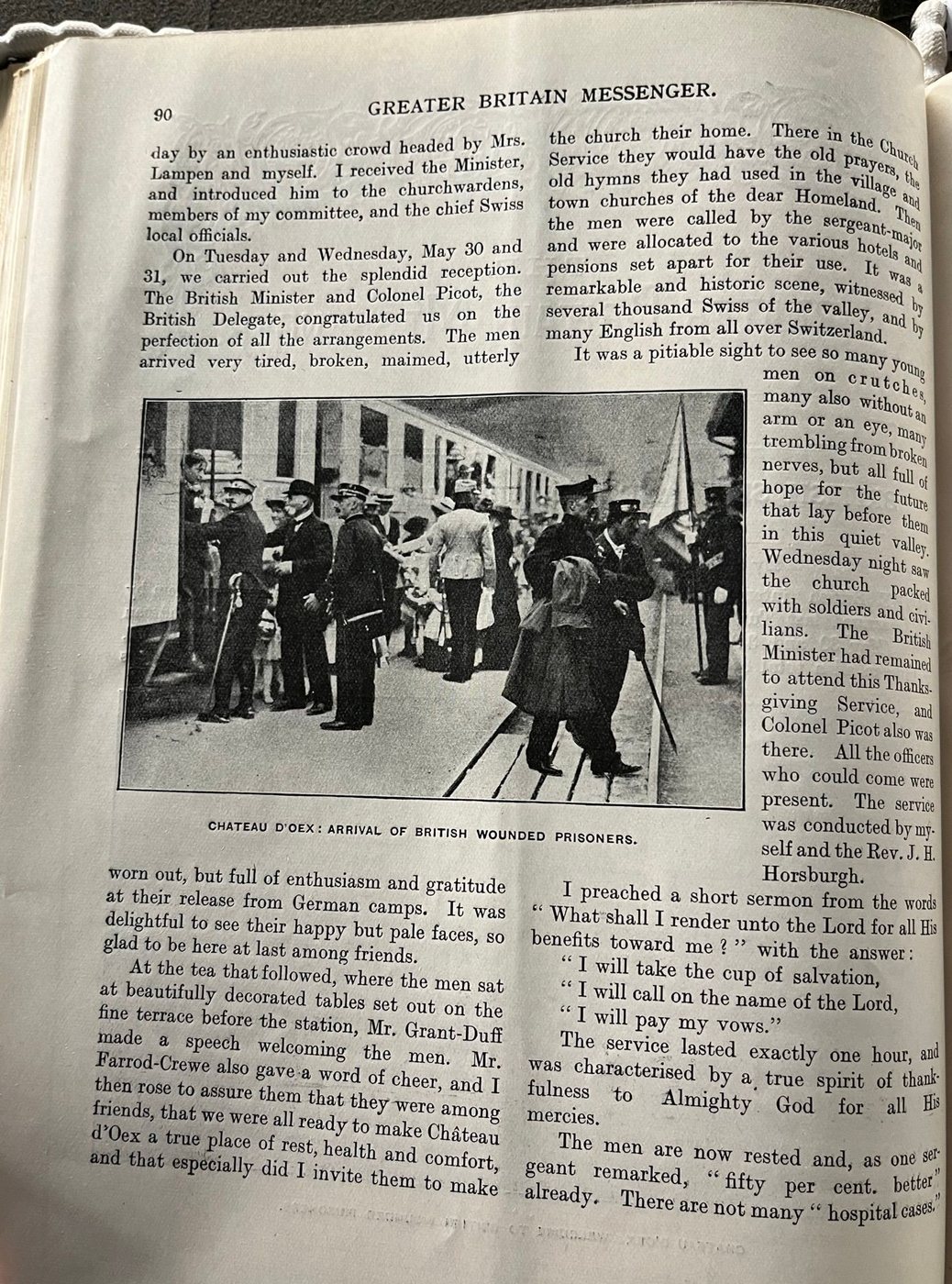
On Tuesday and Wednesday, May 30 and 31, we carried out the splendid reception. The British Minister and Colonel Picot, the British Delegate, congratulated us on the perfection of all the arrangements. The men arrived very tired, broken, maimed, utterly worn out, but full of enthusiasm and gratitude at their release from German camps. It was delightful to see their happy pale faces, so glad to be here at last among friends.
At the tea that followed, where the men sat at beautifully decorated tables set out on the fine terrace before the station, Mr. Grant-Duff made a speech welcoming the men. Mr. Barroll-Crewe also gave a word of cheer, and I desired to assure them that they were among friends, that we were all ready to make Château d’Oex a true place of rest and health and comfort, and that especially did I invite them to make the church their home. There in the Church Service they would have the old prayers, the old hymns they had used in the dear Homeland and the men were called by the sergeant-major and were allocated to the various houses and pensions set apart for their use. It was a remarkable and historic scene, witnessed by several thousand Swiss of the valley and many English from all over Switzerland.
It was a pitiable sight to see so many young men on crutches, many also without an arm or an eye, trembling from broken nerves, but all full of hope for the future that lay before them in this quiet valley.
Wednesday night the church was filled with soldiers and civilians. The British Minister had remained to attend this Thanksgiving Service, and Colonel Picot also was there. All the officers who could come were present. The service was conducted by myself and the Rev. J. H. Horsburgh.
I preached a short sermon from the words “What shall I render unto the Lord for all his benefits toward me?” with the answer: “I will take the cup of salvation, I will call on the name of the Lord, I will pay my vows.”
The service lasted exactly one hour, and was characterised by a true spirit of thankfulness to Almighty God for all his mercies.
The men are now rested and, as one sergeant remarked, “fifty per cent. better already.” There are not many “hospital cases”.
All that are in bed I visited at once and found them cheerful and much improved. By the five doctors in charge, and I am told by the surgeon that most of the cases of fracture, crippling, wounds, &c., can in time be greatly improved.
There are in Château d’Oex ten pensions and hotels set apart for the men and officers; in Rougemont there are two with fifty men. At the end of June we are to have ten officers, about a hundred more men, and possibly five more officers. All are under Swiss military discipline. The organisation is perfect.
I have started a service at Rougemont. At Château d’Oex we have on Sunday: 8 a.m. Holy Communion; 10 a.m. Morning Prayer and sermon; 11, Holy Communion; 5 p.m. Evening Prayer and sermon. On Wednesdays at 5 o’clock a Bible Reading; on Fridays at 5 o’clock a Service of Intercession with an address.
I am visiting the men constantly and making their acquaintance. In addition I have a weekly committee to provide amusements and comforts. I am also conducting inquiries for lost and missing officers and men, which involves a large correspondence.
In addition, there is the social side for the officers and their relatives who are beginning to come, and the many civilians who wish to visit Château d’Oex at this time. The work is extremely interesting on all sides, but rather heavy at present.
II. AT LEYSIN.
By the Rev. H. W. Teesdale, C.C.C.S. Chaplain.
I have time now to send you a report about our invalid soldiers who have arrived from Germany.
Their coming was quite unexpected, as I had been assured that none would be sent here, and we had only fifteen hours’ notice to expect them. However, we managed to get our little English colony of invalids together, and gave them a very hearty welcome. The warmth of this was added to by the kindly welcome of the Swiss authorities and by our French and other allies. Leysin is now full of soldiers, as already more than nine hundred French and seventy Belgians have arrived, so that there was considerable difficulty in finding quarters for our own men. However, they are now comfortably settled in, and I trust that under God’s blessing most of them will do well here.
End of the transcribed document
Questions answered
- How many British soldiers were interned at Château-d’Œx in May 1916?
- The chaplain, the Rev. E. Dudley Lampen, wrote that the British interned prisoners of war arrived on Tuesday and Wednesday, 30 and 31 May, “in two contingents, making in all a total of 357 men and thirty officers”. (The Times, reporting the first train alone, counted 304 including 32 officers — the two figures cover different things.)
- What happened at the reception for the interned men?
- Lampen described tea at “beautifully decorated tables set out on the fine terrace before the station”, where the British Minister Mr. Grant-Duff made a speech welcoming the men. Lampen told them they were among friends, that all were ready to make Château-d’Œx “a true place of rest and health and comfort”, and invited them especially “to make the church their home”. The men were then allocated to the various houses and pensions set apart for their use, in a scene witnessed by several thousand Swiss of the valley.
- Was there a church service for the newly arrived men?
- Yes. Lampen wrote that on the Wednesday night “the church was filled with soldiers and civilians” for a Thanksgiving Service, attended by the British Minister and Colonel Picot, and by all the officers who could come. It was conducted by Lampen with the Rev. J. H. Horsburgh, who preached from the words “What shall I render unto the Lord for all his benefits toward me?” The service lasted exactly one hour.